
A county public works department begins using an AI tool to flag likely infrastructure defects from inspection photos. Leadership is deciding what role field inspectors should play going forward. Which decision best reflects a strategic balance between AI capability and human strengths?
Select an answer to reveal the explanation.
Short Explanation
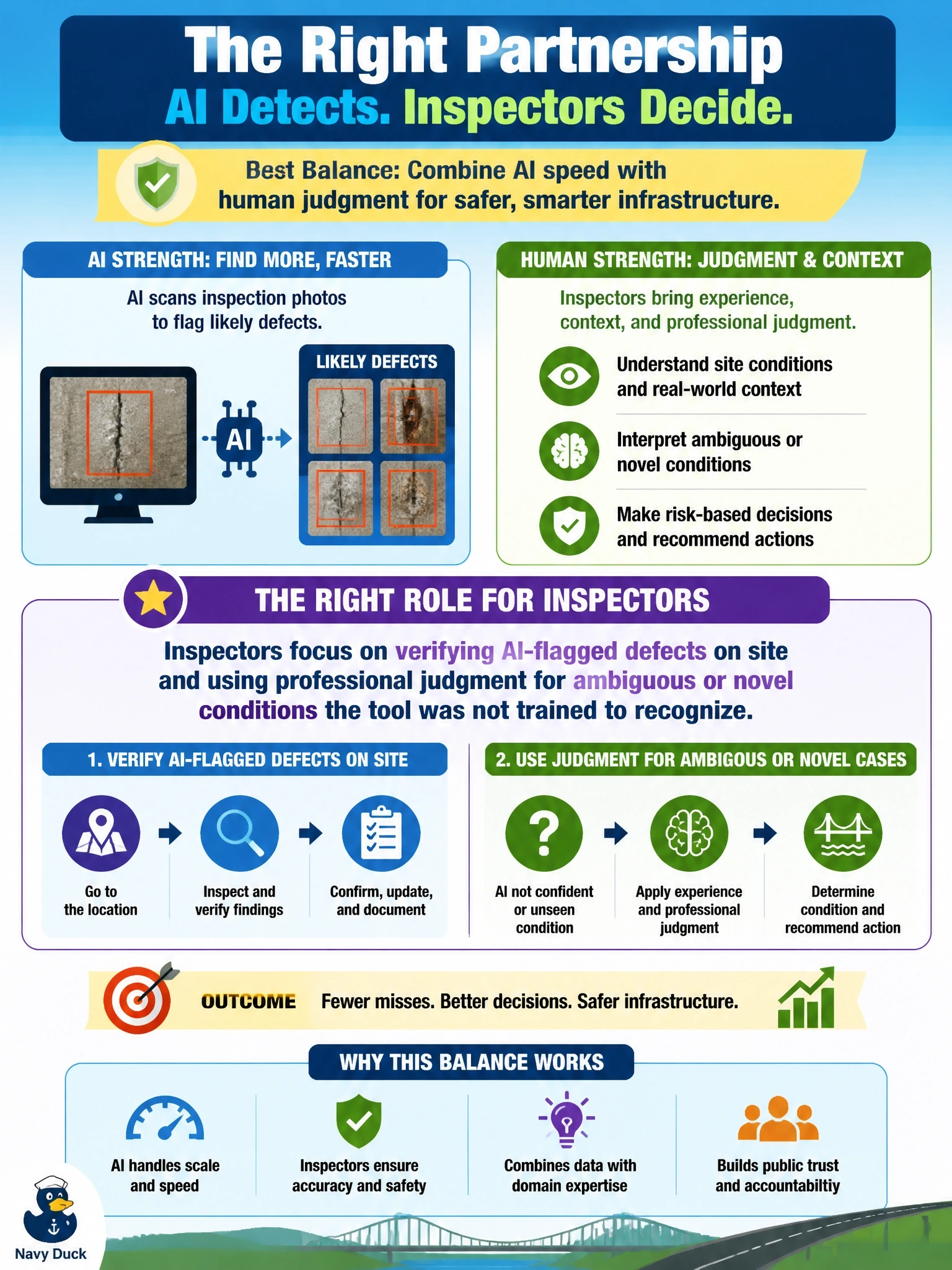
The AI tool is a first pass that catches the obvious stuff, freeing your inspectors up for the calls that actually need a trained eye. When a defect looks ambiguous or the tool's never seen it before, that's exactly where their judgment matters most — AI handles volume, people handle the edge cases.
Full Explanation
Having inspectors verify AI-flagged defects in the field and apply professional judgment to ambiguous or novel conditions uses the tool for fast initial screening while keeping human judgment exactly where the AI is weakest — cases it wasn't trained to recognize. Removing inspectors from the process entirely trusts the tool with no human check at all, which is risky since any flagging model will miss or misjudge conditions outside its training data, and infrastructure defects carry real safety consequences. Having inspectors manually review every single photo in addition to the AI's output doubles the review workload and cancels out the tool's efficiency benefit — it isn't a genuine role shift, just added duplicate work. Reassigning inspectors to an unrelated call-center role discards their field expertise instead of redirecting it toward the oversight work that still matters, which is verifying and judging cases the AI can't reliably handle. What makes the correct answer work is that it keeps humans focused on exactly the failure modes automated flagging is least reliable at — novel or ambiguous conditions — while letting the tool absorb routine screening. Operational check: for any AI-flagging workflow, ask what happens when the tool encounters something it's never seen before, and who is responsible for catching that.