
A media streaming company launched a generative AI system, built on Amazon Bedrock, that automatically writes episode summaries and moderates viewer comments. The system passed all acceptance tests before launch and has now been running in production for three months. What should the company's AI governance lead prioritize next?
Select an answer to reveal the explanation.
Short Explanation
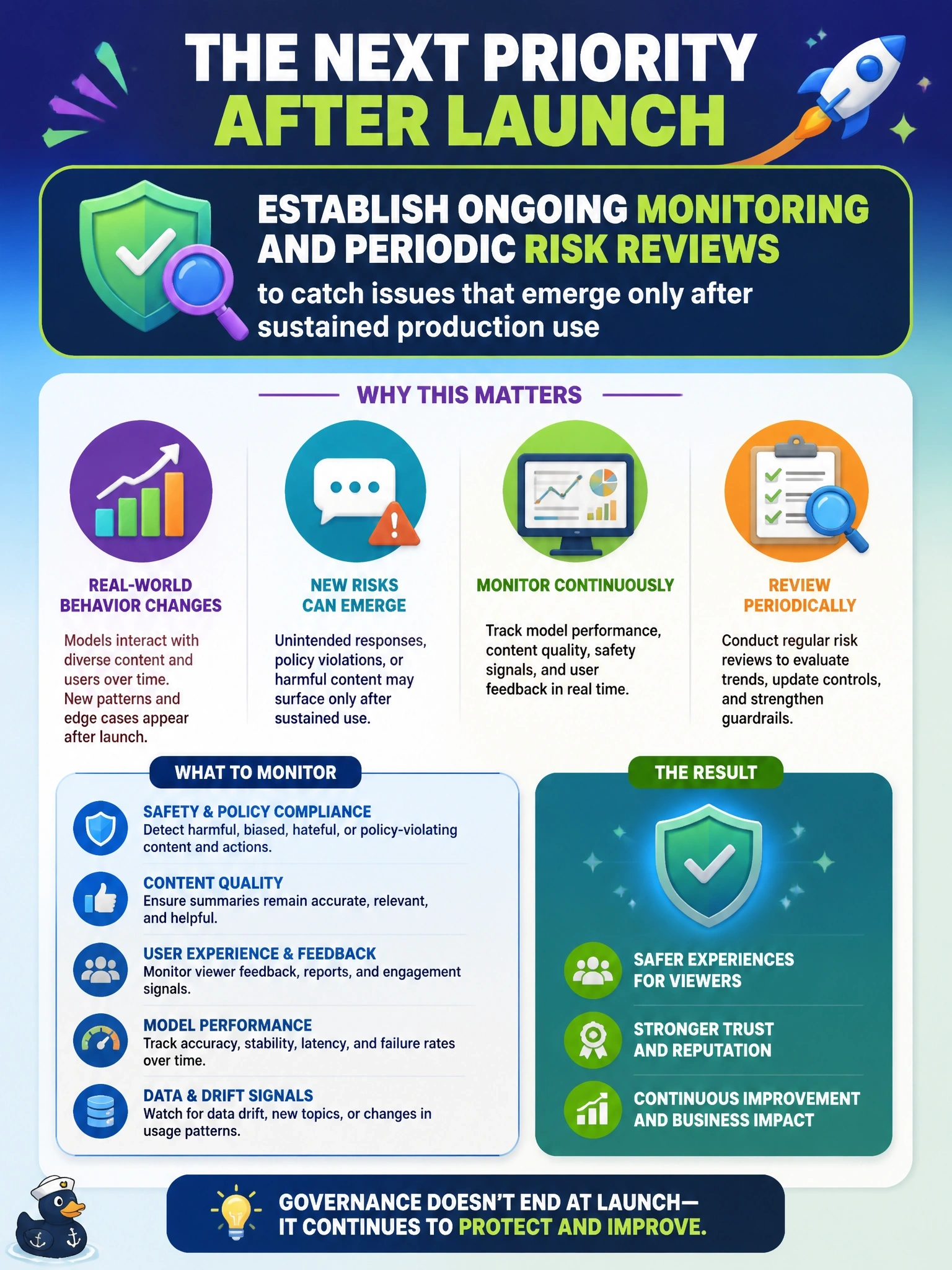
Passing a driving test once doesn't mean you're a safe driver forever — conditions change, and so does an AI system's world after launch. Ongoing monitoring and periodic risk reviews catch the problems that only show up once real traffic, real content, and real edge cases start hitting the system.
Full Explanation
Establishing ongoing monitoring and periodic risk reviews is correct because pre-launch testing only validates a system under the conditions present at that moment. Content trends, viewer behavior, and inputs keep changing after launch, so risk controls must be continuous rather than a one-time gate. Relying on the pre-launch test results is tempting because the system did pass initial testing, but a passing result before launch says nothing about how it performs against new content, edge cases, or misuse months later; treating that result as sufficient ignores the need for continuous oversight. Waiting for a complaint before deciding whether to review outputs describes a reactive posture: problems go undetected until someone is already affected, which is the opposite of a risk control. Treating the shared responsibility model as covering output quality misapplies it — that model divides responsibility for securing and operating the underlying cloud infrastructure between AWS and the customer; it does not shift responsibility for an application's content quality or business outcomes away from the company that deployed it. The general principle: production AI systems need continuous monitoring because their inputs and operating environment evolve after deployment.