
A specialty pharmaceutical company built an AI tool, deeply integrated with its internal research workflow, that helps scientists prioritize which drug candidates to advance based on decades of the company's own experimental results. A competitor asks to license a similar off-the-shelf tool from a vendor but has no comparable internal data to feed it. What is the most accurate description of the difference between the two companies' positions?
Select an answer to reveal the explanation.
Short Explanation
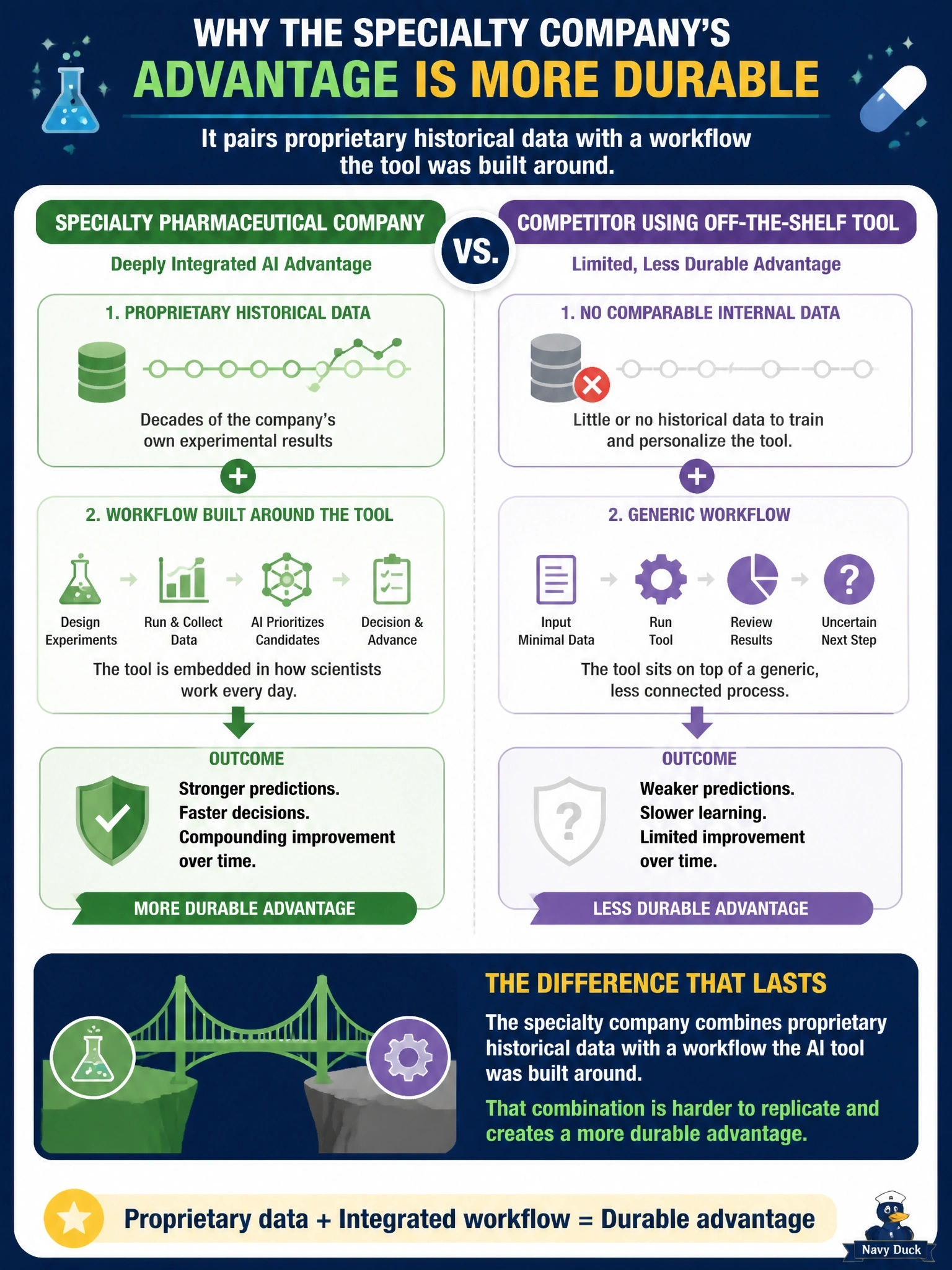
Two companies can buy the same generic camera, but only one of them has twenty years of photos to train it on. The specialty company's edge isn't the AI tool itself — it's decades of proprietary results feeding a workflow the tool was built around, something you can't replicate just by licensing similar software.
Full Explanation
The distinguishing factor isn't which company has an AI tool, but what feeds and surrounds it. The specialty company's advantage is more durable because it pairs proprietary historical data with a workflow the tool was built around, and decades of results embedded in an actual research process is exactly what a competitor can't replicate just by licensing similar software. The idea that the competitor holds the stronger position because licensing avoids build costs confuses a lower upfront price with competitive strength; licensing is cheaper, but it doesn't, by itself, produce the differentiated results proprietary data enables. Treating the two companies as holding an equal advantage because each uses a functionally similar tool mistakenly equates tool similarity with outcome; two companies can run the same category of software and end up with very different results depending on the data and workflow behind it. Claiming neither company gained any real advantage because AI can't outperform experienced scientists overstates a limitation the scenario never makes; the tool is described as helping prioritize candidates, not replacing scientists, so dismissing that value ignores the described benefit. The principle: proprietary data and workflow integration, not tool possession, is what makes an AI advantage durable. As a check, ask whether a rival could get the same output just by paying for a license; if not, the advantage is real.