
An auto dealership network is defining KPIs for an AI assistant that schedules service appointments. Before finalizing the KPI list, what is the most important consideration for the program owner?
Select an answer to reveal the explanation.
Short Explanation
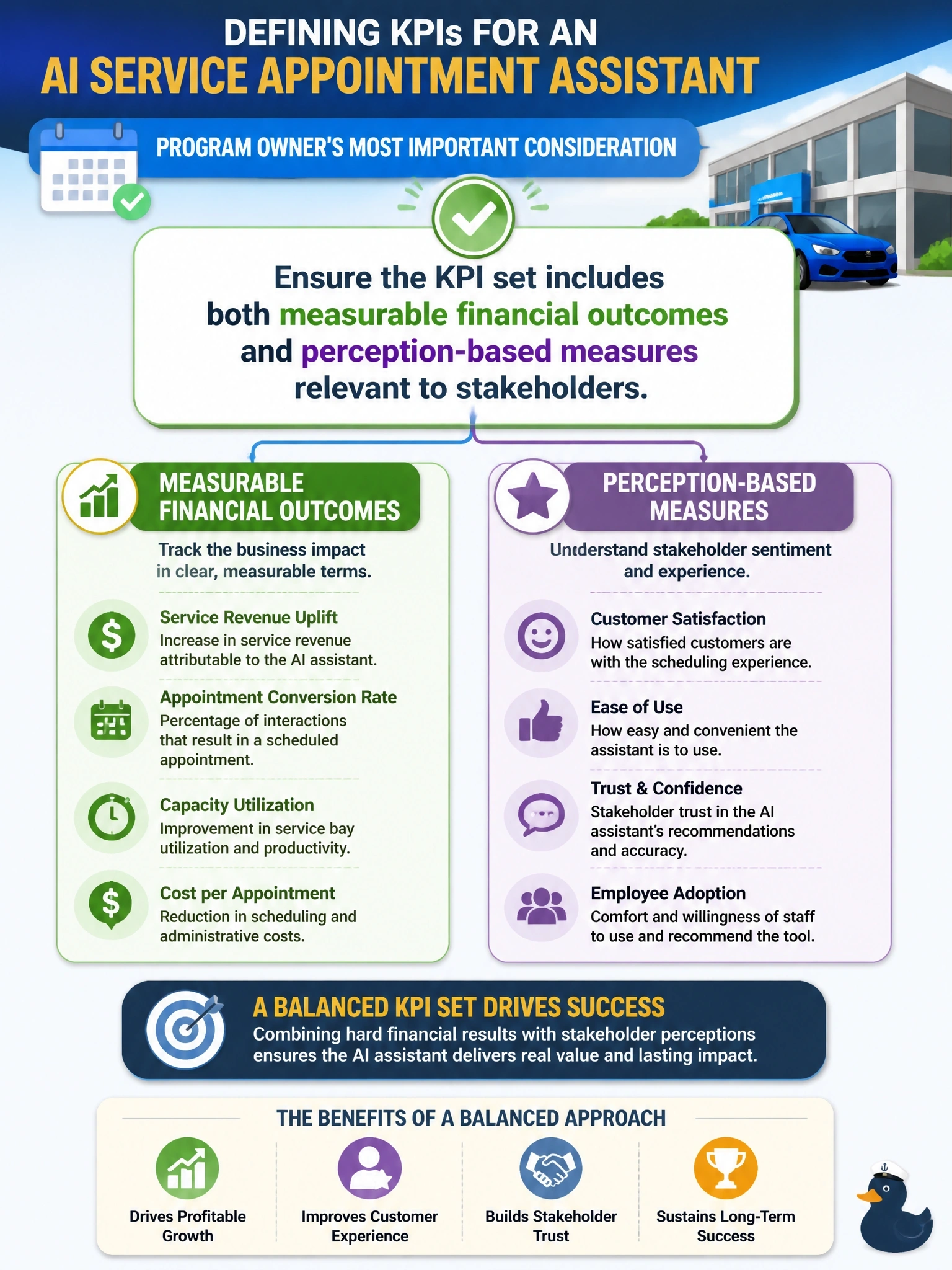
Think of it like this: a KPI list that only tracks dollars saved will miss the advisor who's furious every time the scheduler double-books them, and a list that only tracks happiness will miss a budget quietly bleeding out. You need both — measurable financial outcomes and perception-based measures — because a scheduling tool can look great on one and be a disaster on the other.
Full Explanation
A balanced KPI set matters because a scheduling assistant can hit its financial numbers while quietly wrecking the experience for service advisors or customers, or vice versa — measuring only one side hides the other's failure until it's expensive to fix. Ensuring the set includes both measurable financial outcomes and perception-based, stakeholder-relevant measures is what catches both kinds of problems before they compound. Limiting KPIs to technical system metrics like response latency and uptime tells you the system is running, but nothing about whether it's delivering business value to the dealership or a better experience to customers — it's operational health, not value measurement. Selecting only the KPIs that are easiest to extract automatically from existing scheduling software optimizes for convenience over relevance; a metric that's easy to pull isn't automatically the metric that matters, and building a KPI set this way risks missing exactly the signals that are hardest to automate, like advisor or customer sentiment. Choosing the single financial KPI that will look most favorable to the executive team is worse still — it's cherry-picking a flattering number rather than honestly representing performance, and it can bury real problems until they surface as customer churn or advisor turnover. The operational check: for every KPI on the list, ask whether it reflects a dollar outcome or a stakeholder's lived experience — a healthy set has entries from both columns, not just whichever is convenient or flattering.