
A commercial insurer is transitioning its underwriting risk-scoring process from an aging, in-house rules engine to an AI-based platform. The new platform performs better in testing, but the insurer's underwriters currently rely on being able to explain, line by line, exactly why the old system produced a given score, both to satisfy state regulators and to answer broker questions. The new platform's vendor has not yet demonstrated an equivalent level of decision explainability. Which consideration should most influence the transition timeline?
Select an answer to reveal the explanation.
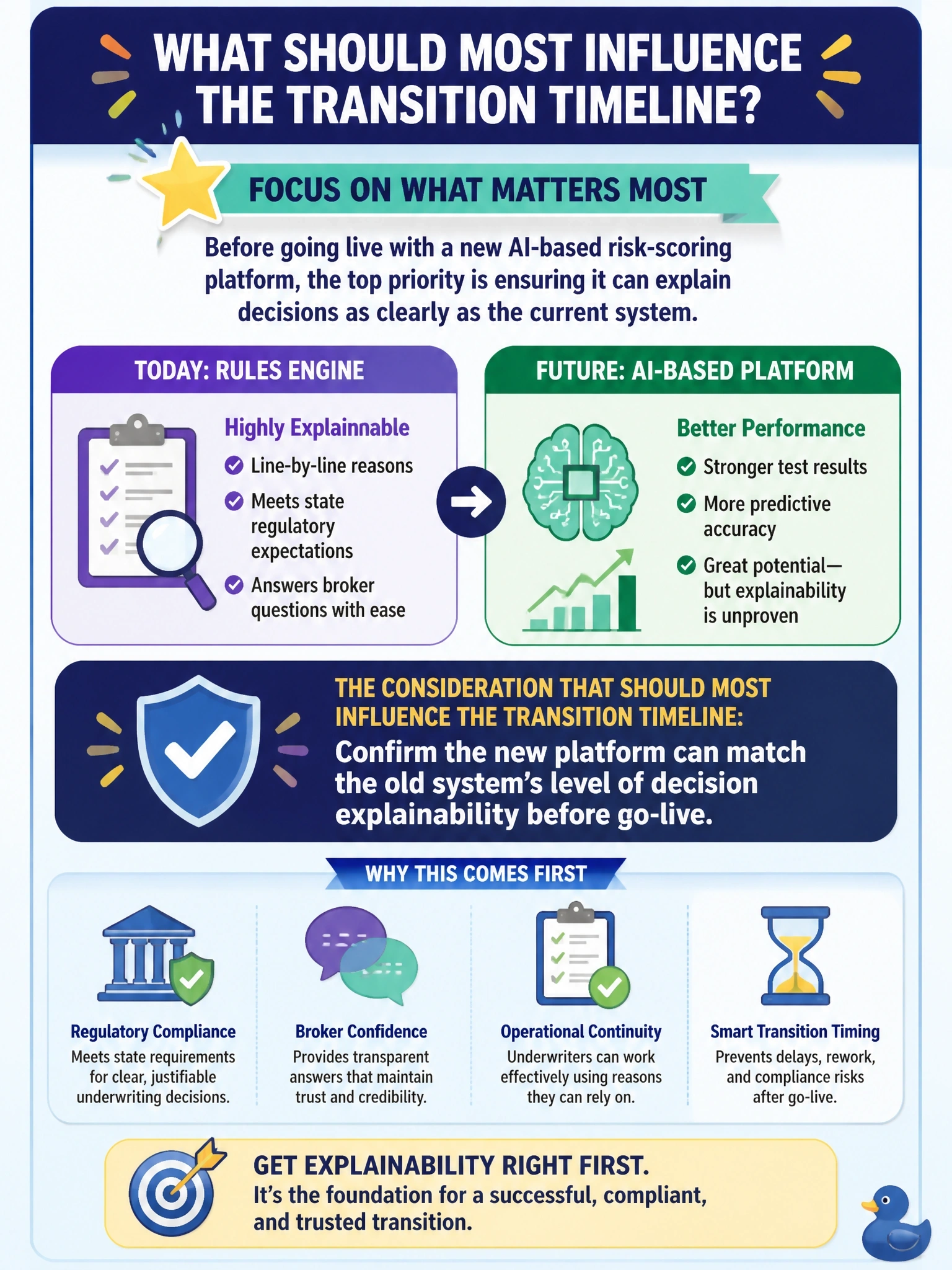
Short Explanation
Imagine standing in front of a regulator with nothing but a shrug when they ask why a score came out the way it did — that's exactly what your underwriters are trying to avoid. They need to walk through every score line by line, for compliance and for brokers alike, so until the new platform matches that explainability, a better accuracy number alone won't get you through the door.
Full Explanation
The stem names a concrete, unresolved capability gap: the new platform hasn't yet demonstrated it can explain a score line by line the way the old rules engine could, and that explainability is tied directly to a state regulatory requirement and to broker-facing accountability. Better test performance doesn't offset that gap, because a model that scores more accurately but can't justify its reasoning creates real compliance exposure the moment a regulator or broker asks for the rationale behind a score. Whether underwriters personally prefer the new interface's look is a genuine usability consideration, but it carries no regulatory consequence if it's simply addressed in training rather than resolved before go-live. Tying implementation to an unrelated internal event like an office relocation has nothing to do with whether the platform meets the explainability bar the underwriters actually depend on; it's a scheduling coincidence, not a risk driver. Matching the current vendor's phone-support hours is a service-level nicety that doesn't touch whether a given score can be justified to a regulator. None of those three carry the compliance stakes that unresolved explainability does. As an operational check: whenever a new AI platform outperforms the system it replaces but hasn't matched a named regulatory or compliance capability, let that gap govern the go-live timeline rather than the accuracy win.