
A university wants its GenAI writing assistant to consistently produce feedback on student essays in a specific, structured rubric format and tone that the writing center has used for years, regardless of which essay topic is submitted. The desired behavior is stable and doesn't depend on lookup of changing facts. Which model adaptation technique best fits this need?
Select an answer to reveal the explanation.
Short Explanation
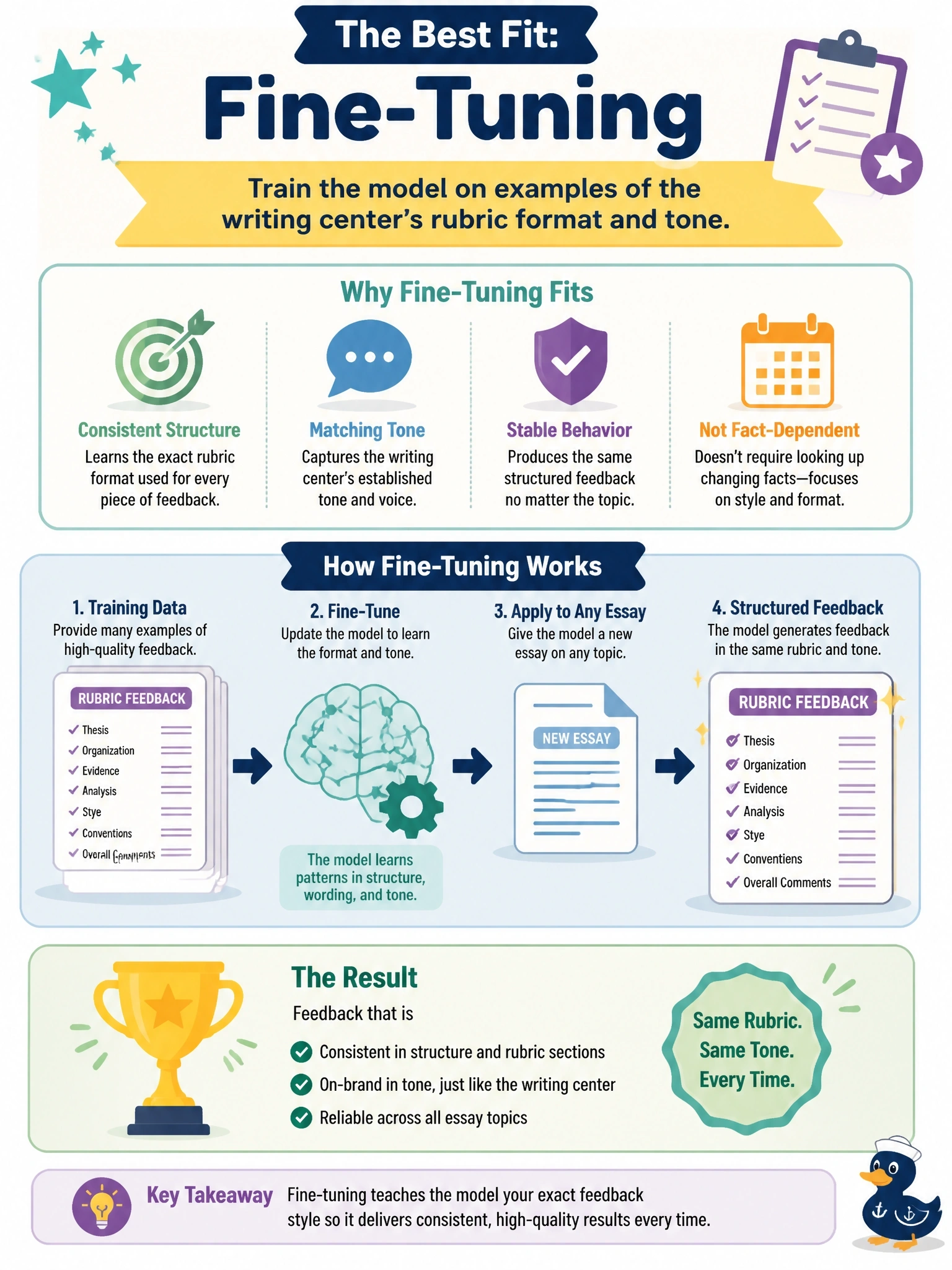
Think about teaching someone a house style — you don't hand them a stack of reference books every time, you show them examples until it becomes second nature. Fine-tuning does exactly that: it trains the model on your rubric's format and tone so every essay gets graded the same consistent way, no matter the topic. That's a pattern, not a fact, so it belongs baked into the model.
Full Explanation
Fine-tuning is well suited to teaching a model a stable, consistent style or format — like a specific rubric structure and tone — that should apply the same way regardless of the input topic, since the goal here is a behavior pattern rather than up-to-date facts. Connecting the model to an external library of writing guides and citation examples applies a retrieval approach, which is best suited to retrieving current or changing information, not to instilling a consistent format; the scenario explicitly says the desired behavior doesn't depend on changing facts, which points away from retrieval. Raising the length limit on submissions addresses an unrelated technical constraint that has nothing to do with achieving a consistent feedback format. Simply removing the rubric requirement eliminates the actual business requirement instead of solving it, which defeats the writing center's goal entirely. The generalizable principle: fine-tuning fits stable, style- or pattern-based needs, while retrieval fits needs driven by current or frequently changing information — recognizing which kind of need you have determines the right technique. Operationally, if the target is 'consistent output regardless of topic,' that's a training signal, not a lookup problem.