
An automotive supplier's engineer wants to report process capability indices (Cp and Cpk) to demonstrate that a newly audited CNC boring operation meets customer tolerances. Before computing those capability indices, what must the quality team verify first?
Select an answer to reveal the explanation.
Short Explanation
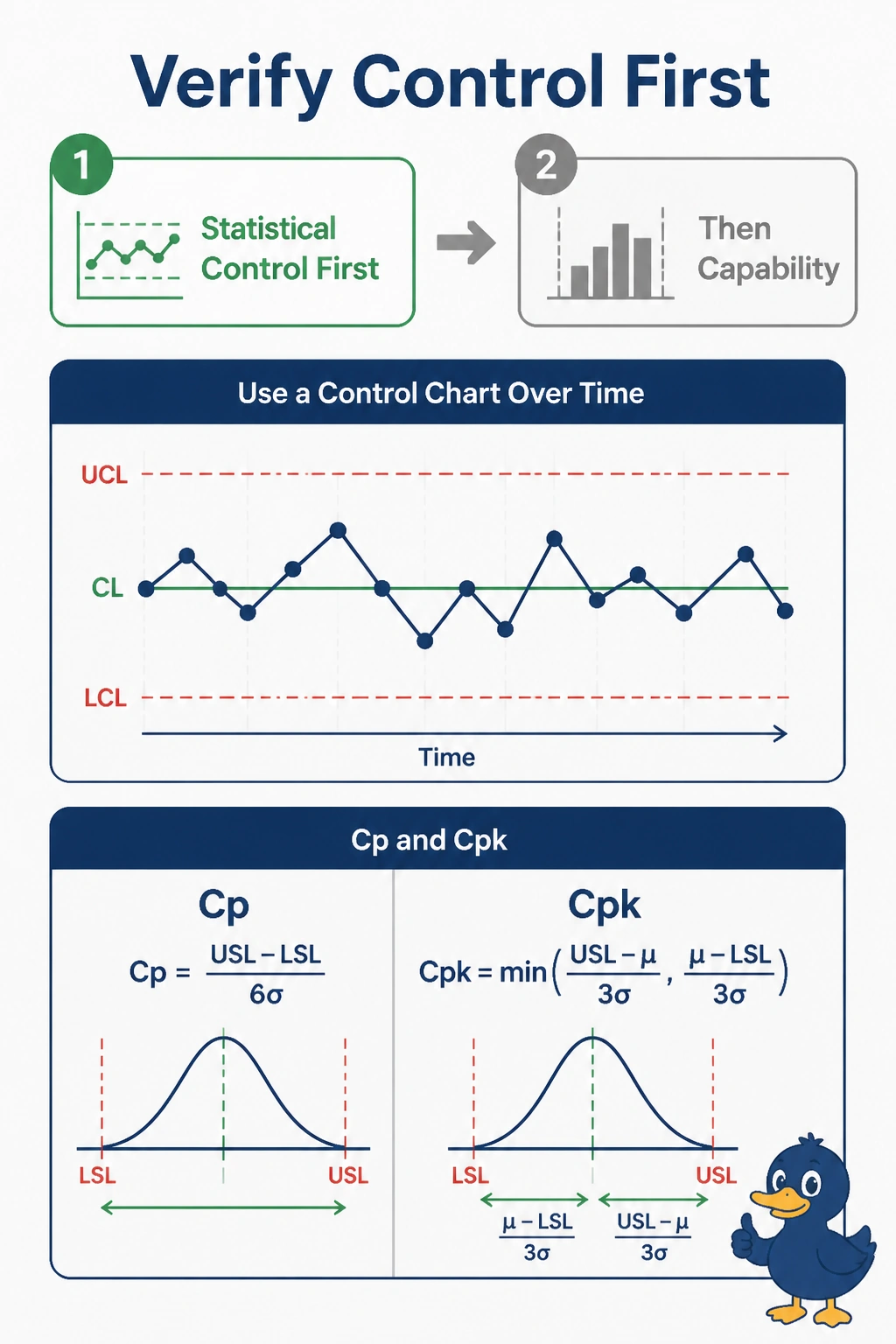
Calculating capability on an unstable process is like measuring your height while jumping on a trampoline. If special-cause spikes are still swinging the output around, Cp and Cpk numbers are meaningless. Check stability on a control chart first before trusting capability.
Full Explanation
Process capability indices summarize how well a stable process fits within specification limits, so stability is a prerequisite for valid interpretation. Confirming That the process is in statistical control using a control chart over time ensures that special-cause variation has been eliminated and that the calculated Cp and Cpk reflect predictable performance. While helpful for workforce qualification, verifying That the machine operator has completed annual blueprint-reading training does not demonstrate statistical stability of the machining output. Checking That every finished part in the lot has been 100% visually inspected reflects downstream sorting rather than predictable process behavior and provides no basis for capability estimation. Confirming That a Pareto chart ranks boring defects as the highest scrap category helps prioritize improvement projects, but it cannot detect out-of-control trends or shifts over time. Note that capability studies also assume the measurement system is adequate and the data distribution is understood. Before accepting any capability claim during an audit, inspect the accompanying control chart to verify there are no out-of-control points or non-random patterns.
Prefer to study offline? Printable PDF study book + test engine ($7.50, unofficial). These questions stay free here.