
After a consumer appliance catches fire in the field, the manufacturer's operations director argues that the company's accredited third-party quality registrar should bear legal responsibility because the registrar audited and certified the plant two months earlier. Which auditing principle explains why this argument fails?
Select an answer to reveal the explanation.
Short Explanation
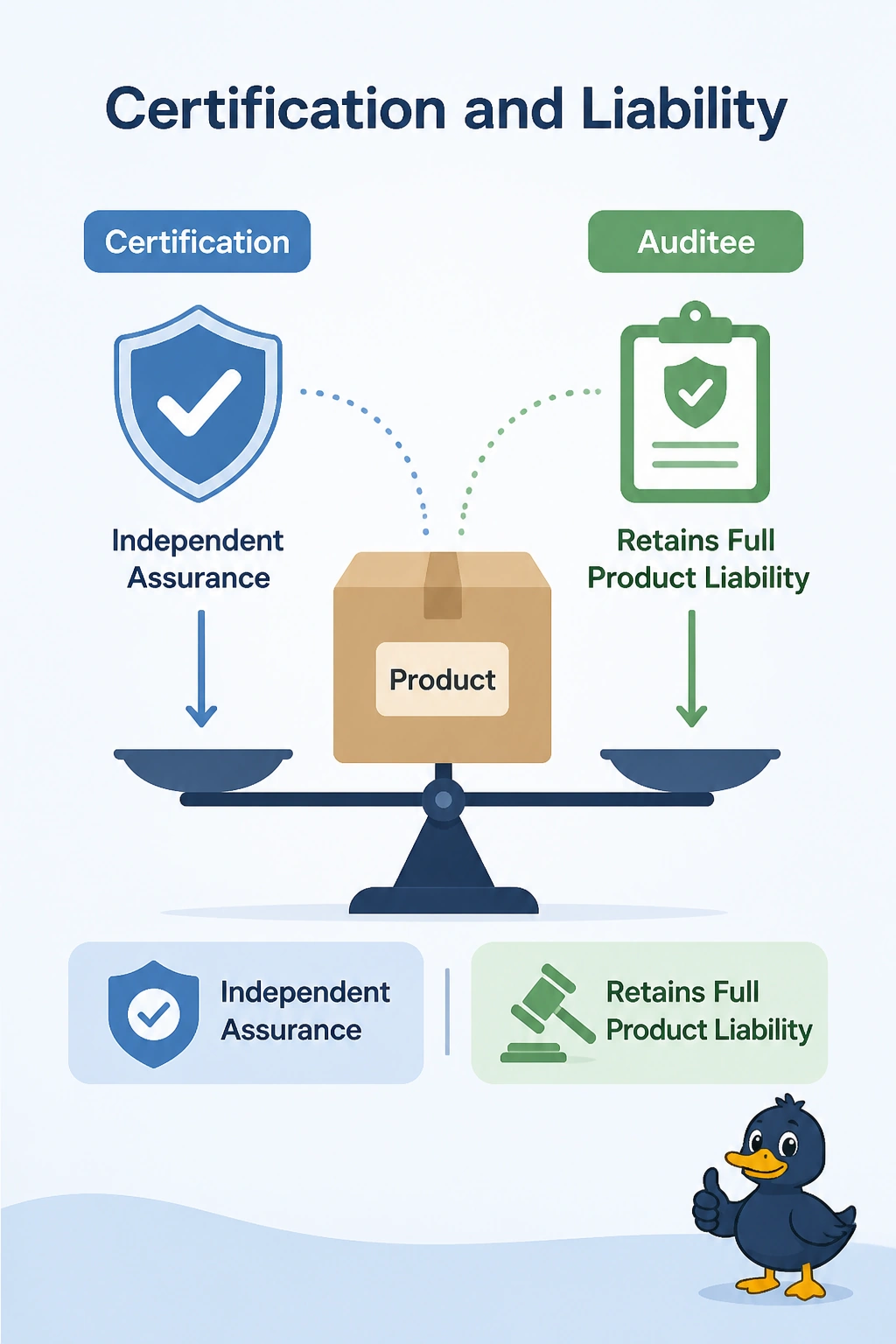
Passing a building inspection does not make the city inspector responsible if you later overload the wiring. When your organization holds a third-party certificate, you still own full legal responsibility for the safety and compliance of every product you ship. The trap is treating an audit certificate like an insurance policy that shifts liability.
Full Explanation
The operations director's claim fails because Certification provides independent assurance while the auditee retains full product liability. A third-party certification audit relies on finite sampling at a point in time to evaluate management-system conformance; it never transfers operational control, design responsibility, or statutory liability for product safety away from the manufacturer. Registrars only verify financial controls rather than product safety is incorrect because quality management registrars evaluate operational quality processes and compliance controls, not financial statements. Certification audits replace all statutory product-safety obligations is false because voluntary third-party certification complements—never replaces—applicable laws and regulatory duties. Auditors assume joint operational liability once a certificate is issued is also wrong since independent auditors must remain separate from management decisions and do not co-own product liability. Exam caveat: always distinguish between an auditor's professional duty to exercise due care during sampling and the auditee's ongoing legal accountability for conforming goods. As an operational check, review supplier and customer quality agreements to confirm liability and regulatory compliance responsibilities remain explicitly assigned to the producing organization.
Prefer to study offline? Printable PDF study book + test engine ($7.50, unofficial). These questions stay free here.