
A medical physicist reviews annual occupational reports showing air kerma at the interventional suite, absorbed organ doses from dosimeters, and a summary risk estimate for a highly exposed radiographer with partial-body exposure. Which SI unit best expresses the risk-weighted effective dose for regulatory comparison under NCRP 184?
Select an answer to reveal the explanation.
Short Explanation
You're converting raw energy into human risk here. Weighting those organ doses into sieverts gives you the fair risk-weighted number regulators want.
Full Explanation
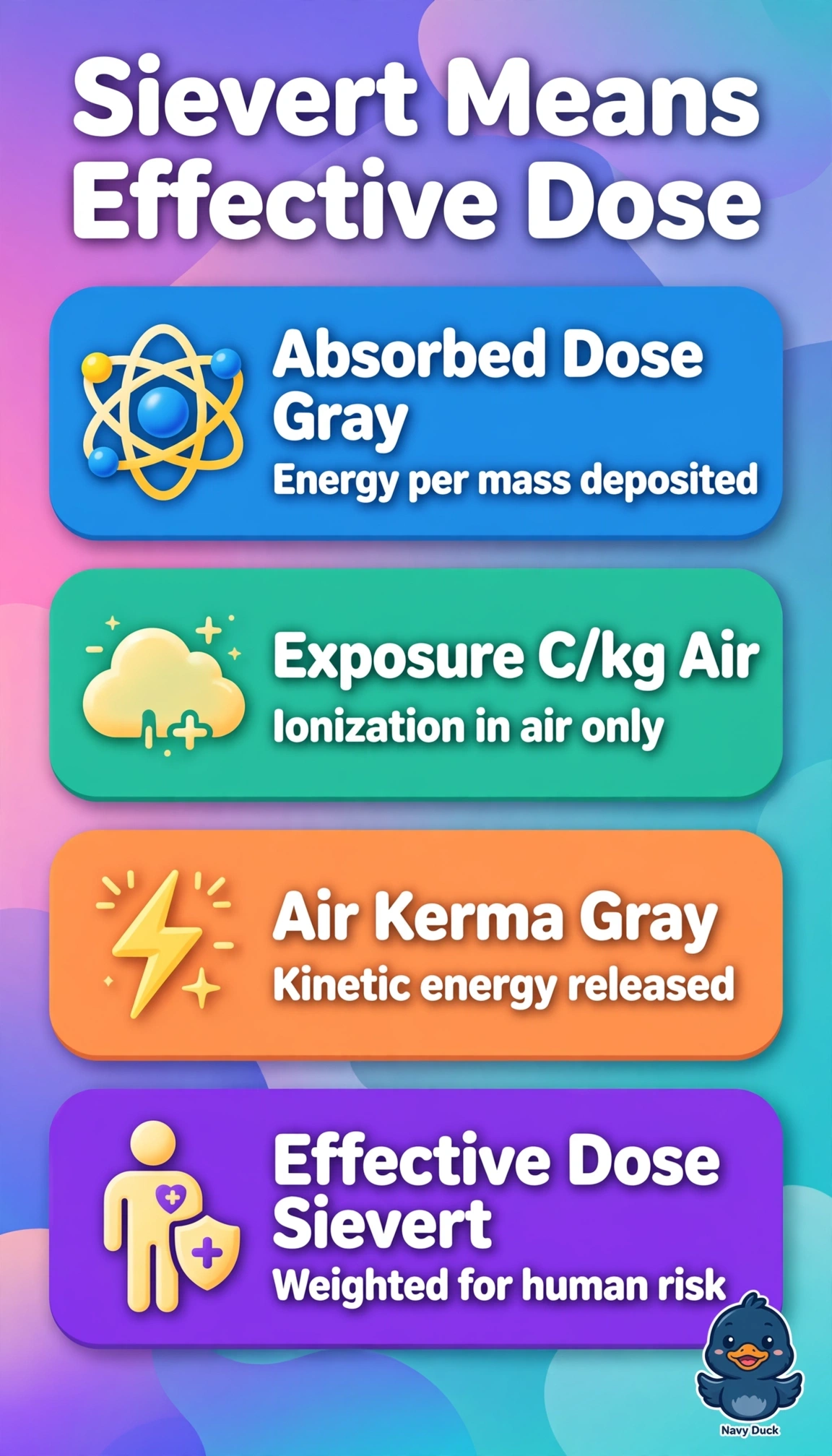
Absorbed dose and air kerma are expressed in gray as energy per mass, exposure in air is expressed in coulomb per kilogram, and equivalent and effective dose are expressed in sievert after applying radiation weighting and tissue weighting factors to reflect biologic risk and allow summation of partial-body exposures for occupational comparison under NCRP guidance. The gray-as-effective-dose explanation confuses physical deposition with risk because gray sums joules per kilogram without accounting for radiation type or organ sensitivity. The coulomb-per-kilogram explanation describes exposure, strictly ionization in air, which does not represent energy absorbed in tissues or weighted risk to the worker. The air-kerma explanation describes kinetic energy released per mass in air at a point, useful for beam output and dosimeter calibration, but without tissue and radiation weighting it cannot express whole-body stochastic risk. Exam caveat: ARRT expects gray for absorbed and kerma, C/kg for exposure, sievert for effective dose, and practical check: read the report label to see whether weighting has been applied before comparing to limits.