
A cath-lab technologist counsels two worried staff after different exposures: one received a high localized skin dose during a prolonged fluoroscopy case with reddening, and another worries about future cancer after scattered low doses. Which distinction correctly differentiates deterministic effects from stochastic effects after radiation exposure?
Select an answer to reveal the explanation.
Short Explanation
You've got this split down when you anchor on thresholds. Threshold is your hook: severity versus chance tells you whether skin injury or cancer risk fits the case.
Full Explanation
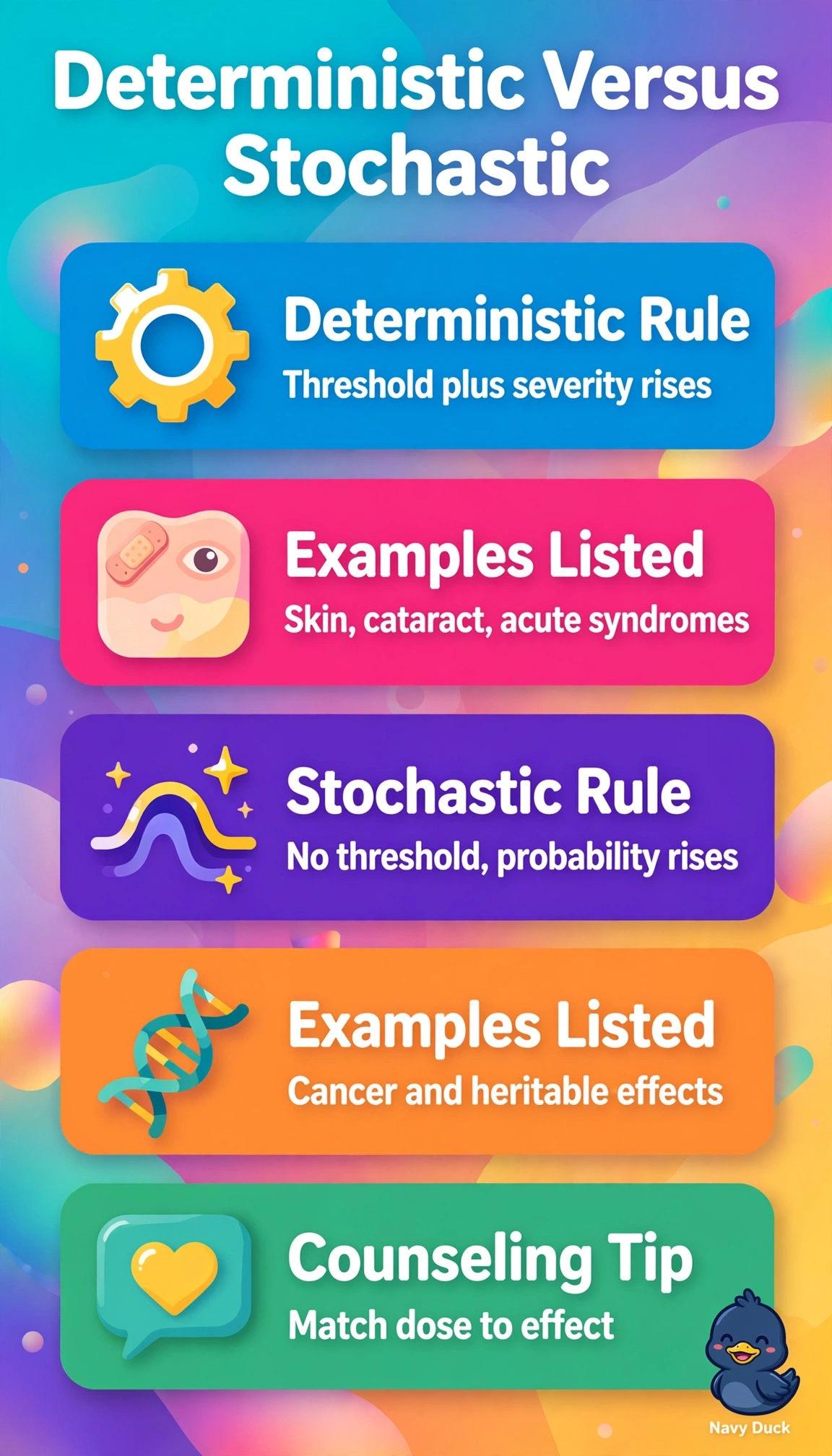
Deterministic effects occur only above a threshold dose and increase in severity with higher dose because cell killing must overwhelm tissue repair, producing skin erythema, epilation, cataracts, and the acute radiation syndromes of hematopoietic, gastrointestinal, and cerebrovascular injury at very high whole-body doses after a latent period. Stochastic effects follow a linear no-threshold model where probability but not severity rises with dose because a single transformed cell can initiate cancer or heritable damage, so no dose is considered completely without risk. The approach claiming both types have thresholds fails because it denies the no-threshold model for carcinogenesis, the reversed approach fails because it swaps early tissue reactions with late malignancy, and the hematopoietic-syndrome approach fails because that syndrome requires high whole-body doses far above diagnostic levels and does not always cause permanent sterility. Exam caveat: ARRT expects you to link high localized dose with severity-graded skin injury and any dose with chance-graded cancer risk. Practical check: when counseling, state the threshold concept first, then match skin changes to deterministic injury and cancer concern to stochastic risk.