
A plan for a lung target was calculated on a water-equivalent phantom. On review you note that the beam crosses a low-density lung segment, uses a physical wedge with its tray mounted, and passes through bolus over the entry skin. Which statement correctly describes how each element changes the dose relative to that calculation?
Select an answer to reveal the explanation.
Short Explanation
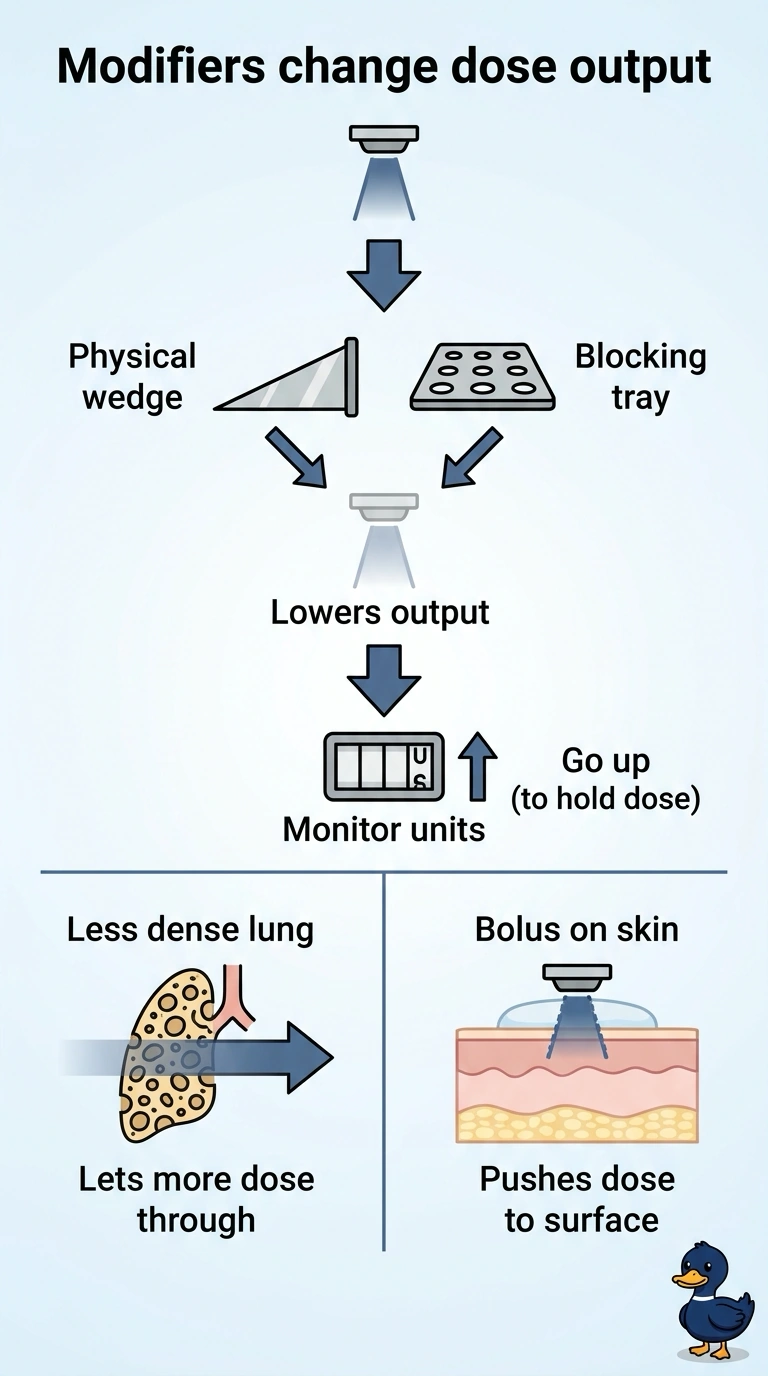
You’re tracking three effects relative to the water-equivalent calculation: lung lets more primary radiation through, the wedge and its mounted tray reduce output so you need more monitor units, and bolus raises skin dose. Keep all three in view, and you’ll have the complete answer.
Full Explanation
The correct statement accounts for all three changes relative to a water-equivalent calculation. Lower-density lung attenuates the beam less than water along the path, so more primary radiation can pass through than calculated; the actual dose distribution also depends on reduced lateral scatter and electronic disequilibrium. A physical wedge attenuates the beam, and its mounted tray adds attenuation, reducing output and generally requiring more monitor units to deliver the prescribed dose. Bolus places tissue-equivalent material at the entrance, shifts the buildup region toward the surface, and increases skin dose. The statement that names the wedge but not its mounted tray omits the tray’s contribution to attenuation, so it does not describe the stated beam path. The statement that says lung changes the depth-dose pattern without increasing target transmission understates the lung effect: reduced density increases transmission relative to water, although scatter disequilibrium can complicate local dose. The statement that says bolus shifts buildup without materially raising skin dose misses a central effect of bolus: increased superficial dose. Exam caveat: “more dose through lung” refers to primary transmission, not a guarantee of higher dose at every point, because lung heterogeneity can reduce local dose through loss of scatter. In practice, verify the lung heterogeneity correction, wedge and tray factors, and bolus placement in the treatment-planning system, and perform the required patient-specific QA.