
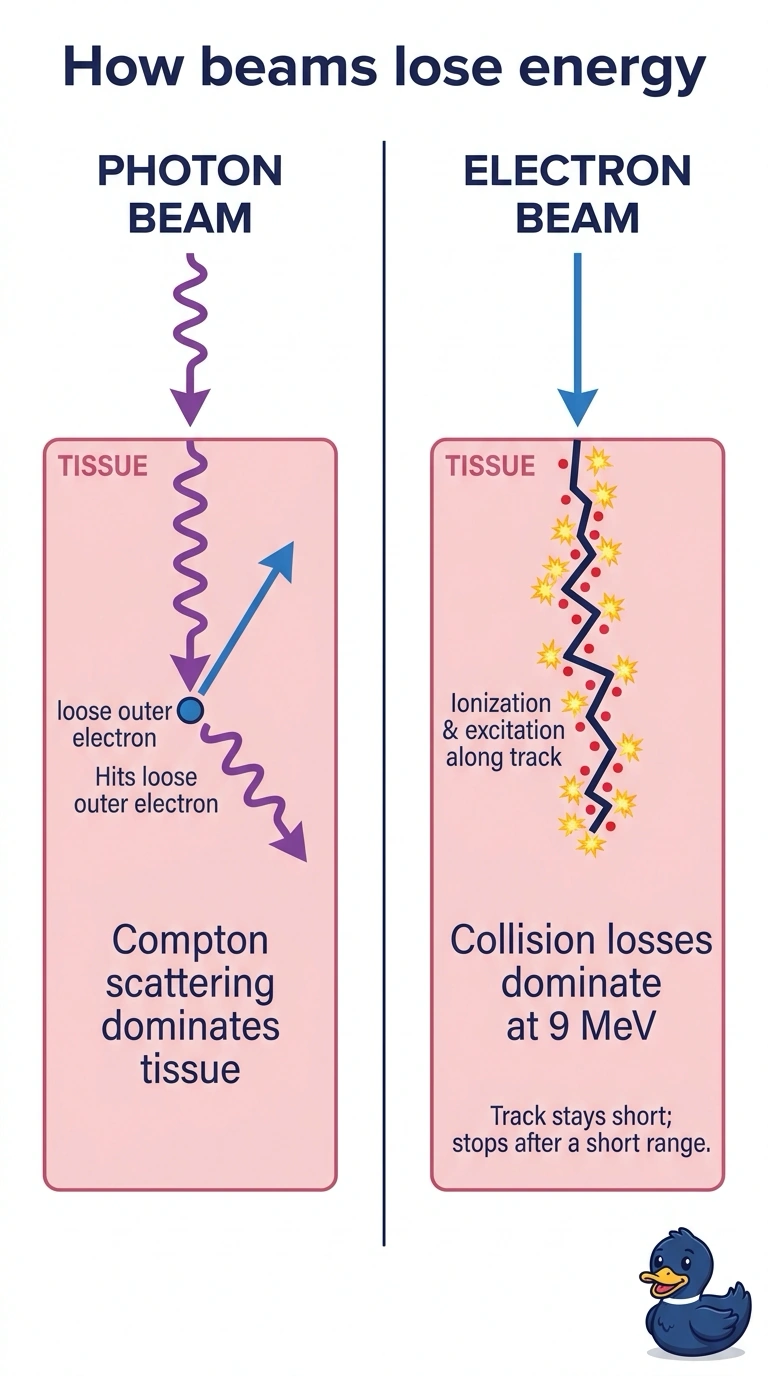
A physics resident is auditing the department's beam data and notes two setups: a 6 MV photon beam treating a target 10 cm deep in soft tissue, and a 9 MeV electron beam treating a chest wall where the range spans only a few centimeters. Which statement correctly identifies the dominant interaction for each beam?
Select an answer to reveal the explanation.
Short Explanation
Your 6 MV photons in soft tissue mostly interact by Compton scattering, while 9 MeV electrons spend their energy ionizing atoms as they travel. Photoelectric absorption is much less important at megavoltage energies, and pair production stays rare at 6 MV even though it's above threshold. A useful hook: photoelectric absorption contributes to how lead aprons attenuate diagnostic X-rays and how iodine contrast works, not what drives a megavoltage beam.
Full Explanation
Photons are indirectly ionizing: a 6 MV photon first transfers energy to an electron, and that electron performs the ionization, so the interaction that governs dose in soft tissue is the one that frees the electron. Above the diagnostic range the photoelectric cross-section falls steeply with rising energy, leaving Compton scattering, which depends mainly on electron density rather than atomic number, as the dominant process for megavoltage photons in low-Z tissue. The photoelectric argument fails because it applies an approximate Z-cubed dependence in the wrong energy regime. The pair-production argument fails because crossing the 1.022 MeV threshold makes the process possible rather than probable, and in tissue its cross-section grows slowly, not overtaking Compton until energies far above 6 MV. The radiative-loss argument fails because an electron below its critical energy in tissue spends energy mainly through ionization and excitation, leaving bremsstrahlung a minor share at 9 MeV. Exam caveat: dominance shifts with atomic number, so high-Z targets and diagnostic beams reorder these interactions. Practical check: name the beam energy and the material before deciding which interaction rules.