
A long treatment volume must be covered by two adjacent photon fields matched over the thoracic spine. Simulation shows beam divergence shifts the two edges past each other at the target depth, so the physicist recommends half-beam blocking at the junction line. What function does the half-beam block serve for the abutting fields?
Select an answer to reveal the explanation.
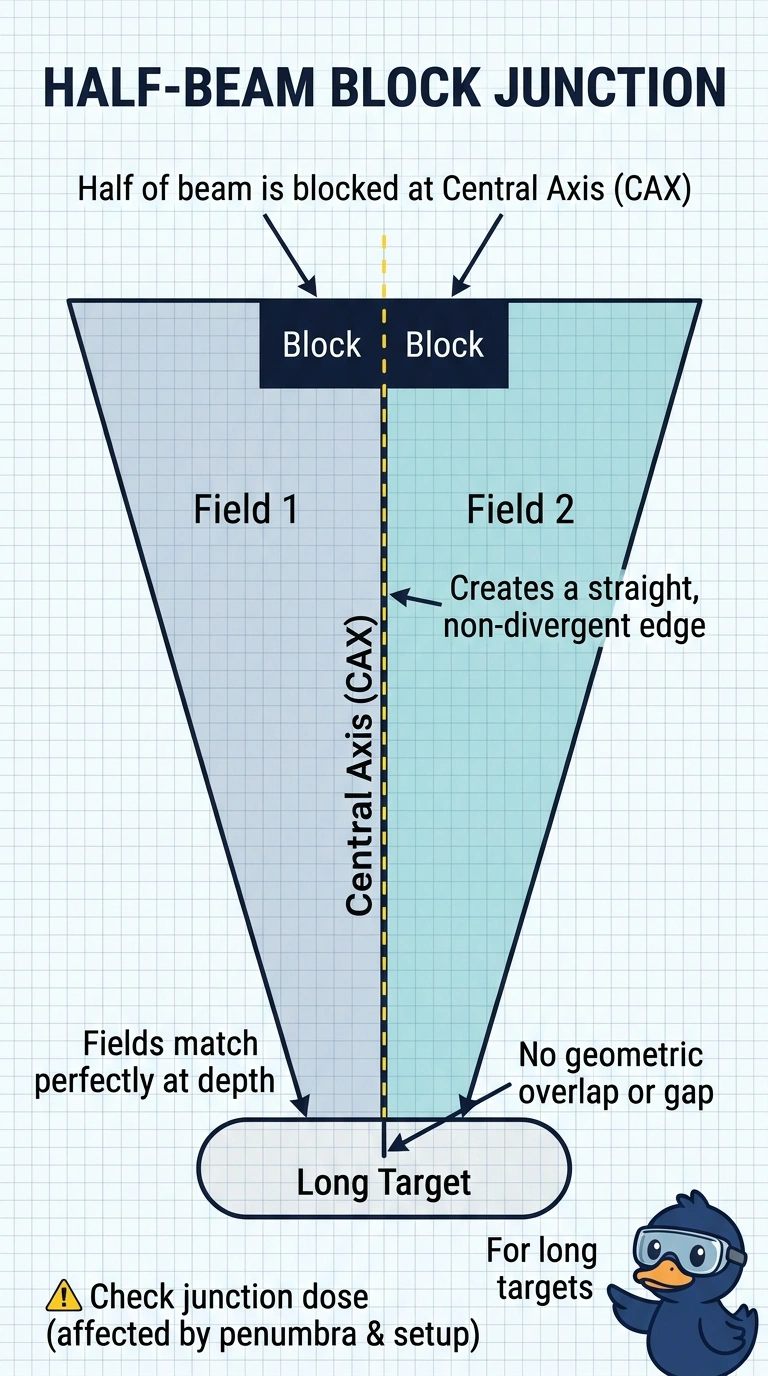
Short Explanation
You can picture the half-beam block as flattening one edge of a fan: it makes the field edge parallel to the beam’s central axis instead of letting it diverge. That non-divergent edge helps your fields meet at depth without a geometric overlap or gap.
Full Explanation
Half-beam blocking places a field edge along the central axis so the projected geometric boundary does not fan outward with depth. With conventional divergent edges, fields matched at one plane may overlap or leave a gap at another. A non-divergent edge helps maintain geometric alignment across depths, though setup accuracy, beam penumbra, and dose distribution still affect the junction dose. Widening the penumbra does not correct the underlying geometric mismatch. Matching at the skin surface alone guarantees agreement at that plane, not at the target depth. Reducing output at the junction is not the function of half-beam blocking; field matching and planned monitor units determine the dose distribution. The same type of non-divergent edge can be created with an asymmetric jaw or MLC leaves positioned at the central axis. Assess the field geometry at the target depth, not only at the skin.