
A patient is being set up for chest wall irradiation after a mastectomy. The physician requires that the dose at the skin surface match the prescribed depth dose, and the scar lies over a curved, uneven contour that the beam must follow. Which accessory best satisfies both the surface dose requirement and the contour requirement?
Select an answer to reveal the explanation.
Short Explanation
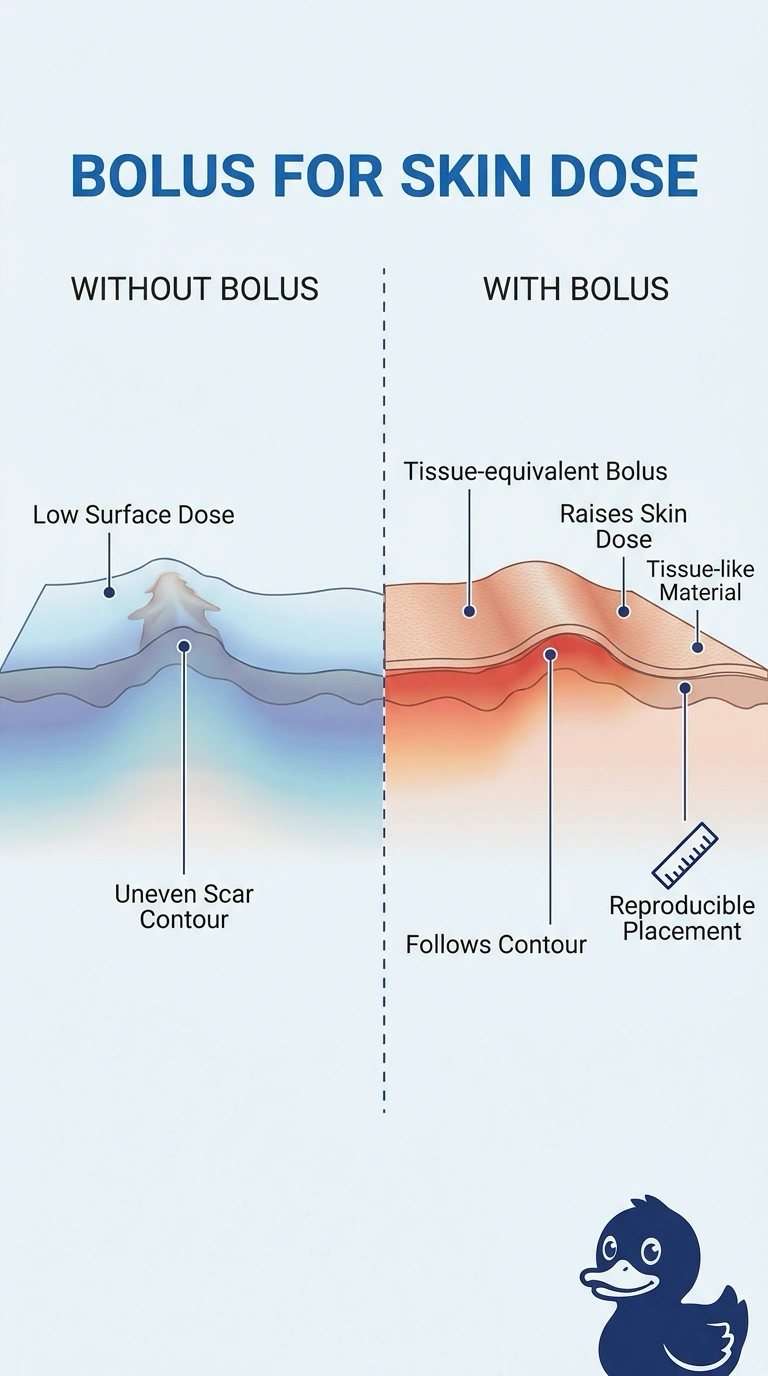
A flexible sheet of tissue-equivalent bolus shifts the photon build-up region closer to your skin, so you’ll raise the surface dose to match the prescribed depth dose. It molds over your scar’s uneven curve like a soft cover, meeting both needs.
Full Explanation
A flexible tissue-equivalent bolus is the best choice because it adds material at the skin to increase dose in the buildup region, while its flexibility lets it contact the uneven scar contour. Close contact matters: the bolus must both provide the intended buildup effect and follow the surface rather than bridging depressions. A standard flat bolus can raise surface dose, but may not lie flush on a curved chest wall; air gaps reduce the bolus effect and make dose less reliable across the scar. A shaped electron field can define coverage to the scar footprint, but a cutout shapes the field rather than supplying the missing buildup material, so skin dose may remain below the required level. Tangential IMRT can shape the planned dose distribution around the chest wall, yet photon skin dose still depends on buildup; without a surface bolus, it does not ensure the specified skin dose. Exam caveat: bolus thickness and beam energy affect the resulting dose, so “bolus” alone does not guarantee an exact surface dose. Practical check: verify bolus contact over the full scar, especially at curved or recessed areas, and confirm the planned surface dose using the treatment plan and the department’s dose-verification procedure.