
A patient with a laryngeal tumor is simulated for an opposed lateral setup. The neck must stay extended so the mandible and cervical spine clear the target, the shoulders must stay below the field borders, and the head and neck must sit in the same place every day. Which positioning and immobilization arrangement best meets these localization requirements?
Select an answer to reveal the explanation.
Short Explanation
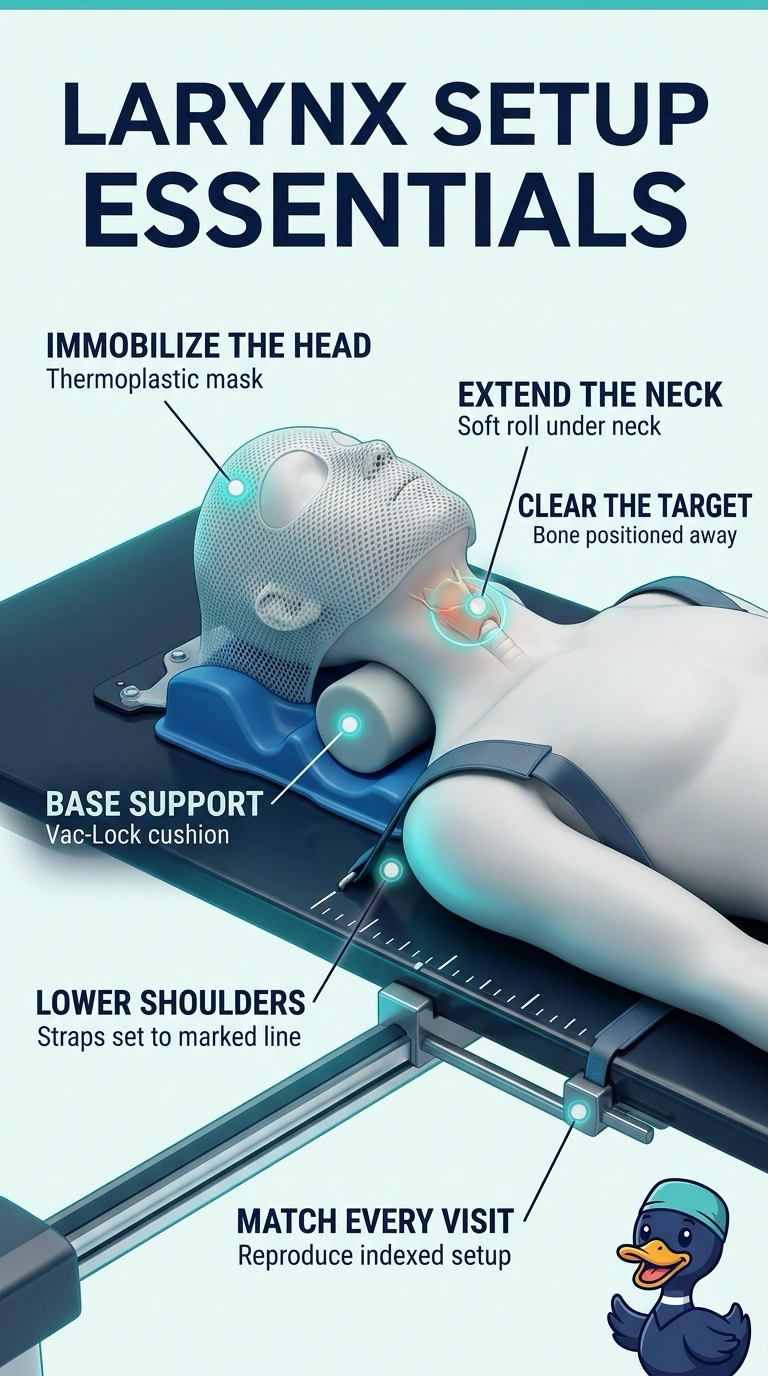
Like a custom-fit frame, a thermoplastic head-and-neck mask over a vac-lock helps keep your head and neck in the same position each day, with a cervical roll maintaining extension. Set the shoulder straps to a marked line so your shoulders stay below the field borders and your setup is reproducible.
Full Explanation
The larynx lies between the mandible and cervical spine, and shoulder position can affect clearance of the lateral fields. A thermoplastic head-and-neck mask secured to a vac-lock base helps immobilize the head and neck; a cervical roll supports neck extension, and shoulder straps set to a marked line help reproduce shoulder position. A foam headrest with a cervical roll and shoulder straps provides less head-and-neck immobilization. A mask on a flat cushion with a tucked chin does not meet the neck-extension requirement. A full-body cradle with the shoulders left free does not control shoulder position. At simulation, confirm that the mask, roll, and straps can be positioned consistently using the intended references.