
In a photon treatment head, a stream of electrons leaves the accelerator and must be converted into a usable x-ray beam before the collimating devices shape it. Which linear accelerator component performs this electron to photon conversion?
Select an answer to reveal the explanation.
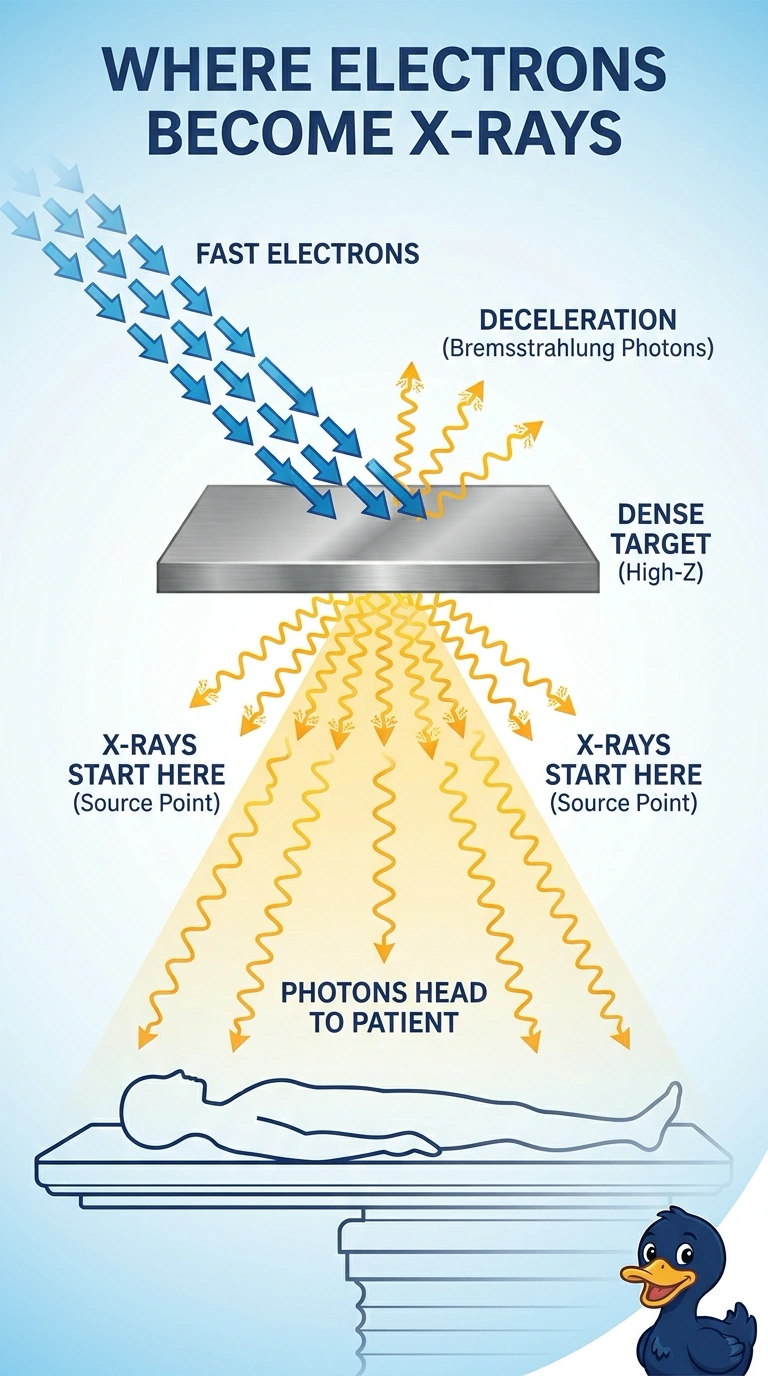
Short Explanation
You’ve got it: electrons become x-rays when they strike dense, high-atomic-number material in the target. The waveguide accelerates electrons, the magnetron generates microwave pulses, and the flattening filter evens photon fluence after x-rays exist.
Full Explanation
The target is where electron kinetic energy becomes photon energy. High-energy electrons accelerated by the waveguide strike a high-atomic-number plate; their deceleration in this dense material releases bremsstrahlung radiation, the x-ray beam used for treatment. The waveguide accelerates electrons but does not produce photons. The magnetron generates the microwave pulses that feed the waveguide; it is not the component where the electrons strike material to produce x-rays. The flattening filter redistributes the fluence of photons that have already been created, changing the beam’s profile rather than generating radiation. Exam caveat: in flattening-filter-free operating modes, the flattening filter is removed while the target remains in the photon path, so do not associate photon production with the filter. Practical check: distinguish the four jobs—magnetron generates microwave pulses, waveguide accelerates electrons, target converts electron energy into bremsstrahlung x-rays, and flattening filter evens photon fluence.