
A hospital radiopharmacy prepares a Tc-99m albumin aggregate suspension for an adult lung perfusion study. Free pertechnetate would leave the lung field and collect in the stomach, thyroid, and salivary glands, so the supervisor wants the tracer's chemical form confirmed before release. Which quality control test verifies that the activity is bound to the aggregates?
Select an answer to reveal the explanation.
Short Explanation
Chromatography is the only one of these tests that tells you what chemical form the activity is actually in. It's like checking whether the sugar dissolved or is still sitting at the bottom of the cup, because radiochemical purity looks past appearances. Aggregate size, pH and resuspendability, and the dose assay each answer a different question about the vial.
Full Explanation
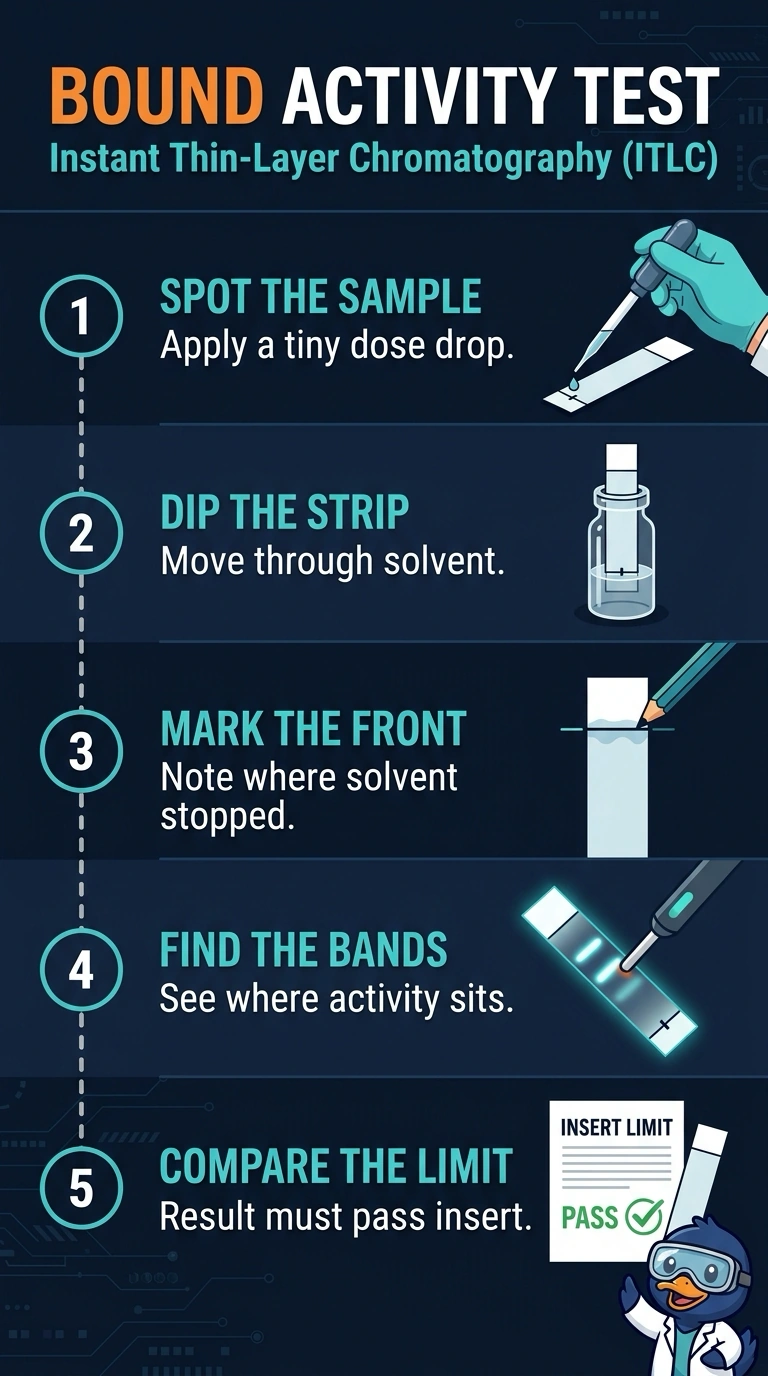
Instant thin-layer chromatography (ITLC) is the appropriate test because a validated solvent system separates mobile free pertechnetate from technetium associated with the albumin aggregates; measuring the activity in the separated regions allows the free-pertechnetate fraction to be checked against its limit. This directly evaluates radiochemical purity, the chemical-form requirement that matters here because unbound pertechnetate can distribute to the stomach, thyroid, and salivary glands rather than remain in the pulmonary vascular bed. Microscopy can establish whether aggregate sizes meet the product specification, an important determinant of pulmonary trapping, but aggregates of the correct size may still contain unbound activity. A pH and resuspendability check assesses formulation suitability and physical uniformity, yet neither reveals whether the technetium is chemically bound to the aggregates. A dose-calibrator assay establishes total activity and supports accurate dose preparation, but counts bound and free technetium together, so the measured activity cannot establish radiochemical purity. Exam caveat: the exact ITLC medium, solvent, and acceptance limit are product- and protocol-specific; a named chromatography method is useful only if it separates the impurity of concern. In practice, use the approved kit-specific ITLC procedure, sample the suspension as directed, and quantify the activity in both chromatographic fractions before release.