
Within minutes of an intravenous radiopharmaceutical injection, a patient develops generalized hives, a raspy voice and audible wheeze, and the blood pressure drops. The injection site itself is comfortable with normal skin color. Which emergency medication should be given first to treat this systemic reaction?
Select an answer to reveal the explanation.
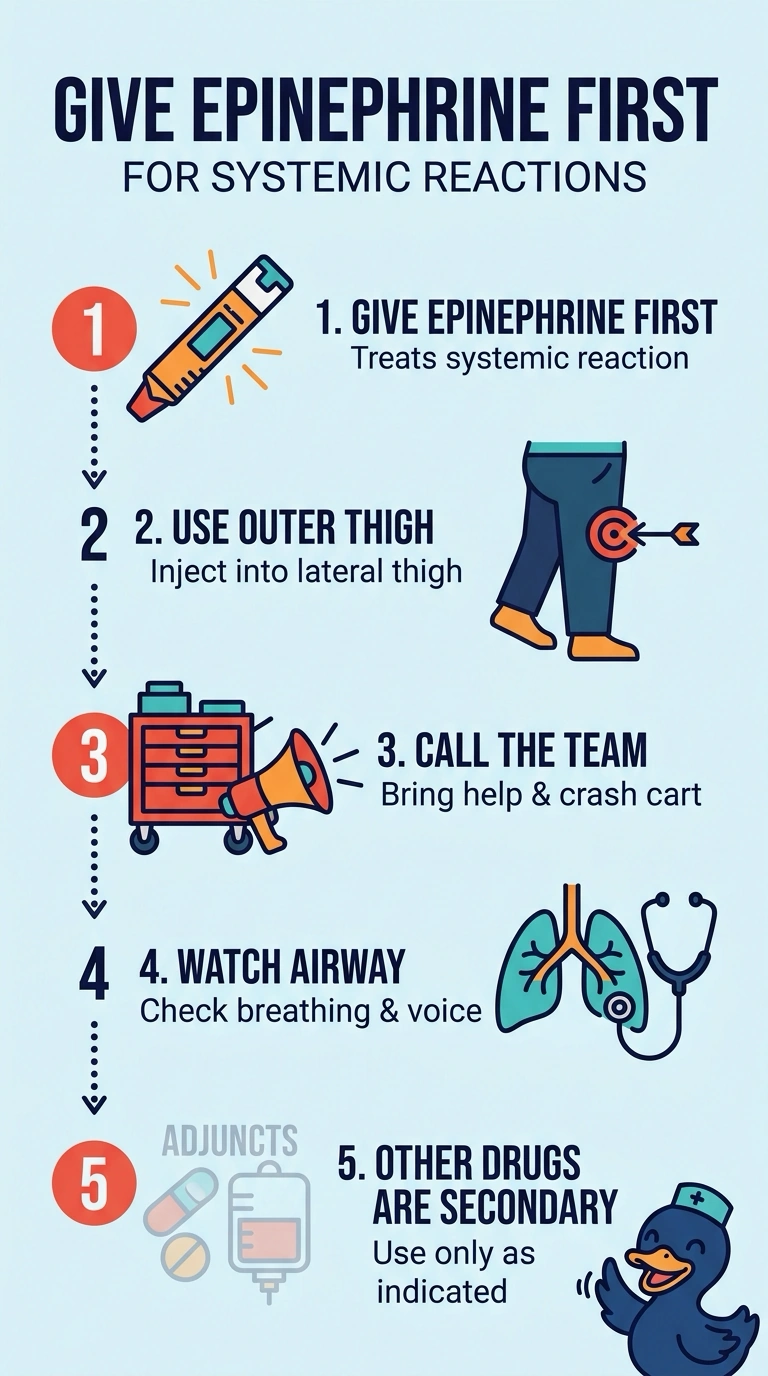
Short Explanation
Your patient's hives, raspy voice, wheeze, and falling blood pressure signal a whole-body emergency, not a reaction limited to the injection site. Give intramuscular epinephrine in the lateral thigh first; the other listed medicines cannot quickly protect both your patient's airway and circulation.
Full Explanation
Intramuscular epinephrine in the lateral thigh is first-line because the rapid onset of generalized hives, a raspy voice, wheezing, and hypotension indicates anaphylaxis, a systemic reaction involving both airway and circulation. Epinephrine can improve bronchoconstriction and laryngeal edema while supporting vascular tone and blood pressure; it should not be delayed while treating individual symptoms. Intravenous diphenhydramine may reduce hives and itching, but it does not reliably reverse airway obstruction or shock, so giving it first addresses only the skin findings. Nebulized albuterol can help persistent lower-airway bronchospasm, but it does not treat laryngeal edema, hives, or hypotension and cannot replace epinephrine. Intravenous methylprednisolone may be given as an adjunct, but its onset is too slow for immediate stabilization and it does not reliably prevent biphasic reactions. Exam caveat: diphenhydramine, albuterol, and methylprednisolone may have a role after epinephrine, but none is an equivalent substitute or a reason to wait. Practical check: promptly reassess airway, breathing, circulation, and blood pressure after epinephrine, and repeat the dose if symptoms persist according to the emergency protocol.