
A department plans Tc-99m aerosol ventilation studies in an interior room and occasional Xe-133 inhalation work. The room shares the building return-air plenum with the corridor, the door stays closed during procedures, and the nebulizer sits on the counter beside the patient. Which room condition must be verified before aerosol and radioactive gas studies begin?
Select an answer to reveal the explanation.
Short Explanation
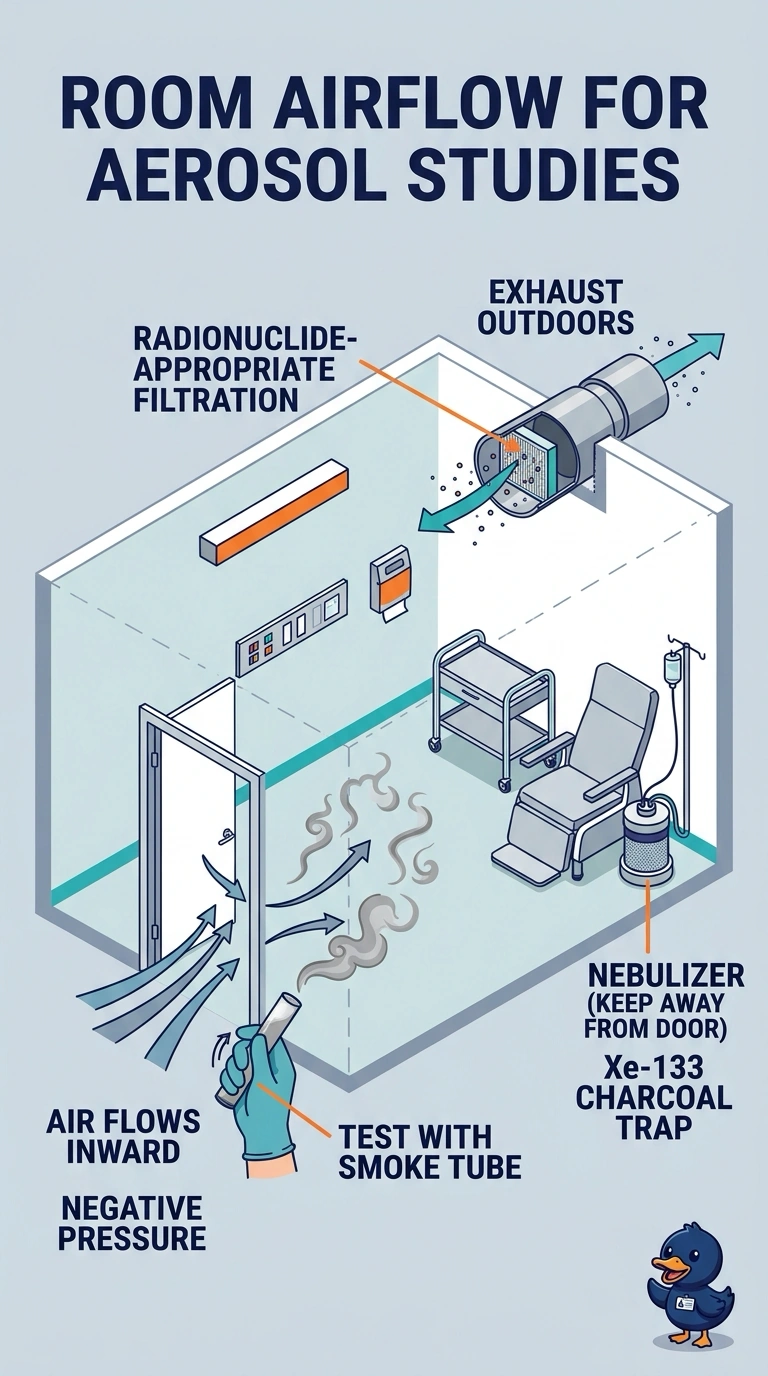
You need negative pressure so air flows into the room instead of carrying contamination into the shared return-air plenum, helping keep it contained. Exhaust should go outdoors through filtration suited to the radionuclide: HEPA captures aerosol particles, while Xe-133 gas needs suitable gas filtration, such as a charcoal trap.
Full Explanation
The required condition is verified negative room pressure with exhaust discharged outdoors after treatment appropriate to the radionuclides used. Negative pressure helps prevent room air from escaping into the corridor when the closed door is opened or leakage occurs; outdoor discharge avoids sending activity into the shared return-air plenum. Tc-99m aerosol is particulate and can be captured by suitable HEPA filtration, whereas Xe-133 is a radioactive gas and requires an effective gas-phase sorbent, typically activated charcoal, selected and maintained for the intended use. A system specifying HEPA filtration validated for aerosol capture addresses particles but does not reliably capture xenon gas. A system specifying activated-carbon filtration validated for xenon capture addresses the gas but omits particulate filtration needed for aerosol studies. Neutral pressure with source capture and HEPA and charcoal filtration is inadequate because source capture at the nebulizer does not control radioactive material exhaled by the patient, and neutral pressure fails the room-containment requirement. Exam caveat: exhaust-treatment and discharge requirements can depend on applicable regulations, facility design, and radionuclide-specific activity, so do not assume one filter type is sufficient for every study. Practical check: before use, document a room-to-corridor pressure differential with the door closed, confirm airflow direction at the doorway, and verify the exhaust route and installed filter media with facilities or radiation safety staff.