
A supplier change brings thicker 5 mL vials for unit doses, and readings on the new vials run several percent high while the daily constancy check with the sealed reference source stays on its control chart. Which dose calibrator performance test best evaluates how the new vials affect the reading?
Select an answer to reveal the explanation.
Short Explanation
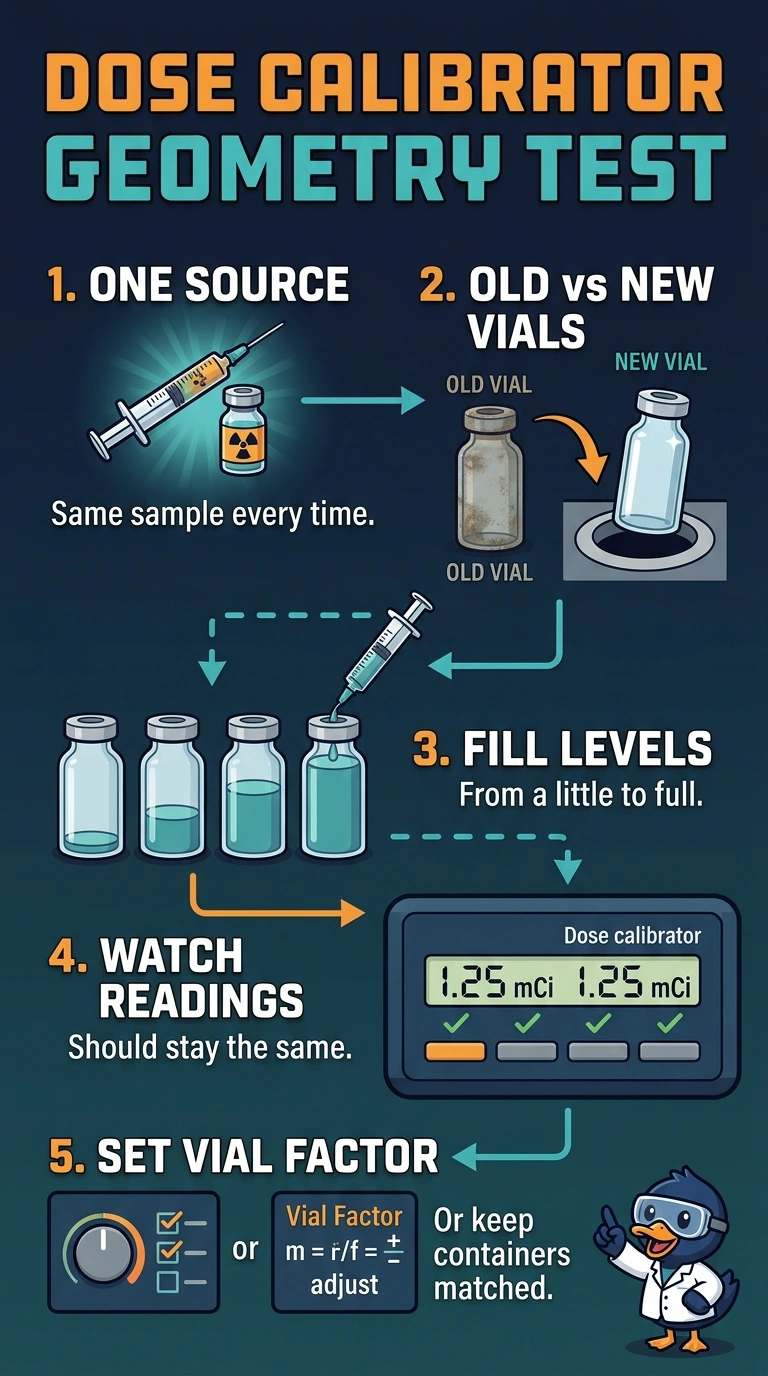
Since your constancy check is stable, the high readings may come from how the new vial affects the calibrator. A geometry test is like comparing the same drink in different cups: measure one source in old and new vials at several fill volumes, then compare the readings.
Full Explanation
The geometry test is the best choice because vial size, wall thickness, and the amount and distribution of solution can affect the response of a dose calibrator. Measuring the same source in both vial types at several fill volumes isolates these geometric effects: the old vial provides a direct baseline, while the range of fills shows whether the difference changes with solution volume. A traceable-source accuracy check in matched new and old vials is useful for checking agreement with a certified activity, but at one nominal fill it cannot reveal a volume-dependent geometry effect. A linearity test during decay assesses response over an activity range; keeping fill volume fixed means it does not test how the new vial’s geometry changes readings across fills, even if both vial types are included. Repeatability measurements across vial types and fill volumes assess precision, but comparing only the spread does not establish whether the new vials produce a systematic shift in the mean reading. Exam caveat: a stable constancy result with a sealed reference source supports day-to-day consistency but does not establish that a different vial geometry is unbiased. Practical check: use the same radionuclide source and calibrator setting, control and record fill volumes, and keep timing and positioning consistent when making the paired measurements.