
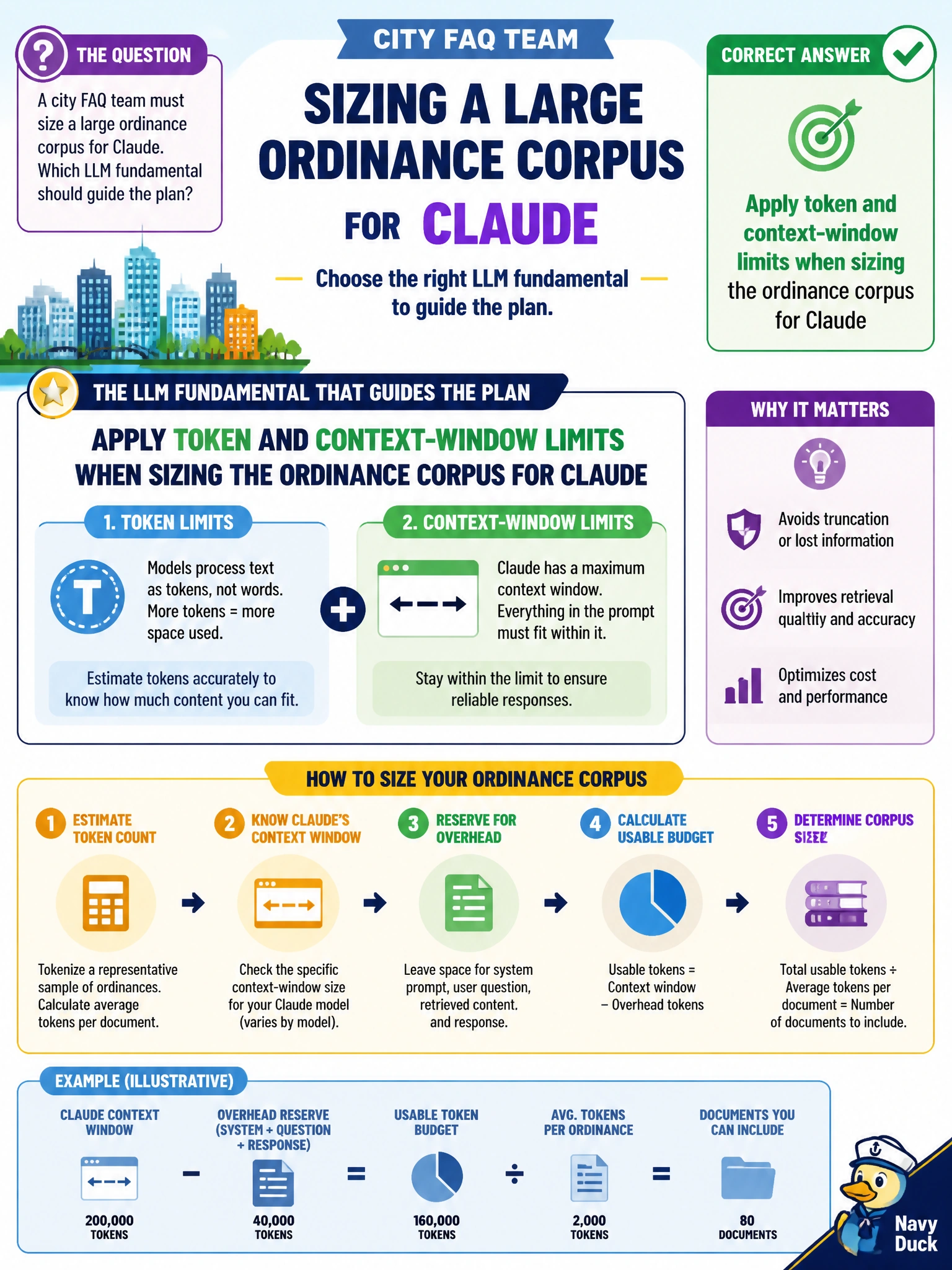
A city FAQ team must size a large ordinance corpus for Claude. Which LLM fundamental should guide the plan?
Select an answer to reveal the explanation.
Short Explanation
Ordinances aren't infinite sticky notes—size the corpus against tokens and the context window or Claude will choke on the pile.
Full Explanation
Sizing a large municipal ordinance corpus for Claude must be guided by token and context-window limits. LLMs ingest discrete tokens, not infinite documents; capacity planning for a city FAQ team therefore converts ordinance text into estimated tokens, reserves room for system prompts and answers, and designs chunking or retrieval so the model never silently overflows.
Estimating capacity from Claude parameter count and training data cutoff date fails because parameter count and knowledge cutoff do not determine how many tokens fit in a context window—model size and training freshness are unrelated to the simultaneous text limit that governs whether ordinance text overflows. Counting total ordinance word count instead of tokens to estimate resource usage fails conceptually—word counts and token counts diverge enough across punctuation-heavy legal text and citations that a word-based budget can still overflow the real token limit. Sizing the corpus from PDF page count and department file storage quota for archiving fails because page counts and storage quotas do not map to token usage—scanned pages, formatting, and archival limits say nothing about how much text Claude can read within its context window.
Exam caveat: retrieval-augmented designs still need per-chunk token budgets and citation of which ordinance sections entered the window. Operational check: tokenize representative ordinance packs, measure prompt+corpus+response headroom against the target model's window, and fail the FAQ deploy if routine queries exceed a defined fill threshold without retrieval.