
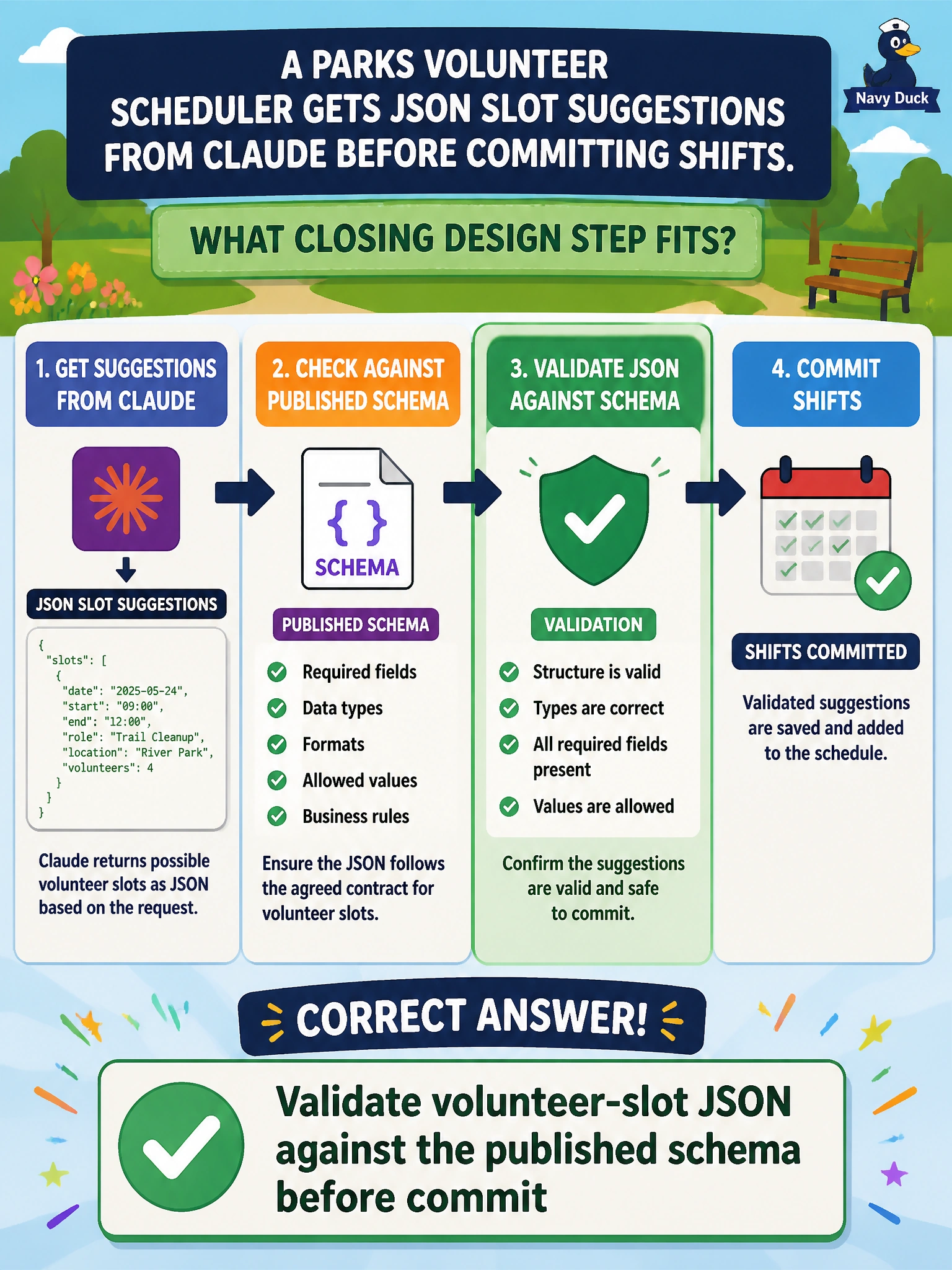
A parks volunteer scheduler gets JSON slot suggestions from Claude before committing shifts. What closing design step fits?
Select an answer to reveal the explanation.
Short Explanation
Schema design is half the job—validation is the handshake. Check Claude's volunteer-slot JSON against the published schema before you commit shifts.
Full Explanation
Schema design for volunteer-slot JSON is incomplete without a validation gate before the parks scheduler commits shifts. Validating Claude’s volunteer-slot JSON against the published schema before commit works because it catches missing fields, wrong types, illegal enums, and extra properties that would corrupt calendars or overbook sites. Parks staff get model suggestions with a machine check rather than blind trust. Caching volunteer-slot JSON in session state for reuse across commits fails because cached payloads can still be schema-invalid and reusing them across commits propagates unchecked model output into live shifts. Rendering volunteer-slot JSON in the scheduler preview for coordinator approval fails because a human preview is not a machine validation gate; coordinators can miss missing fields, wrong types, or illegal enums before shifts are written. Enriching volunteer-slot JSON with park location metadata before commit fails because enrichment adds data but does not verify conformance to the published schema, so invalid payloads can still reach the commit path. Exam caveat: validation should be strict against the published schema version the scheduler deploys; silently "fixing" fields in ad hoc code recreates drift. Operational check: store the published volunteer-slot schema in version control, validate every Claude suggestion in CI or the commit path, and reject or quarantine payloads that fail before writing shifts to the live calendar.