
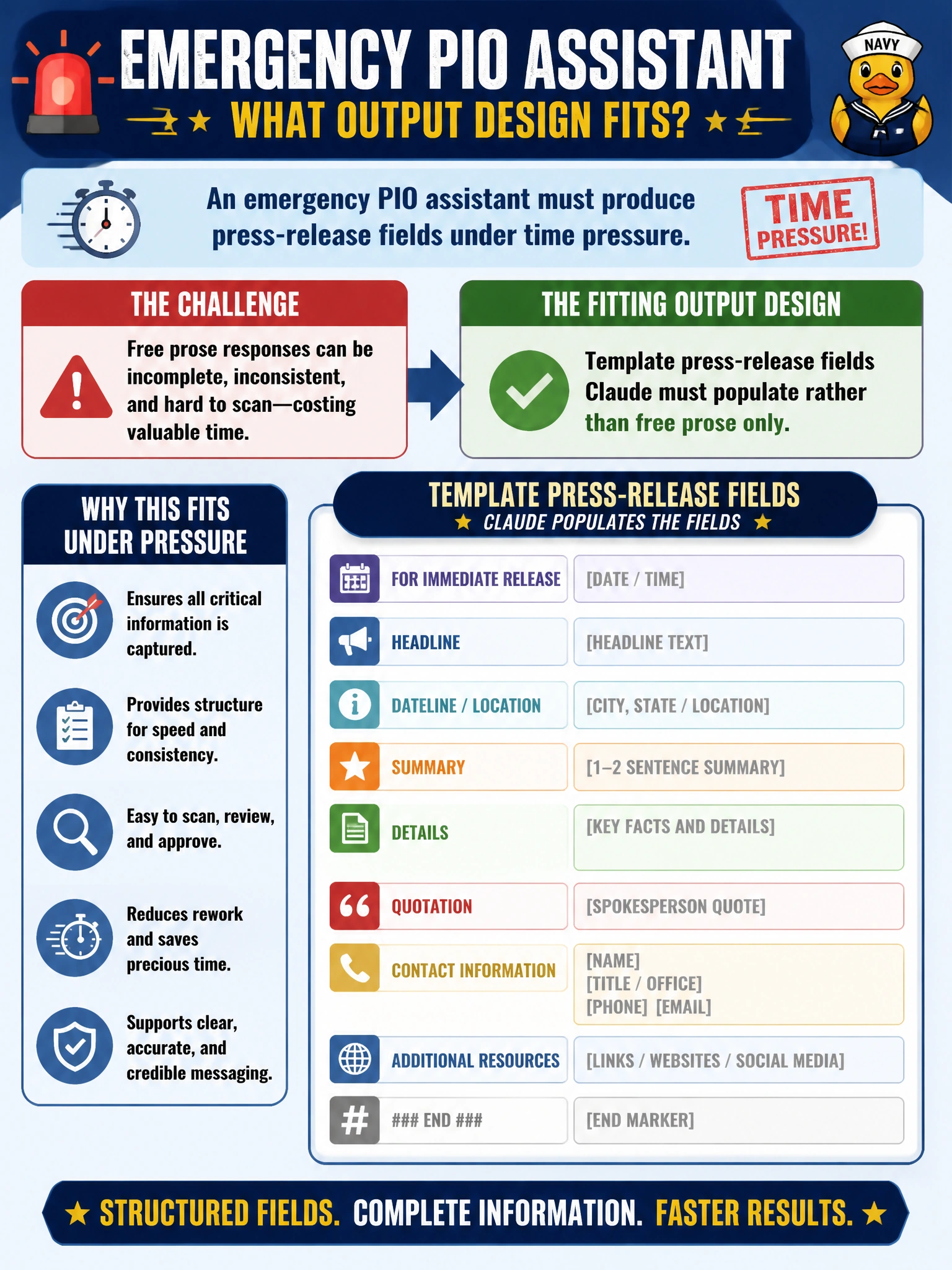
An emergency PIO assistant must produce press-release fields under time pressure. What output design fits?
Select an answer to reveal the explanation.
Short Explanation
When the sirens are on, PIOs need fields filled—not a novel and not a running commentary on how Claude chose them. You template the press-release slots and have Claude populate them, so nothing mandatory gets skipped.
Full Explanation
Emergency public information officers need consistent press-release structure when minutes matter. Templating press-release fields that Claude must populate—rather than relying on free prose only—works because required slots for headline, incident summary, protective actions, timestamps, and approved contacts reduce omission risk and speed human review before publication. PIO assistants can draft under pressure while still producing agency-shaped output. Presenting press-release fields as suggested examples for narrative adaptation fails because optional fields treated as narrative suggestions still let contacts, times, or mandatory safety lines be dropped. Formatting incident details as a social post template for press distribution fails conceptually because a social post template lacks the required press-release slots and can still invite fabricated or mismatched official details during an emergency. Showing detailed step-by-step reasoning about field choices alongside the completed press release fails as operations: under time pressure, extra reasoning output slows publication and does not deliver the stable field set that reviewers and syndication channels expect. Exam caveat: templates improve completeness but do not authorize release—human PIO approval and fact checks against verified incident status remain mandatory. Operational check: maintain a municipal press-release schema or checklist, require Claude to fill every mandated field or mark unknown, and run tabletop drills where incomplete or invented contact fields are rejected before any public post.