
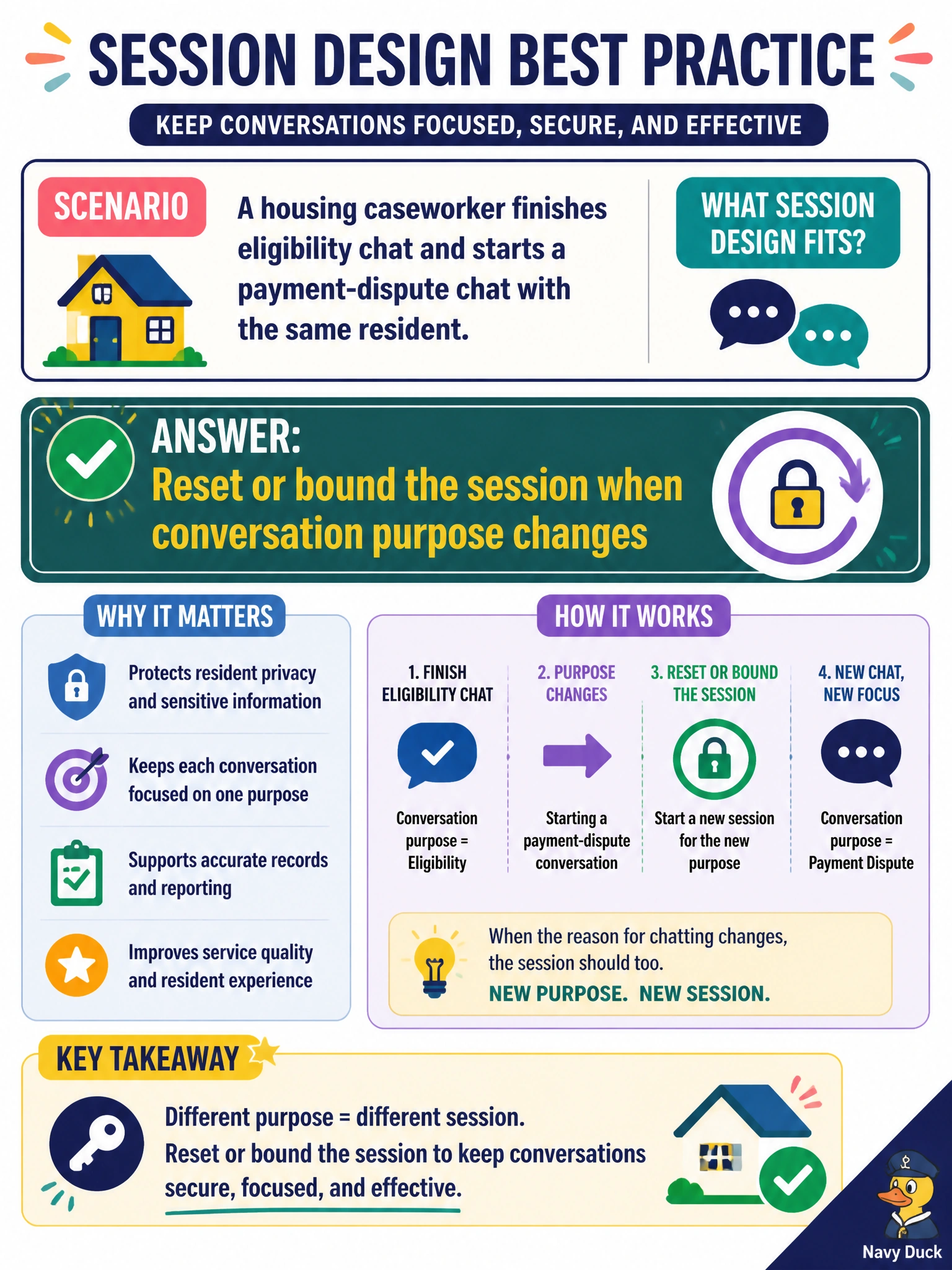
A housing caseworker finishes eligibility chat and starts a payment-dispute chat with the same resident. What session design fits?
Select an answer to reveal the explanation.
Short Explanation
Eligibility talk and payment-dispute talk are different rooms. Reset or bound the session when the purpose changes so yesterday's facts don't smear into today's dispute.
Full Explanation
Housing casework often changes purpose mid-resident relationship—eligibility intake is not the same conversation as a payment dispute. Resetting or bounding the session when conversation purpose changes works because it prevents prior eligibility narrative from being treated as dispute evidence, reduces cross-contamination of goals and tone, and lets each workflow load the right tools and policy. Caseworkers can still retrieve durable case facts through systems of record rather than an endless chat transcript. Reusing the full eligibility transcript as if it were dispute evidence forever fails because conversational history is not adjudicated evidence and may include tentative or incorrect statements. Appending both purposes into one endless thread with no boundary fails conceptually by mixing intents so Claude answers dispute questions with eligibility framing or the reverse. Disabling sessions so every dispute answer ignores prior case context entirely fails as overcorrection: purpose boundaries are needed, not the total erasure of useful continuity from systems of record. Exam caveat: a reset should not delete official case files; it bounds chat context while CRM or housing systems remain authoritative for durable facts. Operational check: define purpose-change triggers (new dispute, new program, new legal matter), implement session reset or scoped summarization, and verify dispute prompts do not inherit eligibility-only assumptions from the prior thread.