
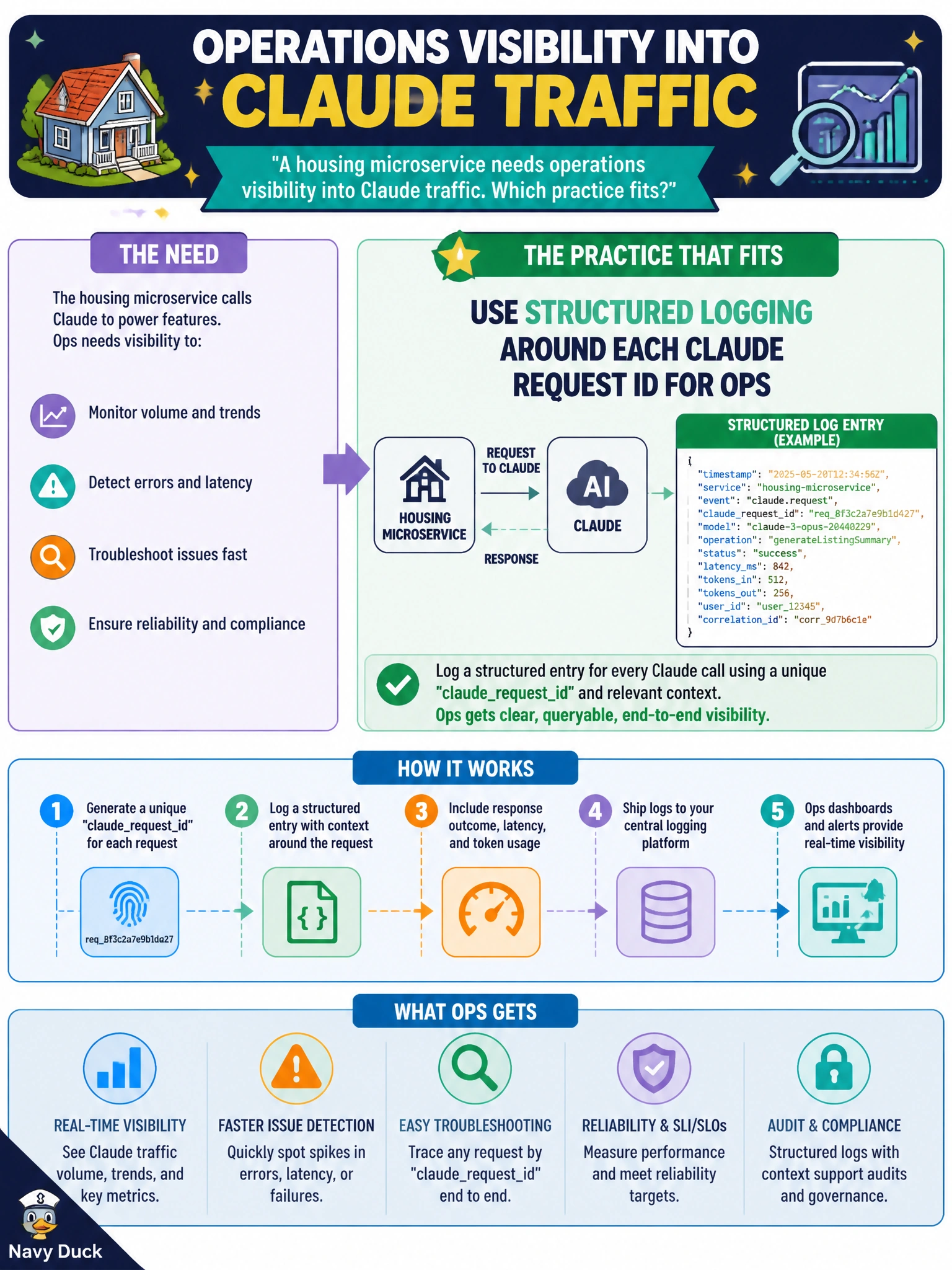
A housing microservice needs operations visibility into Claude traffic. Which practice fits?
Select an answer to reveal the explanation.
Short Explanation
When housing ops asks "which Claude call broke?", a request ID in structured logs is the flashlight. Leave a trail you can follow.
Full Explanation
Housing microservices that need operations visibility into Claude traffic should use structured logging around each Claude request ID. Structured, correlatable logs fit because housing ops must answer which call failed, for which case workflow, and with what latency or error class during an incident. Request IDs link application logs, gateway traces, and vendor-side diagnostics without relying on free-form jokes or missing identifiers. Storing full Claude prompt text in metrics labels for filtering fails by concept: stuffing full prompts into metrics labels creates unbounded cardinality and exposes resident data, so it cannot serve as usable operations telemetry for Claude calls. Forwarding Claude call logs to local files on each host fails by concept: logs trapped in per-host local files cannot be centrally searched, alerted, or correlated across housing microservice instances during an incident. Recording aggregate token usage daily for billing dashboards fails by concept: daily aggregates are a billing rollup, not per-call operations telemetry, so they cannot show which Claude call failed, its latency, or its error class. Exam caveat: structured logs must exclude secrets and unnecessary case PII—log identifiers and status metadata, not full prompt bodies with resident data unless a compliant sensitive-logging path exists—and retention should match municipal policy. Operational check: emit JSON logs containing Claude request ID, latency, and status for each housing microservice call; trigger a deliberate failure; and confirm on-call can retrieve the exact failing request ID from the log system within the incident playbook time target.