
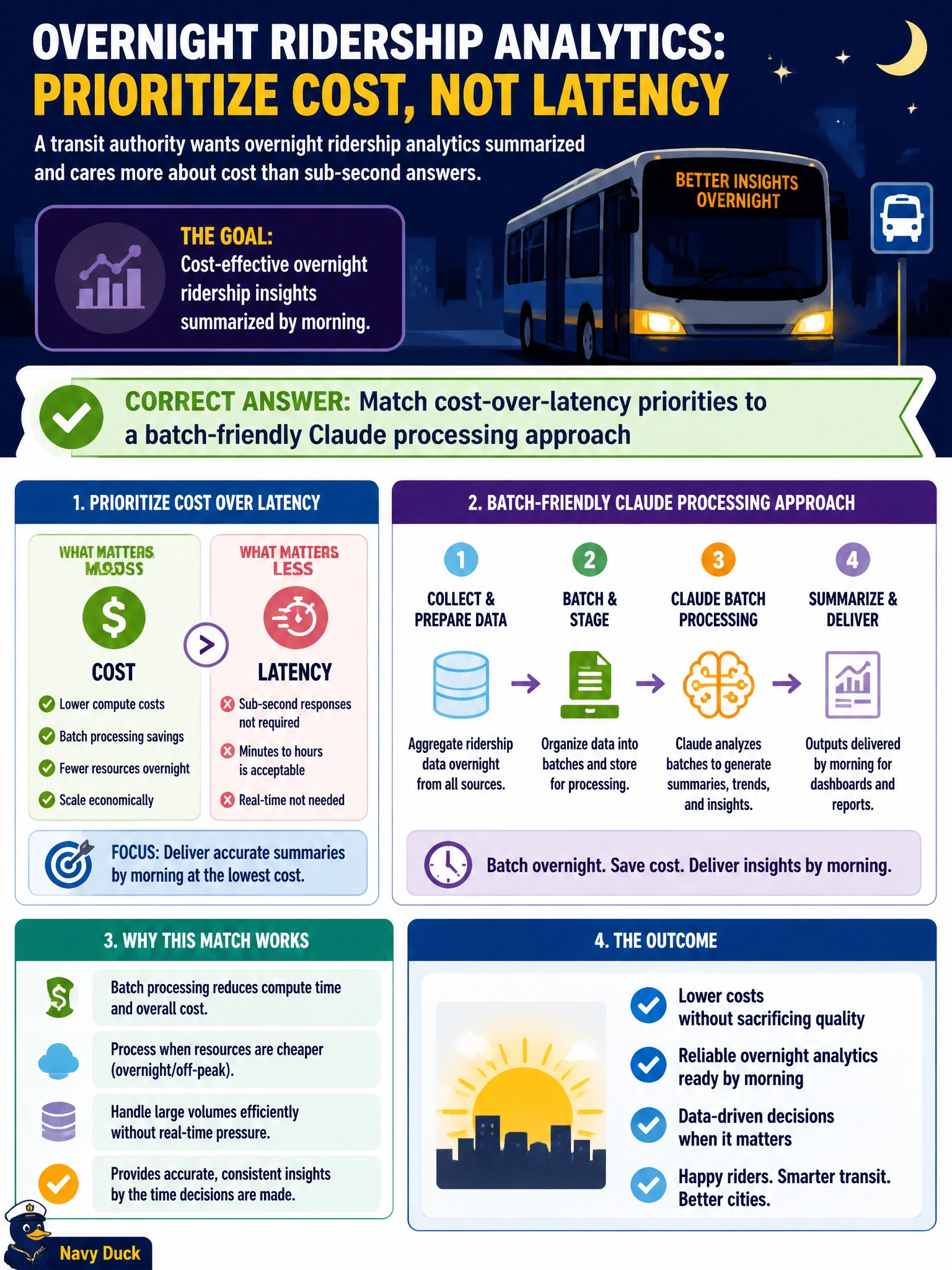
A transit authority wants overnight ridership analytics summarized and cares more about cost than sub-second answers. What should developers prioritize?
Select an answer to reveal the explanation.
Short Explanation
Overnight ridership digests aren't 911 calls—pennies matter more than milliseconds. Pick the processing path that matches cost-first priorities.
Full Explanation
Transit overnight ridership analytics are latency-tolerant summaries where cost usually outweighs sub-second interactivity. Matching cost-over-latency priorities to a batch-friendly Claude processing approach is correct because requirements analysis includes selecting the processing path that fits business priorities: overnight batch jobs can queue, run asynchronously, and optimize for price/throughput rather than chat SLAs. Conceptually this keeps municipal analytics budgets sustainable while still delivering morning-ready digests for planners.
Routing overnight summaries through streaming responses for incremental token delivery fails by concept: streaming exists to make a live session feel responsive token-by-token for a human watching the screen, which is a UX optimization, not a cost lever for an unattended overnight batch job nobody is staring at. Prioritizing sub-second response tuning for overnight batch summarization workloads fails as prioritization—it contradicts the stem's stated preference by chasing latency the authority explicitly said it does not need, and sub-second tuning typically raises cost rather than lowering it. Selecting a larger Claude model to enrich summary detail for overnight report batches fails the stem's cost framing: a bigger model raises per-token cost for extra detail the transit authority never asked for, when the lever to pull is the processing path, not the model size.
Exam caveat: CCDV-F often pairs 'cost over latency' with batch-friendly approaches; do not default to realtime prestige or oversized models when the stem cares about cost. Keep transit ridership overnight framing. Operational check: classify the job as latency-tolerant, select batch/async Claude processing, track cost per report set, and verify morning summaries meet quality bars without streaming or oversized-model patterns.