
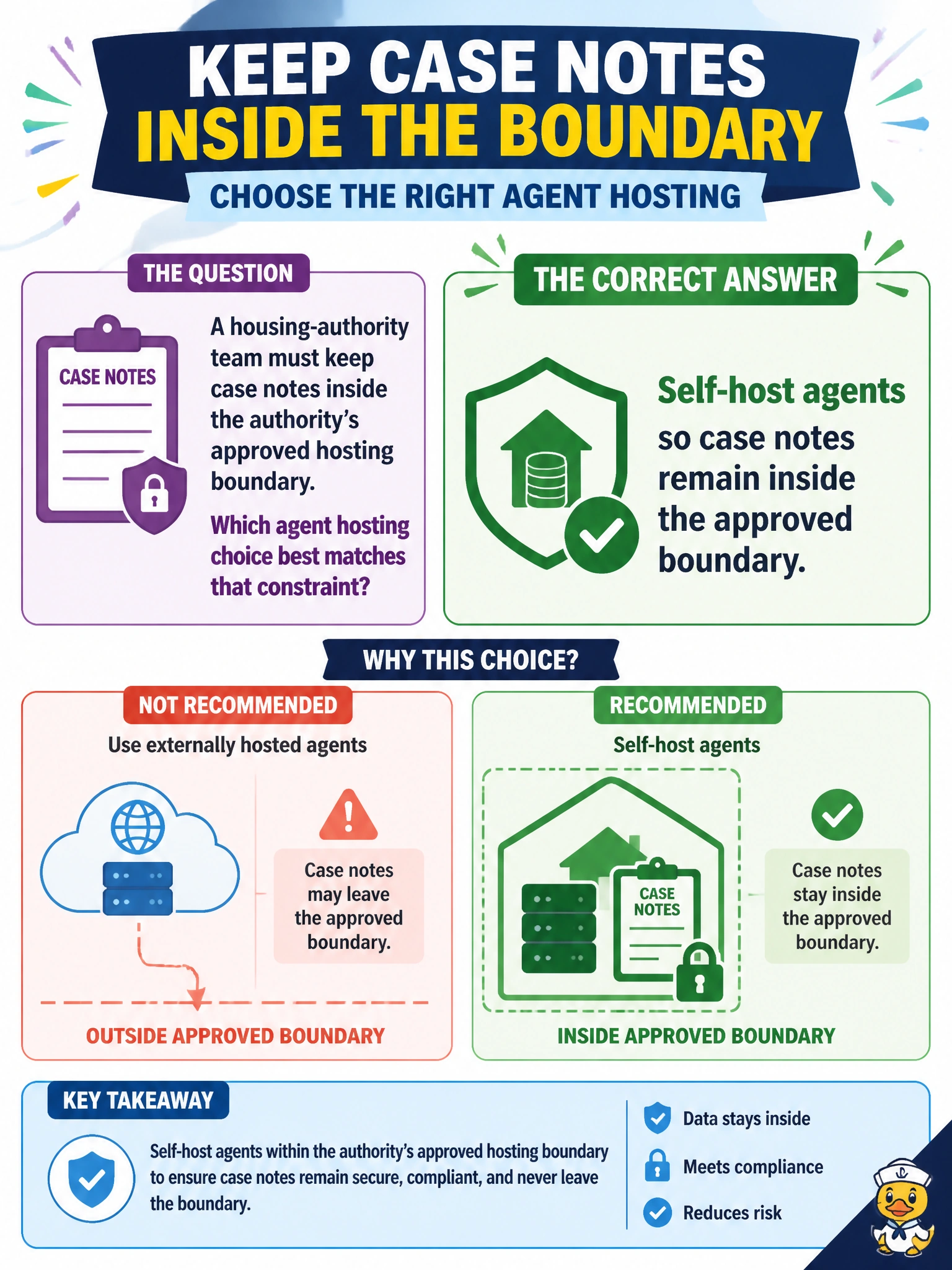
A housing-authority team must keep case notes inside the authority's approved hosting boundary. Which agent hosting choice best matches that constraint?
Select an answer to reveal the explanation.
Short Explanation
Case notes are like files that never leave the records room. Self-hosting keeps the agent runtime in that room; a vendor SaaS with only standard regional controls might still put your files outside the approved boundary. Shared public cloud or external model APIs also send case notes beyond the boundary, even if they're encrypted or promise better quality.
Full Explanation
Self-hosting agents so case notes remain inside the approved boundary best matches a housing-authority constraint that case notes must stay inside the authority's approved hosting boundary. Hosting choice is a data-residency and processing-boundary decision: if policy treats case notes as boundary-bound, the agent runtime, connectors, and logs that handle those notes should not be placed on a vendor SaaS platform with only standard regional controls unless those controls provably match the approved boundary. Self-hosting keeps the runtime in the approved room with the records. Hosting agents on a vendor SaaS platform with standard regional controls fails by concept because standard regional controls do not guarantee the authority's specific approved hosting boundary. Deploying agents in a shared public cloud with encrypted case storage fails the approved-hosting requirement because encryption protects confidentiality but does not keep case notes inside the authority's approved boundary. Routing case notes through external model APIs for improved response quality fails the boundary constraint because it sends case notes outside the approved hosting environment regardless of any quality gain.
Exam caveat: "self-host" means the authority-controlled approved environment—not a random employee's laptop. Managed services may be acceptable only if they are explicitly in the approved boundary and contractual residency terms.
Operational check: inventory where case notes flow during agent use, deploy the agent stack into the approved boundary, block egress to shared public cloud and external model API endpoints outside the approved boundary, encrypt data at rest/in transit per authority policy, and audit for paste/export shadow channels.