
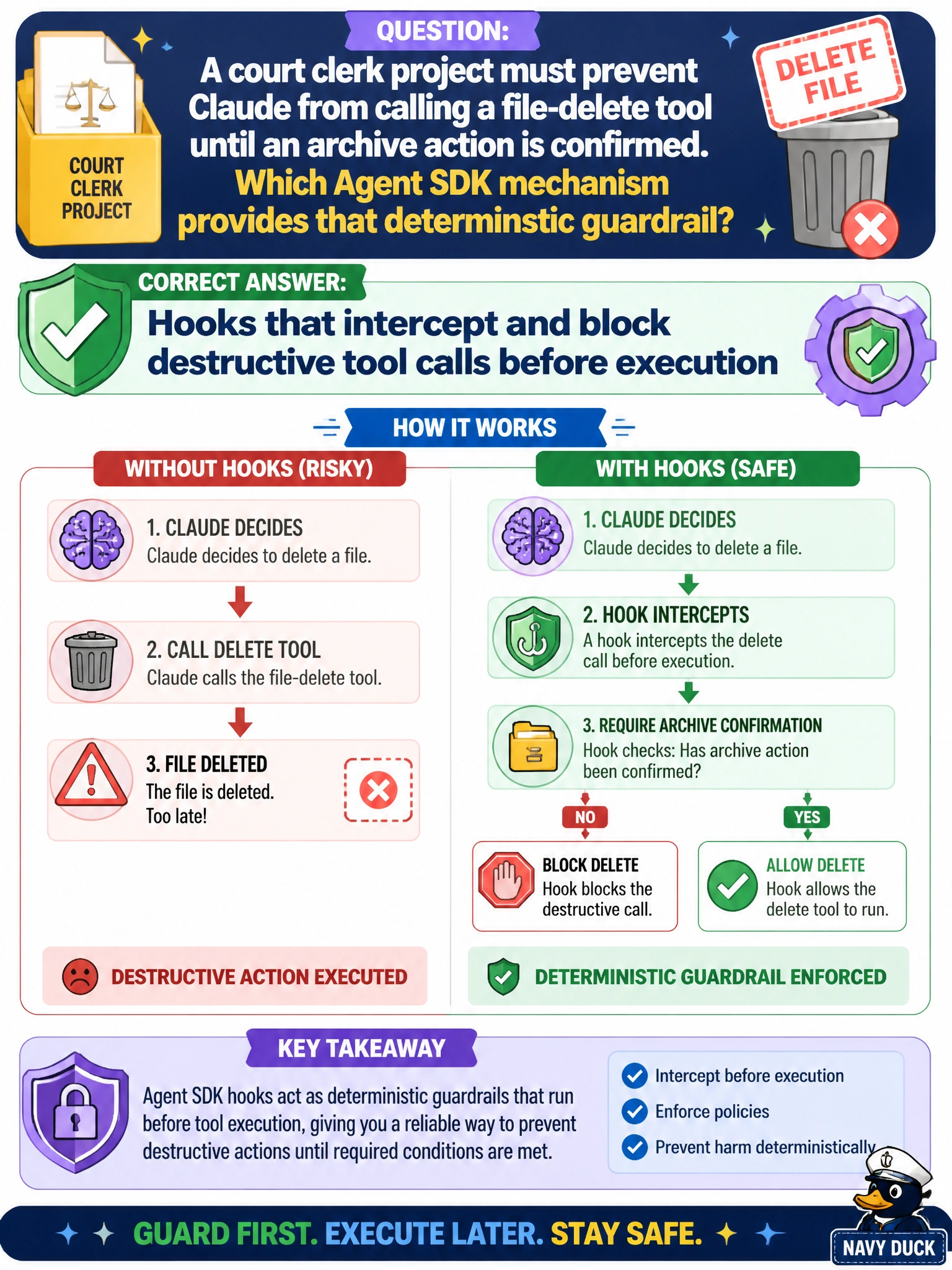
A court clerk project must prevent Claude from calling a file-delete tool until an archive action is confirmed. Which Agent SDK mechanism provides that deterministic guardrail?
Select an answer to reveal the explanation.
Short Explanation
Hooks are the deadbolt on the records vault—Claude can reach for the delete key, but the lock decides whether it turns. Deterministic guardrails beat hoping the model feels cautious today.
Full Explanation
Hooks that intercept and block destructive tool calls before execution provide the deterministic guardrail a court clerk project needs to prevent Claude from calling file-delete until an archive action is confirmed. Hooks sit in the Agent SDK control path around tool execution: the model may propose delete, but the hook evaluates preconditions (archive confirmation present, role authorized) and can deny the call before it touches records. That is a server-side deadbolt, not a suggestion.
Reduced temperature so Claude thinks more carefully before each action fails by concept: temperature only changes sampling randomness, not authorization, so a lower setting makes delete calls no less possible and cannot deterministically block execution. Detailed audit logs that record file-delete calls after execution fail because they only record the action after it occurs; they do not intercept or block the call, so they cannot deterministically prevent an unarchived deletion. System prompt instructions describing archive checks before file-delete tools fail because they are only guidance to the model, not server-side enforcement—without a hook, Claude can still call the delete tool without a confirmed archive.
Exam caveat: hooks enforce runtime policy; they must be tested for bypass paths (alternate tools, direct API calls). Pair deny decisions with clear operator-facing errors and audit events.
Operational check: implement a pre-tool hook on delete that requires a verified archive confirmation token, log allow/deny with clerk ID and case ID, attempt deletes without archive in staging (must fail), and periodically review denied destructive calls in court IT audits.