
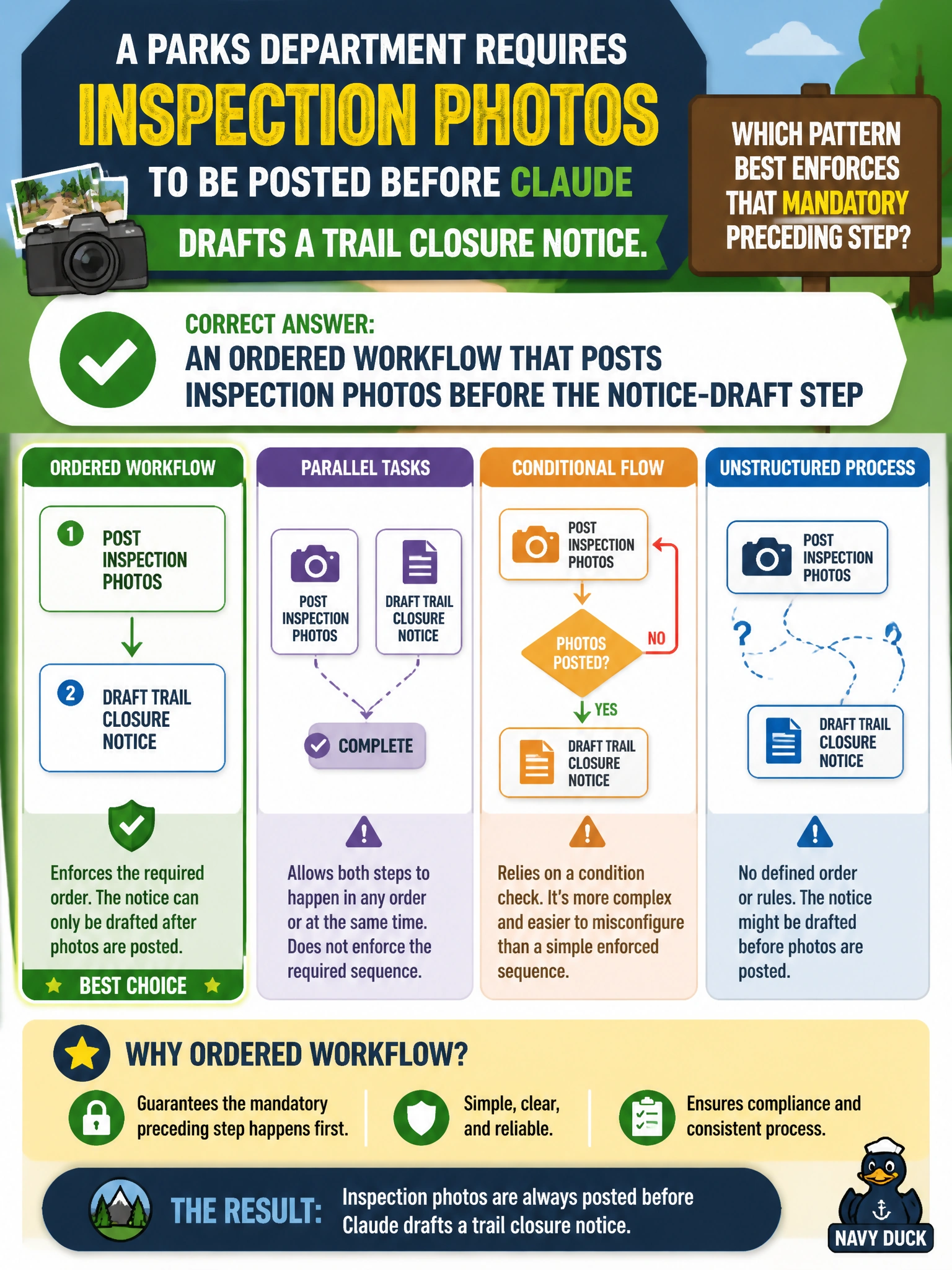
A parks department requires inspection photos to be posted before Claude drafts a trail closure notice. Which pattern best enforces that mandatory preceding step?
Select an answer to reveal the explanation.
Short Explanation
No photo, no closure notice—same idea as no inspection sticker, no reopening the pool. An ordered workflow puts the camera step on the conveyor before the drafting step.
Full Explanation
An ordered workflow that posts inspection photos before the notice-draft step best enforces the parks department rule that inspection photos must be posted before Claude drafts a trail closure notice. Mandatory preceding steps are sequencing constraints: evidence capture precedes public communication so notices rest on documented field conditions. Ordered workflows make that dependency structural—no photo upload completion, no draft stage—rather than relying on the model to remember the policy under pressure.
An agent that drafts notices and uploads photos simultaneously to save time fails by concept because running both at once provides no guarantee the photo finishes first, which still allows the mandatory preceding step to be skipped in practice. A workflow that lets either step run first, as long as both finish before publication, fails because 'eventually both happened' is not the same as a guaranteed precedence—the notice could still be fully drafted and ready before the photo evidence exists, which is exactly the ordering violation the stem forbids. A workflow that skips photo steps when staff report conditions verbally fails operationally and legally: a verbal description is not the documented visual evidence the policy requires, so substituting it for the photo quietly drops the mandatory evidence step.
Exam caveat: ordered workflows enforce prerequisites; they do not replace content quality review of the photos or the notice text. Emergency closures may need an explicit alternate path with human authorization and after-the-fact evidence rules—document that exception rather than weakening the default order.
Operational check: gate the notice-draft node on successful photo-post artifacts (IDs/URLs), reject drafts lacking those artifacts, log sequence timestamps, and spot-check published notices against inspection media in the parks system of record.