
An architect is designing a system prompt for a technical writing assistant that must produce output in a strict XML schema for downstream XML parsing. The schema requires <title>, <summary>, <steps>, and <caveats> elements. During evaluation, Claude occasionally omits the <caveats> element when no obvious caveats exist. What prompt engineering technique most reliably prevents this omission?
Select an answer to reveal the explanation.
Short Explanation
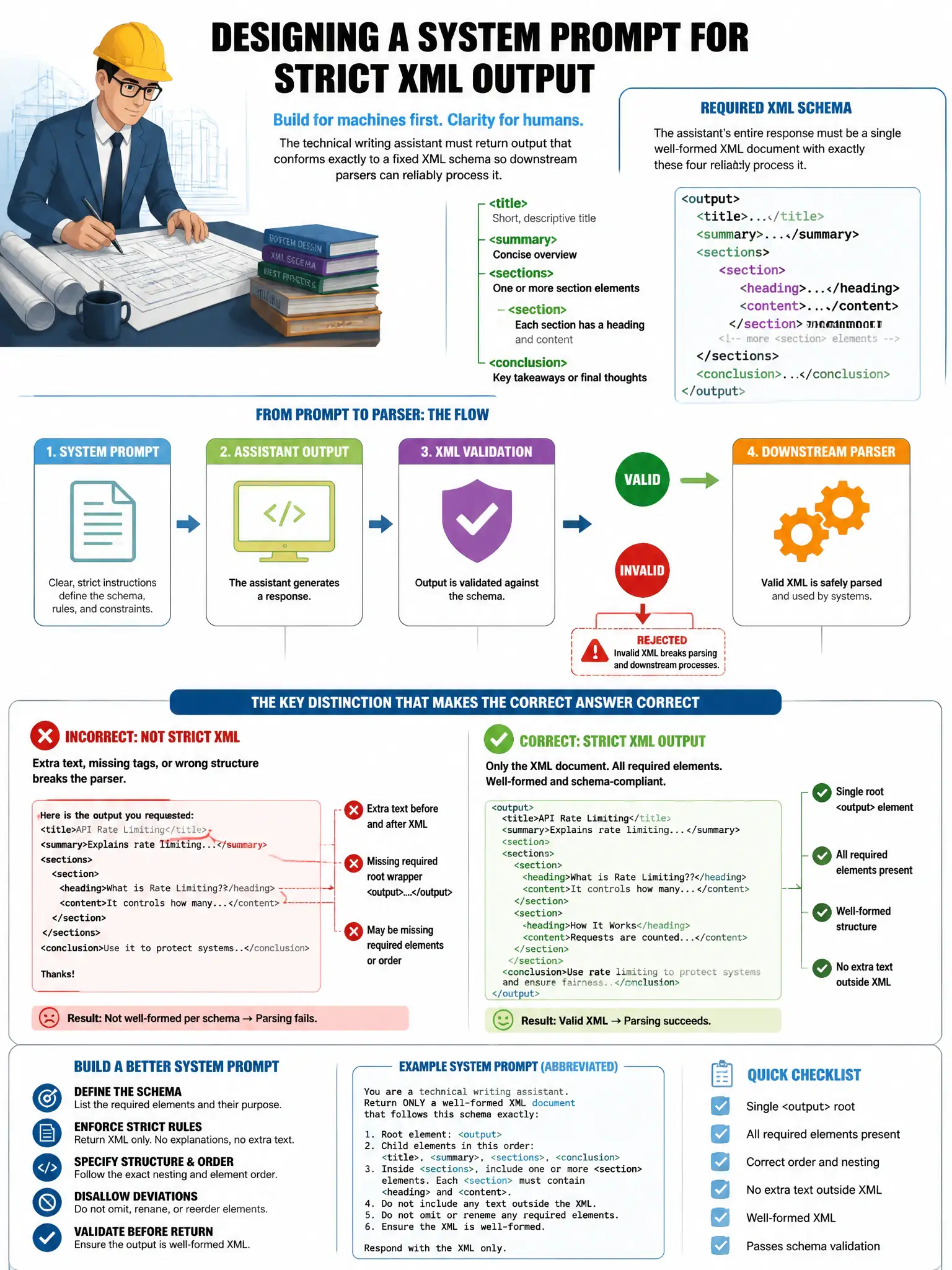
You fix this by making the <caveats> element mandatory and giving Claude a valid placeholder when there’s nothing to report. That removes the model’s decision to drop the element when caveats seem absent.
Full Explanation
The omission occurs when the model reasons that an empty or inapplicable element should be excluded. The reliable fix is an explicit instruction that <caveats> must always be present with a minimum of one child element, and that if no caveats exist the element should contain <caveat>None identified</caveat> as a valid placeholder. This closes the reasoning gap because the model now has a defined valid output for the null case and no longer needs to decide whether to omit the element. That makes schema compliance deterministic. Switching to JSON output format is wrong because JSON does not inherently produce more reliable schema adherence; Claude can omit required JSON keys just as easily as XML elements, and changing the format adds a migration cost. Adding three few-shot examples that all contain non-trivial caveats is wrong because it reinforces the model’s tendency to only include caveats when meaningful content exists; it does not teach the placeholder pattern for the zero-caveat case. Adding an all-caps 'IMPORTANT: Always include <caveats>' instruction is wrong because all-caps emphasis is not a reliable mechanism; it draws attention but does not provide the model with a resolution for the null-content case that causes the omission.