
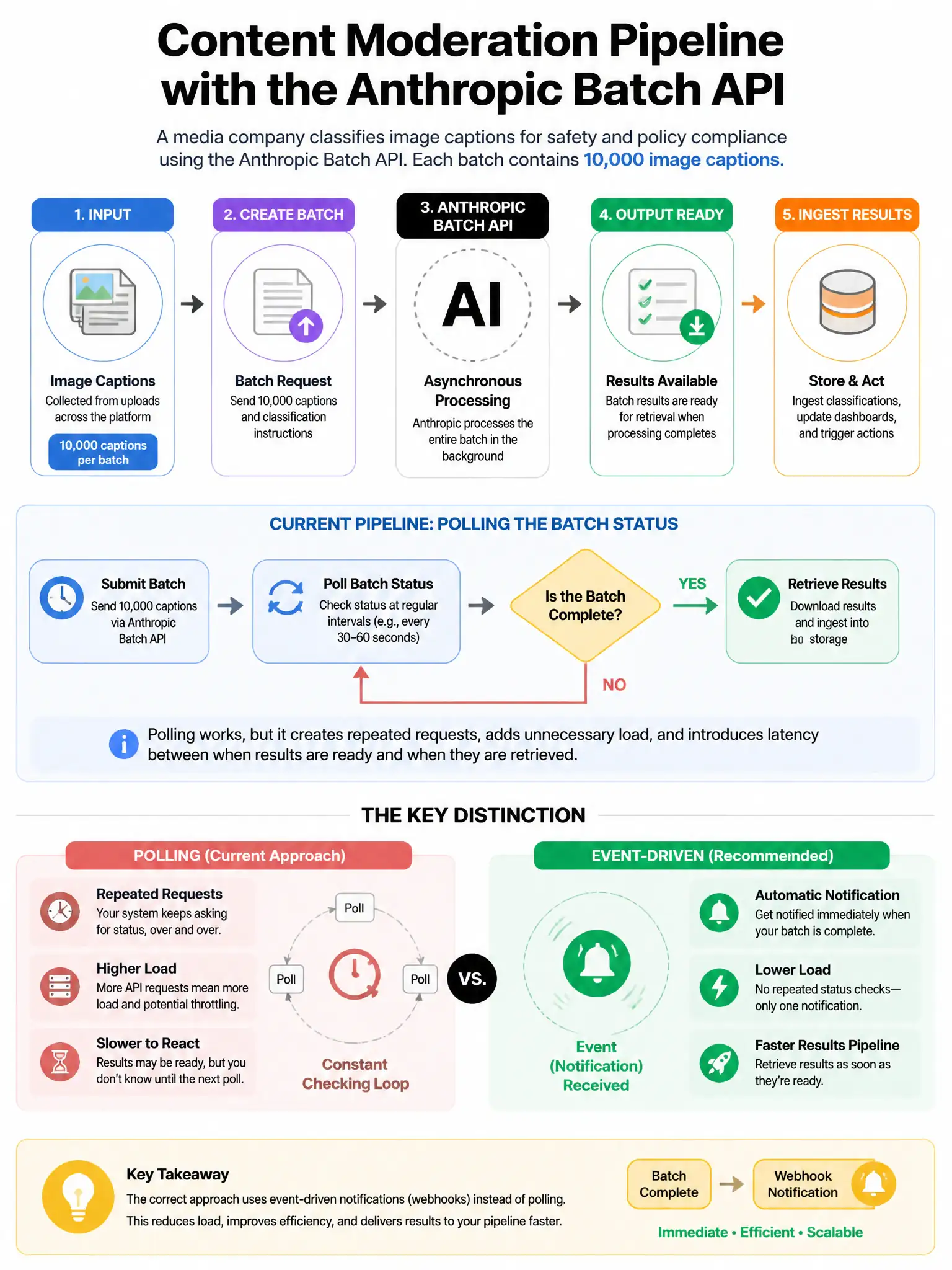
A media company is building a content moderation pipeline using the Anthropic Batch API. Each batch contains 10,000 image captions to classify. The pipeline currently polls the batch status endpoint every 5 seconds. During peak hours the team observes 429 errors on the polling endpoint. What is the correct architectural response?
Select an answer to reveal the explanation.
Short Explanation
Here's the deal — you should stop polling the batch status endpoint and register a webhook callback at submission. The webhook fires when the batch reaches 'ended', so you get completion notification without hammering the status API.
Full Explanation
The correct response is to switch from polling to a webhook callback registered at batch submission, with the webhook receiver triggering downstream processing when the batch status transitions to 'ended'. Polling at any fixed interval creates unnecessary load on the status endpoint and is the root cause of 429 errors during peak hours. The Batch API supports webhook callbacks that notify the caller when processing is complete, eliminating polling entirely. The webhook pattern is event-driven and zero-load between batch submission and completion. Reducing the polling interval to every 1 second is wrong because it dramatically increases the number of status requests, making 429 errors worse rather than better. Increasing max_tokens per request in the batch to reduce total batch count is wrong because 429 errors on the polling endpoint are caused by request frequency, not by batch size or max_tokens; increasing per-request token counts does not affect polling rate limits. Adding a circuit breaker that catches 429 errors and immediately cancels the current batch, resubmitting it to a secondary API key to distribute rate limit pressure, is wrong because it does not solve the architectural issue of polling-induced rate pressure and risks losing work; it is a workaround, not a solution.