
A Constitutional AI training pipeline is being designed for a customer service model. The team must select the set of constitutional principles for the RLAIF (RL from AI Feedback) stage. A junior engineer proposes using a single principle: 'Always be maximally helpful.' A senior architect objects. What is the most technically accurate reason the architect would give?
Select an answer to reveal the explanation.
Short Explanation
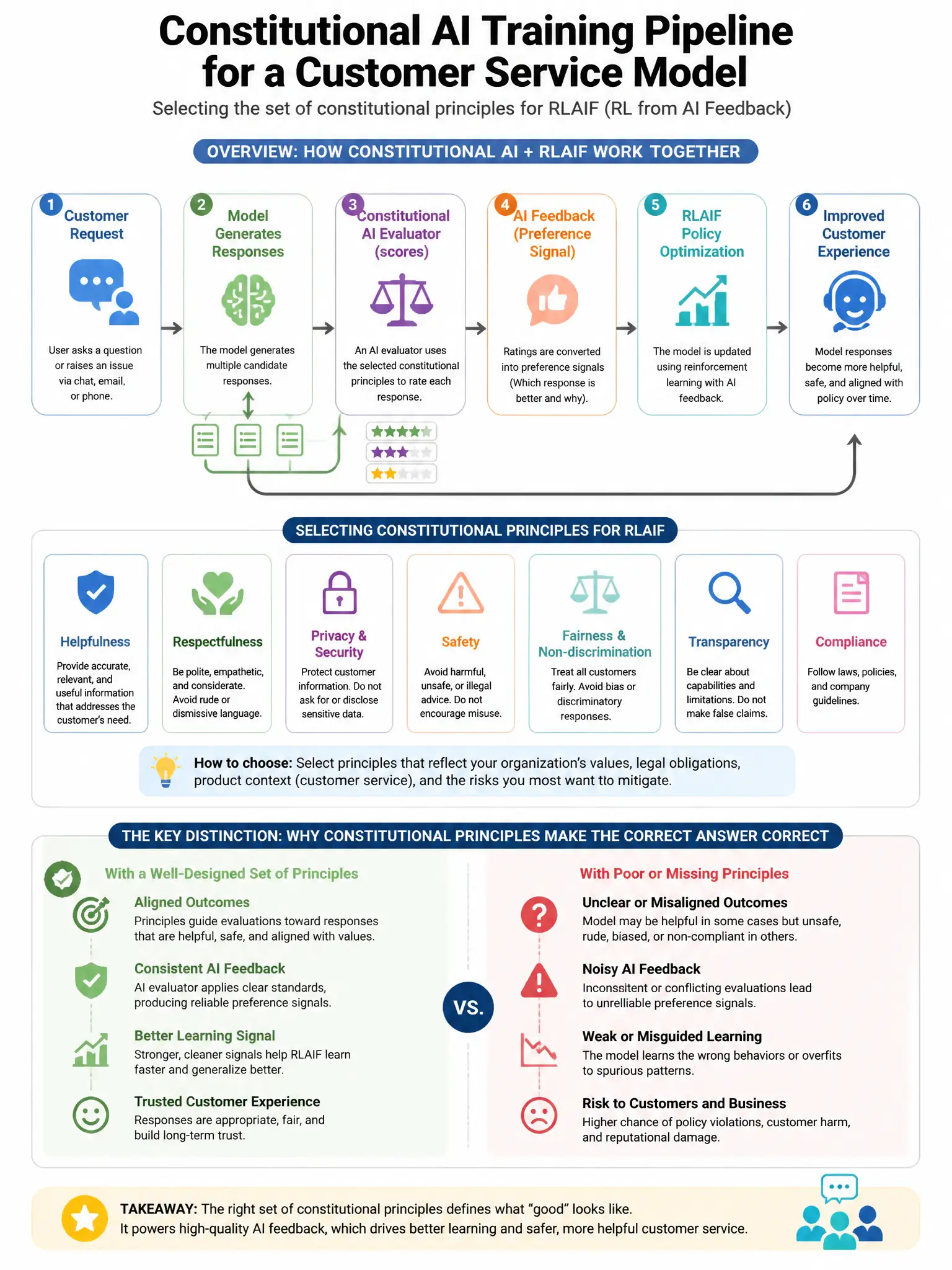
Here's the deal — you need more than 'be maximally helpful' because Constitutional AI exists to balance helpfulness, harmlessness, and honesty. If you drop the safety principles, the critique-revision loop just optimizes compliance, so you get an obsequious model that can be unsafe.
Full Explanation
Constitutional AI is specifically designed to encode the trade-off between helpfulness, harmlessness, and honesty. If the constitution reduces to 'be maximally helpful', it removes the tension between helpfulness and harmlessness from the training signal and removes the harmlessness and honesty components from the critique-revision loop. The critic model never learns to prefer safer or more honest revisions over compliant but harmful ones, so the loop optimizes for compliance without safety constraints, producing a model that is obsequious, sycophantic, and potentially unsafe under adversarial inputs. The degenerate reward model claim is wrong because, although diversity of training signal is a valid concern, the mechanism described is not how Constitutional AI operates; the critique step uses natural language principles, not gradient computation. The minimum principle count claim is wrong because there is no documented minimum principle count requirement in the Constitutional AI framework; Anthropic's published research used a moderate set of principles, not fifty or more. The binary classifier claim is wrong because constitutional principles in the Constitutional AI framework are expressed as natural language instructions, not binary classifiers; the pairwise preference format compares two revisions using the principle as the evaluation rubric.