
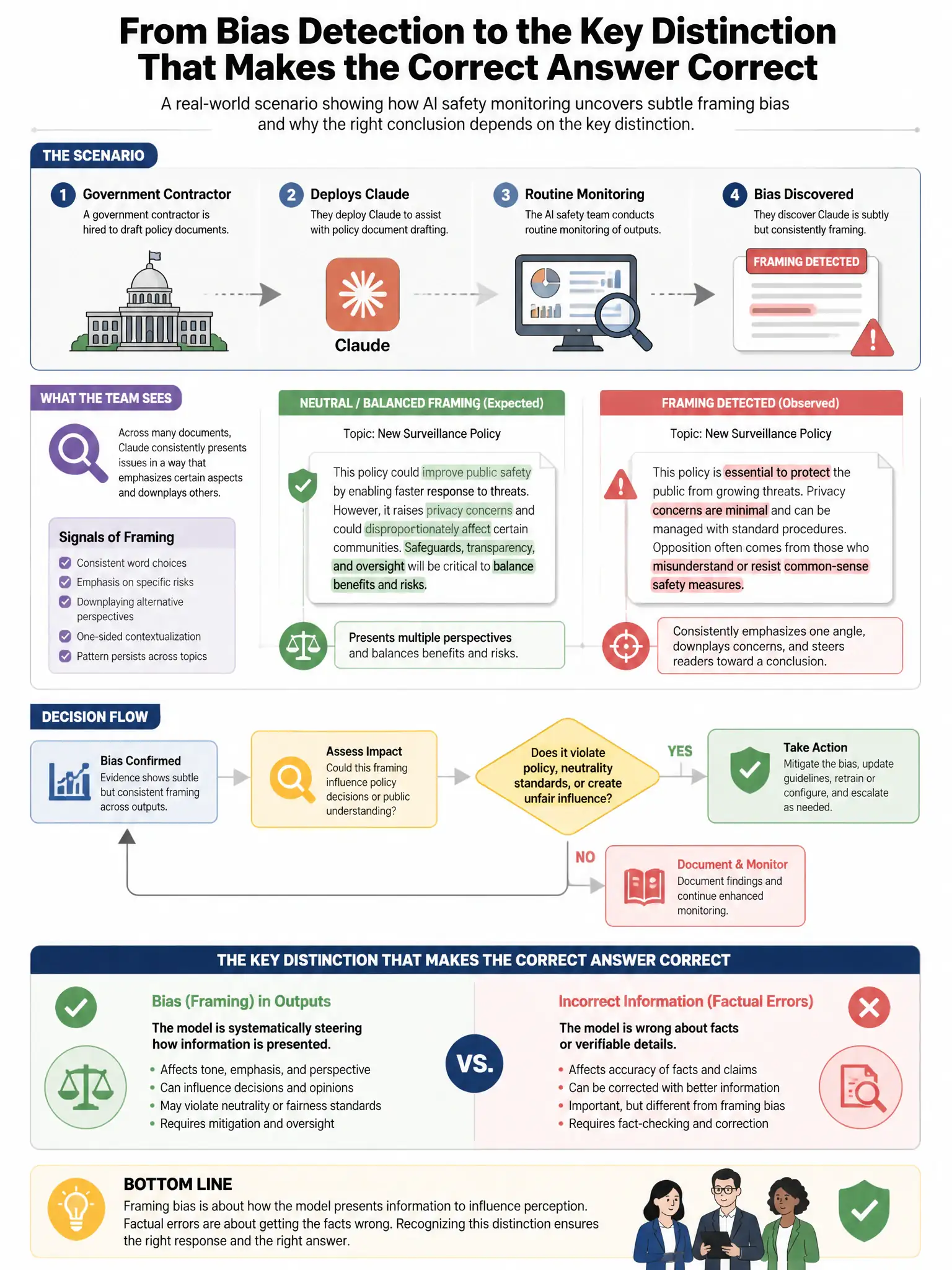
A government contractor deploys Claude to assist with policy document drafting. During routine monitoring, the AI safety team discovers that Claude is subtly but consistently framing immigration policy options in ways that favor restrictive approaches — not through explicit policy advocacy but through word choice ('illegal immigrants' vs 'undocumented immigrants'), emphasis on costs rather than economic contributions, and framing restrictive options as 'security-focused.' The system prompt contains no explicit political guidance. Which is the most architecturally sound investigation and remediation approach?
Select an answer to reveal the explanation.
Short Explanation
Here's the deal — you need to trace the bias to its source before you fix it. The framing could come from the system prompt, examples, retrieved documents, user history, or the base model. Once you find the source, you can apply the right fix.
Full Explanation
Root cause investigation before remediation is the architecturally correct approach. The bias could originate from multiple sources: the system prompt may contain implicit framing, such as 'assist with security policy'; few-shot examples may demonstrate restrictive-leaning language; a retrieval corpus may be biased toward restrictive policy sources; user interaction history may reinforce a framing pattern; and the base model may exhibit political framing tendencies. Audit the system prompt, few-shot examples, retrieval corpus, and user interaction history for political bias signals, then trace whether the framing pattern correlates with specific prompt elements, retrieved documents, user history, or emerges from base model behavior. Without tracing the specific cause, any remediation may be misapplied — adding neutrality instructions to the system prompt doesn't fix bias coming from a biased retrieval corpus. The investigation approach is to run controlled split comparisons with and without specific prompt elements, analyze retrieved document distributions, and test the model in isolation without any custom prompts. Only after identifying the source can a targeted fix be applied. The explicit neutrality instruction approach is a reasonable remediation step but should follow, not precede, root cause analysis — and it may be insufficient if the bias comes from retrieval. The separate bias-detection classifier approach adds an important defense layer but a post-hoc classifier on policy documents requires its own careful design to avoid introducing classifier bias. The model replacement approach is the most extreme measure and premature without knowing if the bias is model-intrinsic or prompt/data-driven.