
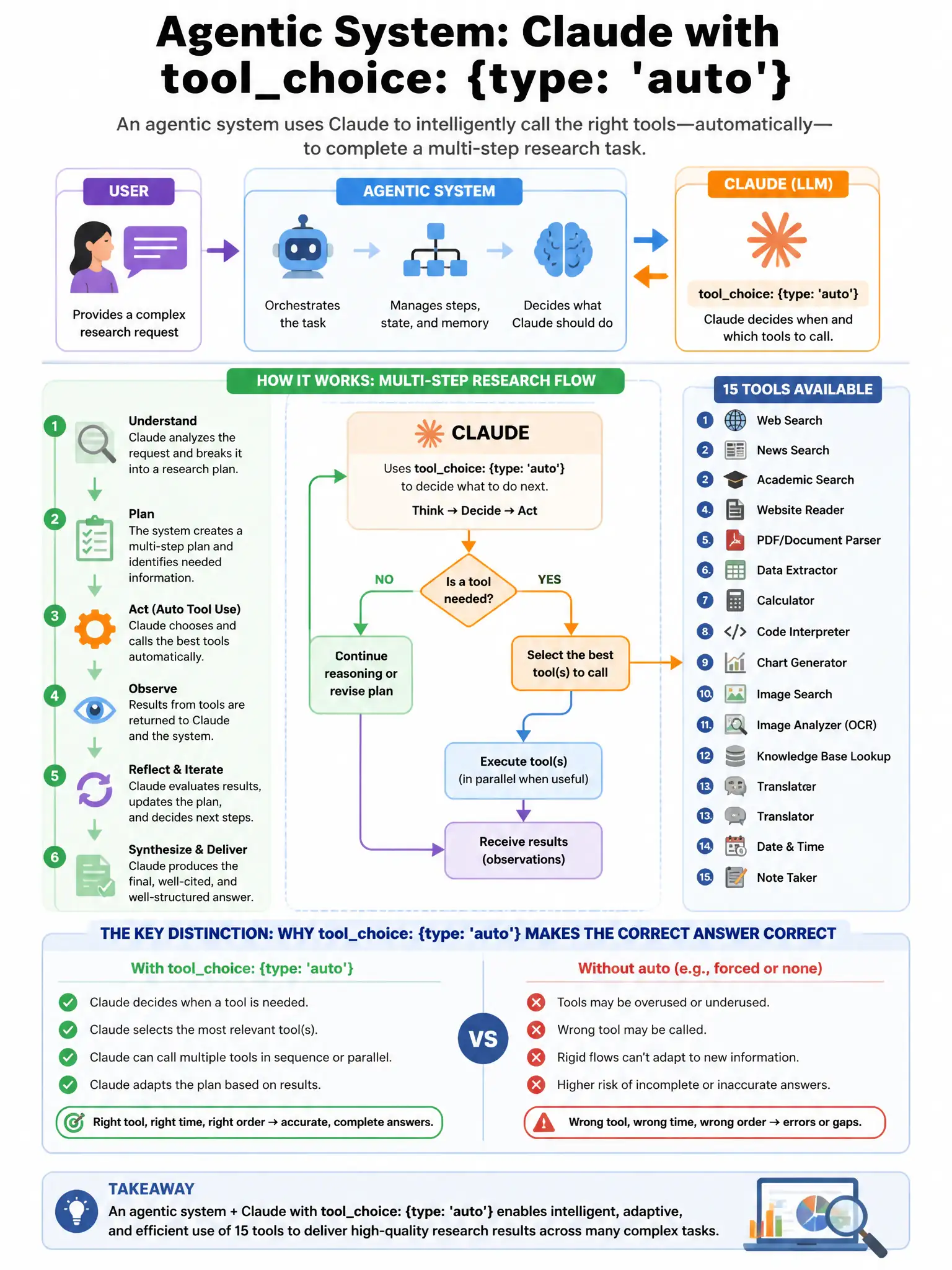
An agentic system uses Claude with tool_choice: {type: 'auto'} to call a set of 15 tools across a multi-step research task. The system processes a complex user request and Claude calls tools in sequence, with each tool result returned in subsequent messages. After 8 tool calls, the context window approaches 190,000 tokens. The system must complete the remaining analytical steps. Which approach correctly handles near-context-window situations in production agentic systems?
Select an answer to reveal the explanation.
Short Explanation
Here's the deal — when a long agentic loop gets near the context limit, you compress the conversation by summarizing accumulated tool results into a compact state, replace the raw tool blocks with that summary, and keep going. That keeps the key facts and task state while freeing room for the remaining steps.
Full Explanation
Context compression via summarization is the correct production pattern for long-running agentic loops approaching context limits. The implementation: before the next tool call, inject a meta-instruction for Claude to summarize what it has learned from the accumulated tool results, replace the verbose tool call/result blocks with a compact state summary, and continue. This preserves the semantic content (what was discovered) while freeing context space for subsequent reasoning steps. The summary must retain key facts, intermediate conclusions, and task state — not just truncate. The approach that increases max_tokens to extend the context window is factually wrong — max_tokens controls output generation length, not the input context window limit; the 200K limit is total context (input + output combined, or model-specific). The approach that switches to a streaming response and extracts a partial completion before context overflow misunderstands streaming — it doesn't extend context; it changes how output is delivered, not how context limits work. The approach that truncates the oldest messages from the conversation history is dangerous in agentic tasks — early messages often contain the original task specification, tool schemas, and critical constraints that ground all subsequent reasoning.