
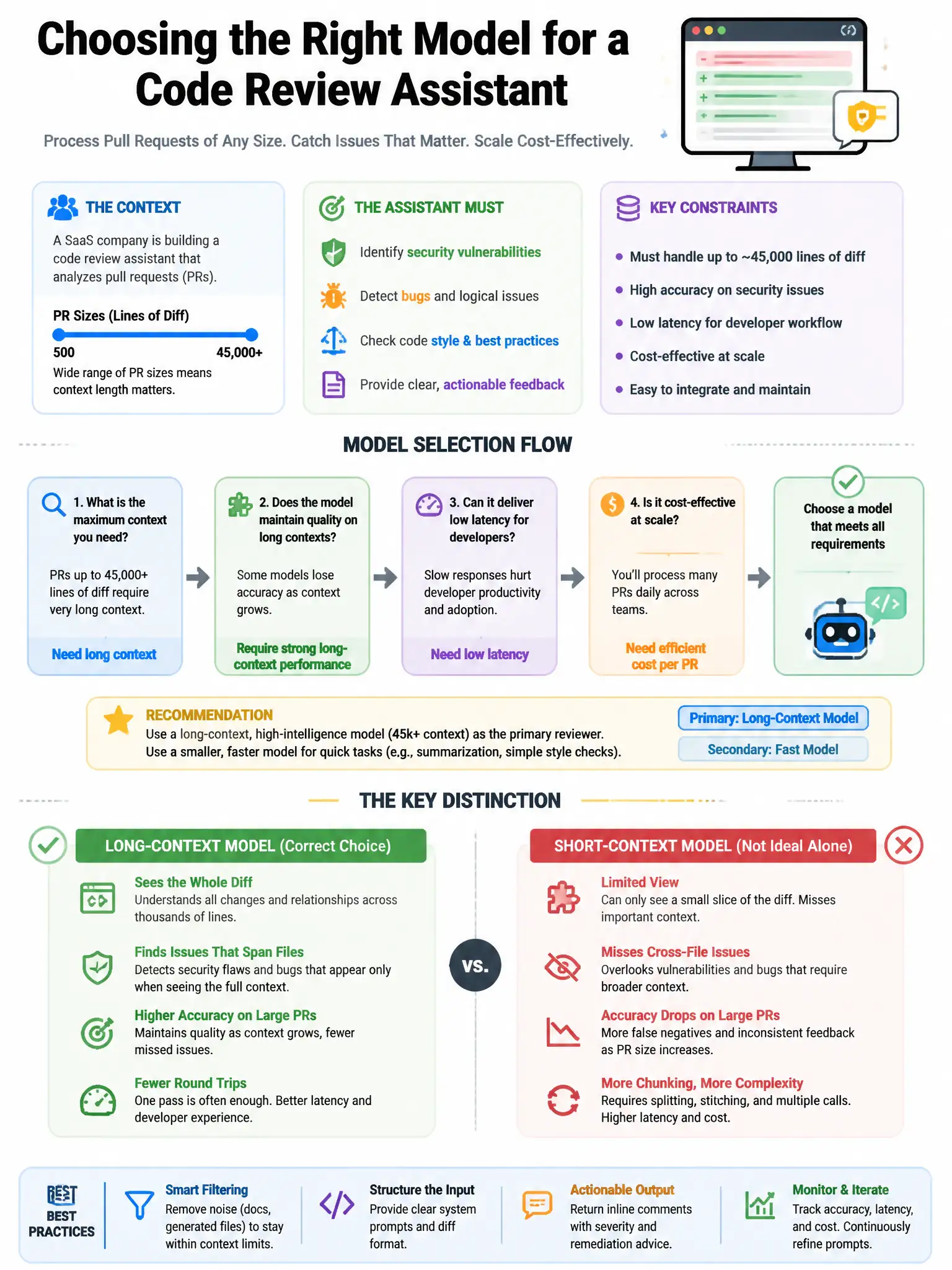
A SaaS company is evaluating model selection for a code review assistant that processes pull requests. PRs range from 500 to 45,000 lines of diff. The assistant must: identify security vulnerabilities, suggest performance improvements, enforce style guidelines, and explain its reasoning. The company's P99 PR size is 8,000 lines. A product manager argues that Claude 3 Haiku is sufficient 'because code review is just pattern matching.' The engineering team disagrees. Which argument most precisely captures why the engineering team is correct for the P99 case?
Select an answer to reveal the explanation.
Short Explanation
Here's the deal — the engineering team's strongest argument is cross-file reasoning coherence. Security vulnerabilities in production code are rarely simple single-file patterns; they emerge from interactions between components, like a variable tainted in one module, passed through another, and used unsanitized in a third. At P99 scale, that demands coherent understanding across many code modules, and that's where capability tier matters.
Full Explanation
The engineering team's strongest argument is cross-file reasoning coherence. Security vulnerabilities in production code are rarely simple single-file patterns — they emerge from interactions between components: a variable tainted in one module, passed through another, and used unsanitized in a third. This requires the model to maintain a mental model of the entire diff's semantics while evaluating each component. This is exactly where capability tier differentiates: higher-capability models maintain more coherent cross-context reasoning across large code diffs, which is especially important for the P99 case where an 8,000-line diff can contain many interacting files and functions.
The smaller-context-window argument is factually incorrect — all Claude 3 models support 200K context, so an 8,000-line diff (even at 10 tokens/line = 80,000 tokens) is within Haiku's context window. The style-versus-performance argument is partially correct about the performance reasoning point, but it incorrectly implies style enforcement is adequate for Haiku and, more importantly, it does not capture the most precise P99 argument: the question is about why Haiku is insufficient for the P99 security-review workload, not merely about style enforcement or general performance suggestions. The less-extensive-training argument makes an unsupported assertion about training data volume differences; the real differentiator is reasoning capability, not code training volume.