
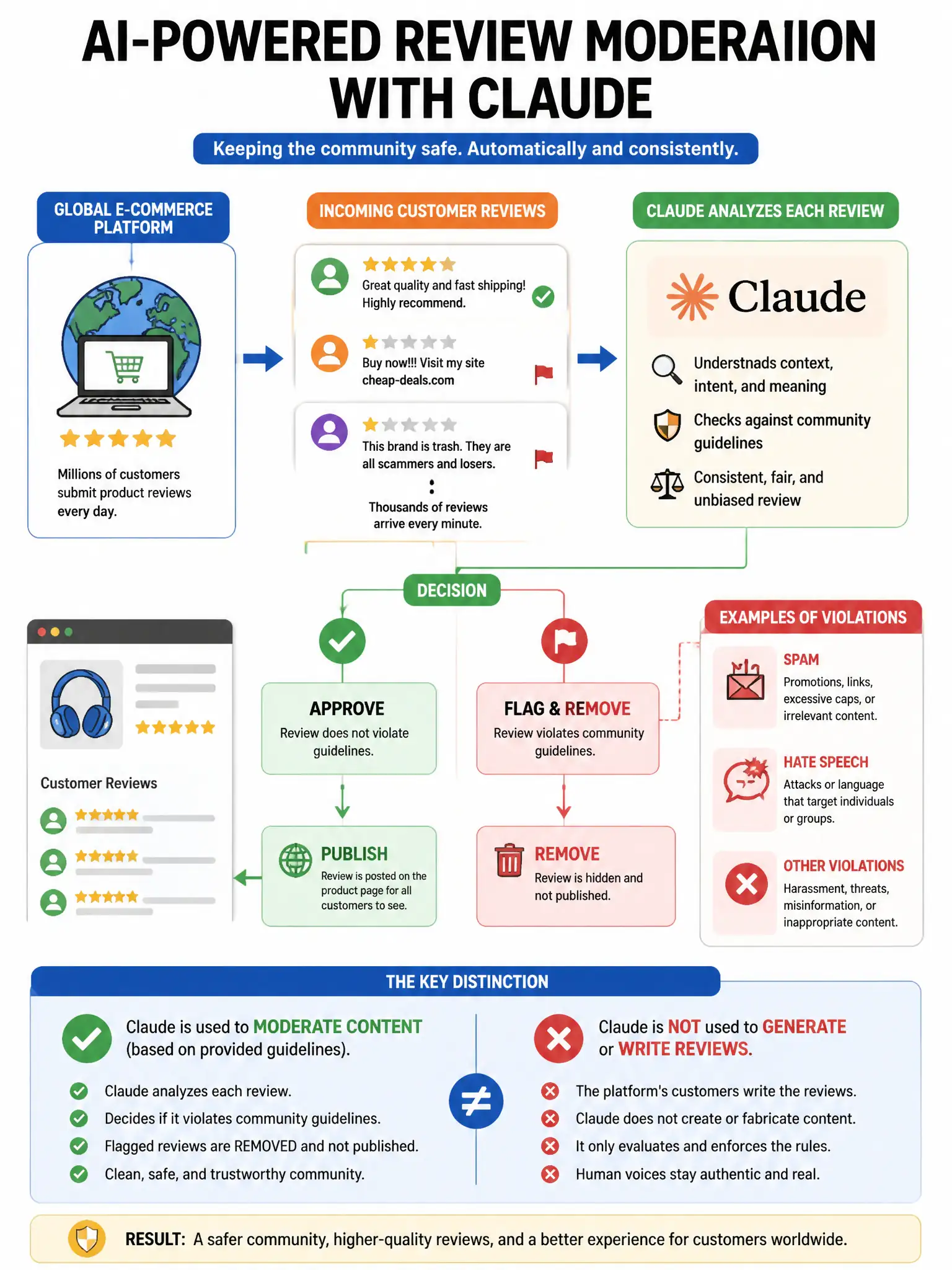
A global e-commerce platform uses Claude for automated customer review moderation. The system removes reviews flagged by Claude as violating community guidelines (spam, hate speech, false claims). During a post-deployment audit, the data team discovers a statistically significant disparity: reviews written in non-English languages are removed at 3x the rate of English reviews, even after controlling for actual policy violations. English-language spam is passing moderation at higher rates. What safety and ethics response is appropriate?
Select an answer to reveal the explanation.
Short Explanation
You’ve got a 3x disparate impact in an automated removal system, so pause removal for non-English reviews and investigate the root cause before you fix it. You need language-stratified benchmarks and per-language thresholds so you don’t keep harming non-English users.
Full Explanation
The 3x disparate impact on non-English content in an automated removal system is a significant fairness issue with real business and ethical consequences: it may remove legitimate non-English reviews at higher rates, harming non-English-speaking sellers and buyers, and it constitutes differential moderation quality across user demographics. The appropriate response is to immediately pause automated removal for non-English reviews, conduct a root cause analysis to determine whether the disparity is caused by language-specific prompt sensitivity, embedding model bias, or training data imbalance, then implement language-stratified evaluation benchmarks and adjust moderation thresholds per language. Running a biased system at full speed compounds harm. Root cause analysis is essential before remediation because the fix differs depending on cause: prompt sensitivity may require improved non-English examples, embedding bias may require switching embedding models, and threshold miscalibration may require per-language thresholds. The approach that expands English-language training examples in the system prompt addresses the wrong side of the disparity and doesn’t investigate the root cause. The approach that applies a statistical correction factor to non-English review removal rates is a crude post-hoc fix that may over-correct and doesn’t address the underlying model quality issue. The approach that switches from automated removal to automated flagging and human review for all non-English content is a reasonable temporary mitigation but operationally unsustainable at scale and treats non-English content as inherently requiring more scrutiny.