
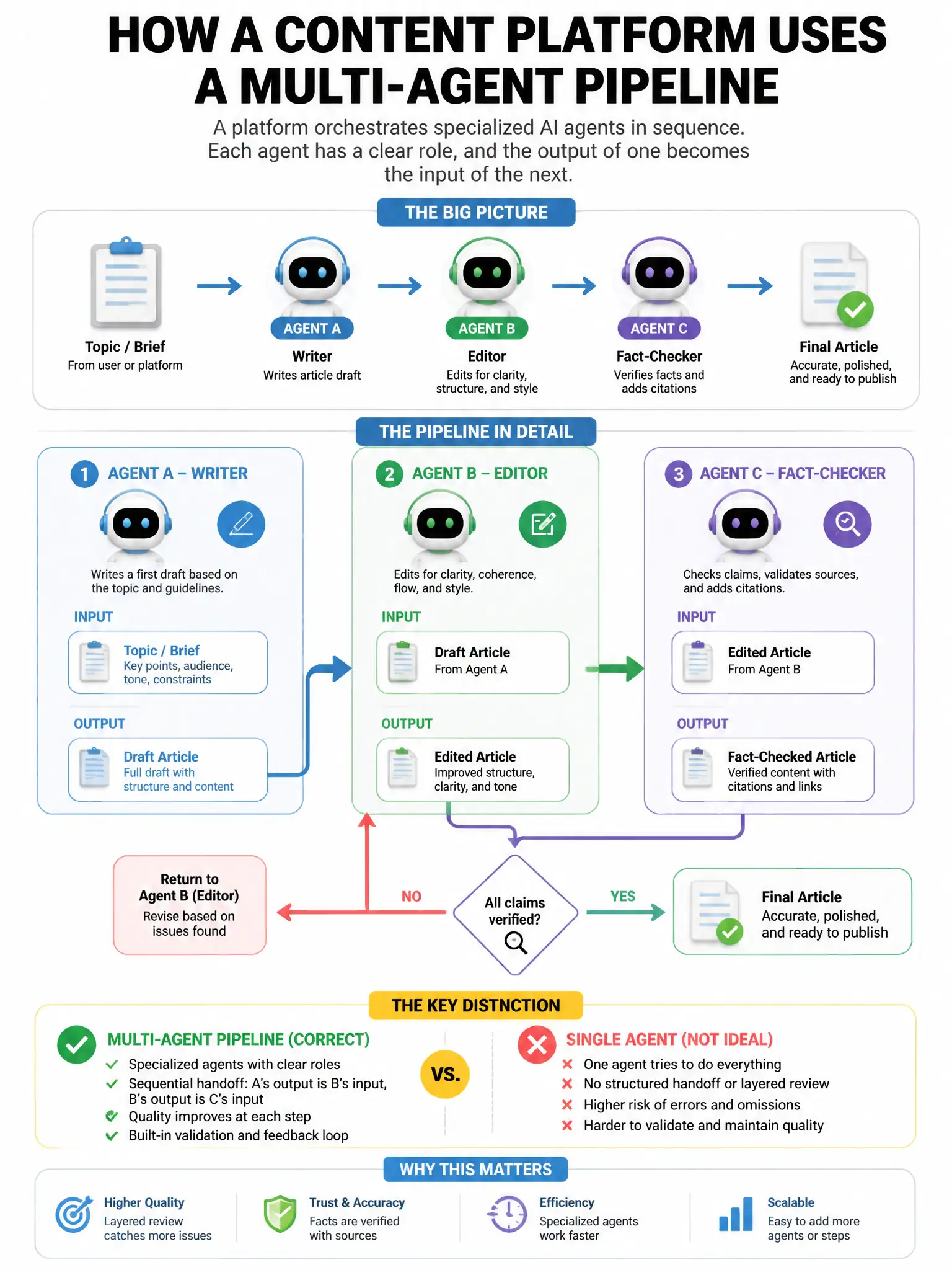
A content platform builds a multi-agent pipeline where Agent A writes an article draft, Agent B edits it, and Agent C fact-checks it. The agents are chained: A's output is B's input, B's output is C's input. In production, they observe that errors in Agent A's output propagate and compound through the chain — B edits with the assumption A's claims are correct, then C fact-checks B's version but misses A's original error because B's rephrasing obscures it. How should the pipeline architecture be redesigned to prevent error compounding?
Select an answer to reveal the explanation.
Short Explanation
Here's the deal — error compounding happens when the fact-checker only sees the edited draft, so the original claim gets buried. You fix it by giving the fact-checker both the original draft and the edited version, so it can verify the underlying claim without the edit obscuring it.
Full Explanation
Error compounding in sequential pipelines occurs when downstream agents operate only on transformed versions of upstream output, losing visibility into the original source of a claim. The fix is to pass both the original draft and the edited version to the fact-checking agent — preserving the original formulation of claims even as editing has changed their wording. The fact-checker can then verify the underlying assertions regardless of stylistic transformation. Running the drafting, editing, and fact-checking agents in parallel on the same source material eliminates the sequential dependency but loses the benefit of having the editing step improve the draft before fact-checking. Adding an explicit validation step that rejects drafts with factual errors before editing is an excellent defense, but it doesn't help when the drafting agent's error is subtle and passes initial validation — it catches obvious errors but not sophisticated factual mistakes. Extending the editing agent's prompt to include fact-checking responsibilities reduces the multi-agent benefit by making one agent responsible for both creative editing, which benefits from focus, and analytical fact-checking, which benefits from separate focus.