
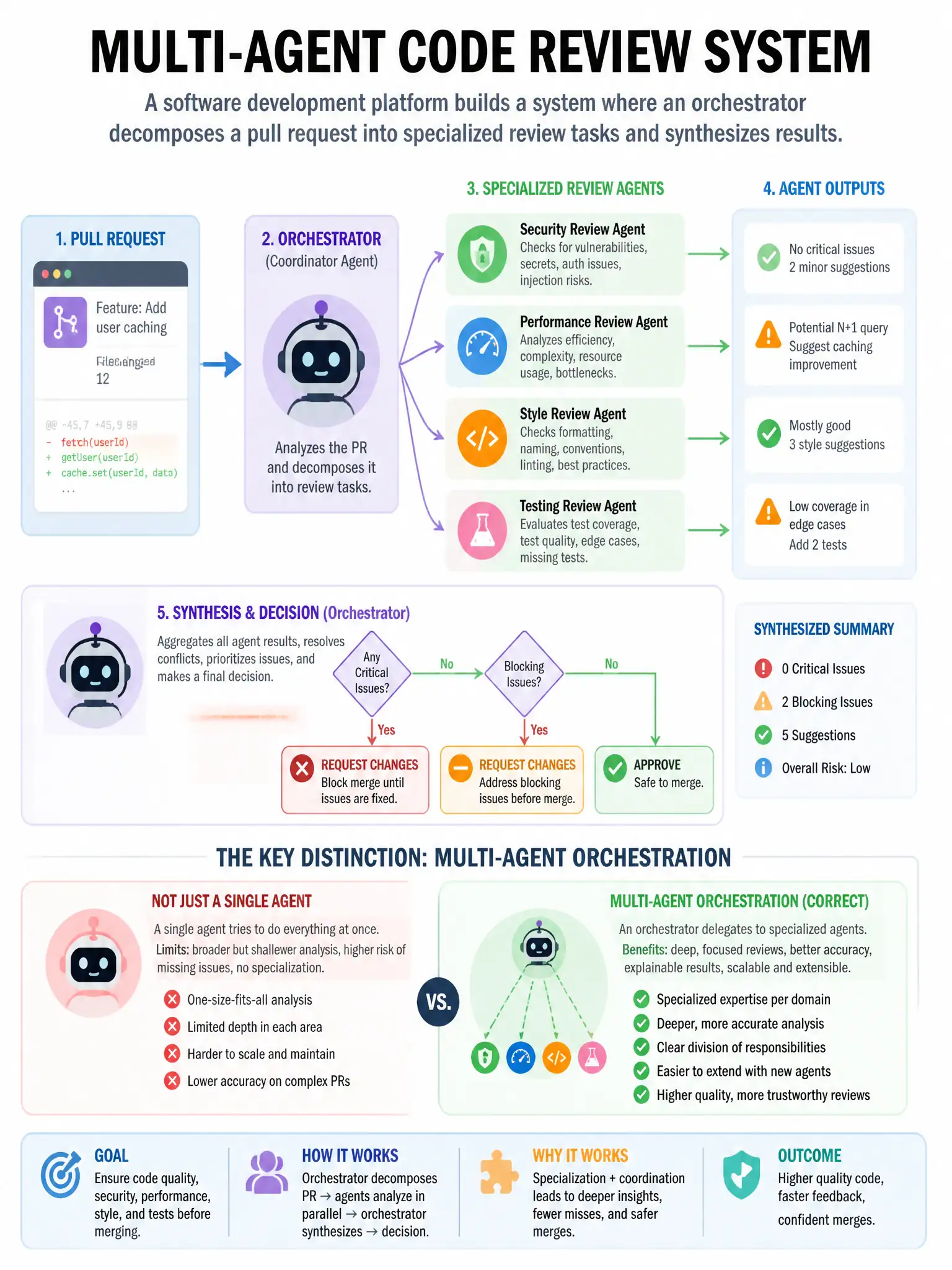
A software development platform builds a multi-agent code review system where an orchestrator decomposes a pull request into sub-tasks (security review, performance review, style review) and spawns specialized subagents for each. The orchestrator then synthesizes findings. The team notices that subagents occasionally produce contradictory findings — e.g., the security agent recommends adding input validation, while the style agent recommends simplifying the validation logic it doesn't realize is security-critical. How should the MCP-based orchestration protocol handle conflicting subagent outputs?
Select an answer to reveal the explanation.
Short Explanation
Here's the deal — let the orchestrator explicitly detect semantic conflicts, surface them as a structured conflict report, and instruct synthesis Claude to reason with full context from both specialized agents before producing recommendations. You keep the benefits of parallel subagents while getting a holistic tradeoff instead of blindly overriding one agent.
Full Explanation
Semantic conflict detection and explicit synthesis is the architecturally correct approach. The orchestrator has full context from all subagents and can identify when agents are reasoning about the same code from different perspectives. Surfacing conflicts explicitly in the synthesis prompt — 'Security agent recommends one change for one reason; Style agent recommends another change for another reason; these are in conflict' — allows the synthesis Claude to reason holistically about the tradeoff. Often the resolution requires domain expertise that neither specialized agent has alone (e.g., 'the security validation is complex but necessary; simplify the surrounding non-security code instead'). Running all subagents sequentially rather than in parallel allows agents to see prior findings but eliminates parallel execution benefits and introduces ordering bias — style may defer to security rather than independently assess. Assigning priority rankings such as security > performance > style and automatically preferring the higher-priority agent's recommendation eliminates nuanced tradeoffs — sometimes style concerns legitimately override security paranoia when risk is negligible. Implementing a voting mechanism where majority subagent opinion wins fails for specialist disagreements where the minority may be correct (1 security agent vs. 2 style agents).