
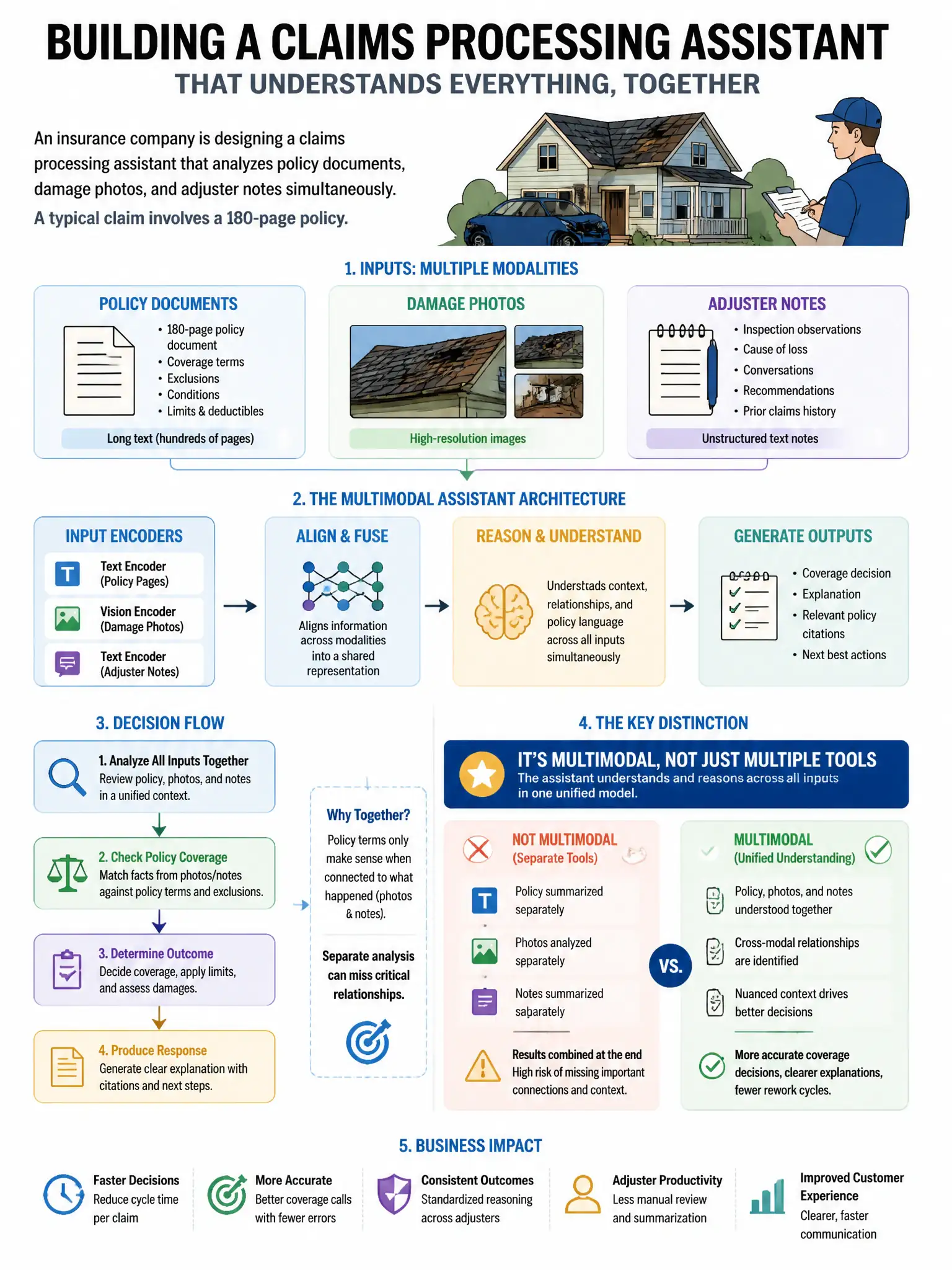
An insurance company is designing a claims processing assistant that analyzes policy documents, damage photos, and adjuster notes simultaneously. A typical claim involves a 180-page policy PDF, 12 damage photos, and 8,000 words of adjuster notes. The architect must choose between (1) multiple specialized Claude instances processing each modality separately, or (2) a single multimodal Claude call with all inputs. The company prioritizes claim consistency and cross-modality reasoning. Which approach is architecturally superior and why?
Select an answer to reveal the explanation.
Short Explanation
Here's the deal — you need one multimodal Claude call because claim consistency comes from cross-modal reasoning, like matching photo damage to policy exclusions and adjuster notes in the same context. Separate instances can't share that unified view, so you lose the correlative reasoning that catches inconsistencies and edge cases.
Full Explanation
Claims consistency depends heavily on cross-modal reasoning — for example, a photo showing pre-existing rust must be weighed against the policy exclusion language and the adjuster's written assessment simultaneously. Separating these into independent instances loses the correlative reasoning that catches inconsistencies and edge cases. Claude's 200K token context window easily accommodates 180 pages (~90K tokens), 12 images, and 8,000 words of notes within a single call. The multiple specialized instances approach, justified by parallel latency and per-modality optimization, would require a separate aggregation step that cannot reason natively across modalities. The multiple specialized instances feeding summaries to a final aggregation Claude call loses detail from the source documents. The claim that a single multimodal Claude call is not feasible because 180 pages plus 12 images plus 8,000 words exceeds Claude's context window is factually incorrect — 200K tokens is sufficient for this workload; 180 pages of PDF text typically renders to 45,000-72,000 tokens, well within limits.