
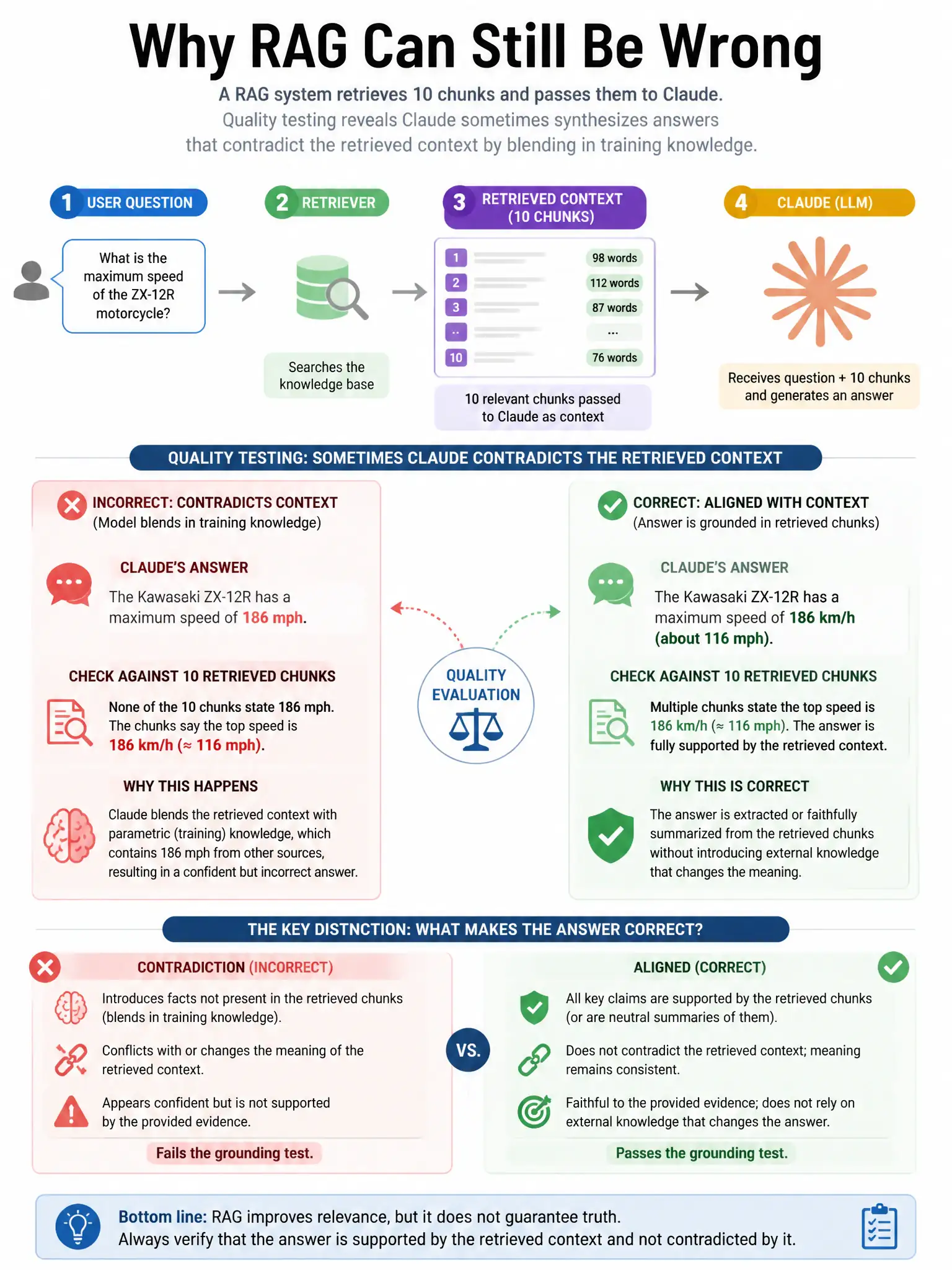
A RAG system retrieves 10 chunks and passes them to Claude. Quality testing reveals Claude sometimes synthesizes answers that contradict the retrieved context by blending in training knowledge. What prompt engineering change most directly addresses this grounding failure?
Select an answer to reveal the explanation.
Short Explanation
Here's the deal — when Claude blends training knowledge with retrieved chunks, you've got a grounding problem, not a retrieval problem. Tell it to answer only from the provided context, say when the answer isn't there, and wrap the context in clear XML tags.
Full Explanation
The failure mode — Claude blending training knowledge with retrieved context — is a grounding problem, not a retrieval problem. The correct change is to add explicit grounding instructions combined with structural clarity: instruct Claude explicitly that it must only use the provided context, define the fallback behavior when context is insufficient ('state that information is not available'), and use XML tags to clearly delimit the retrieved context from the question. This gives Claude an unambiguous behavioral constraint. Retrieving more chunks (20-30) increases context noise and doesn't address the instruction gap — Claude will still blend training knowledge with a larger context. Using a higher-quality embedding model improves retrieval quality but doesn't constrain Claude from using training knowledge when retrieved context seems incomplete. Lowering the temperature to 0.0 affects randomness, not grounding — a deterministic Claude can still confidently produce training-knowledge-blended answers.