
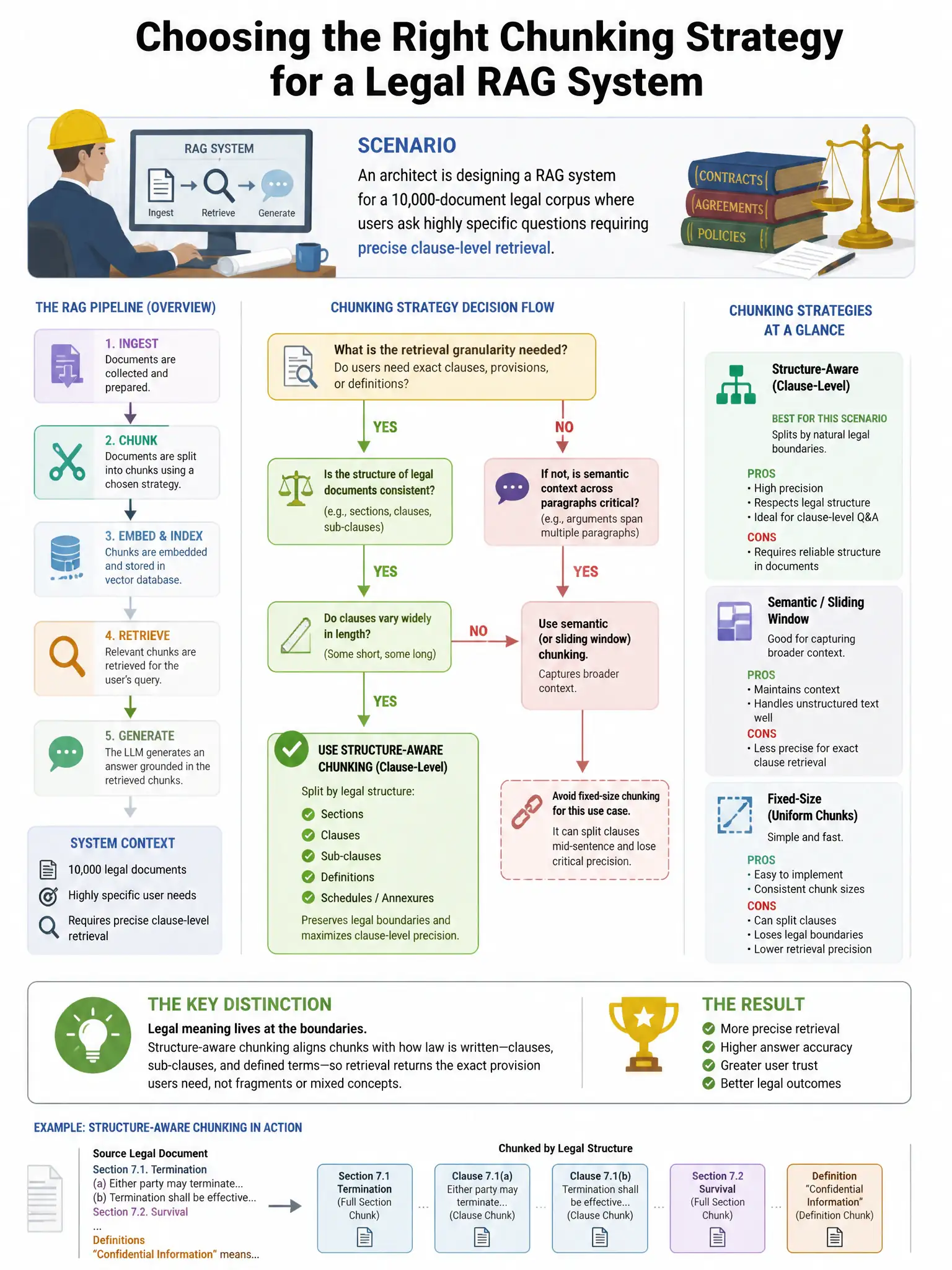
An architect is designing a RAG system for a 10,000-document legal corpus where users ask highly specific questions requiring precise clause-level retrieval. Which chunking strategy is most appropriate?
Select an answer to reveal the explanation.
Short Explanation
You need semantic/hierarchical chunking here because legal clauses only make sense inside their sections and documents. It gives you precise clause retrieval while keeping parent sections available for context.
Full Explanation
Hierarchical/semantic chunking is optimal for legal documents because legal meaning is inherently hierarchical: a clause only makes sense in the context of its section, which only makes sense in the context of the document's structure. Parent-child chunking enables precision retrieval, using child chunks for specific clauses, while maintaining context, because parent chunks provide surrounding structure. This addresses both precision and context needs. Document-level chunking retrieves too much irrelevant content per chunk, overwhelming Claude's context and diluting relevance signals. Fixed-size character chunking cuts across legal structure arbitrarily, splitting clauses mid-sentence and destroying legal meaning at boundaries. Sentence-level chunking maximizes precision but loses the surrounding context that makes individual sentences legally meaningful; sentences like 'This obligation shall not apply' are meaningless without their preceding clause.