
A production system using Claude for medical information queries experiences hallucinations where Claude cites non-existent studies. The system provides Claude with a retrieved context from a verified medical database. What prompt engineering change most directly reduces citation hallucination?
Select an answer to reveal the explanation.
Short Explanation
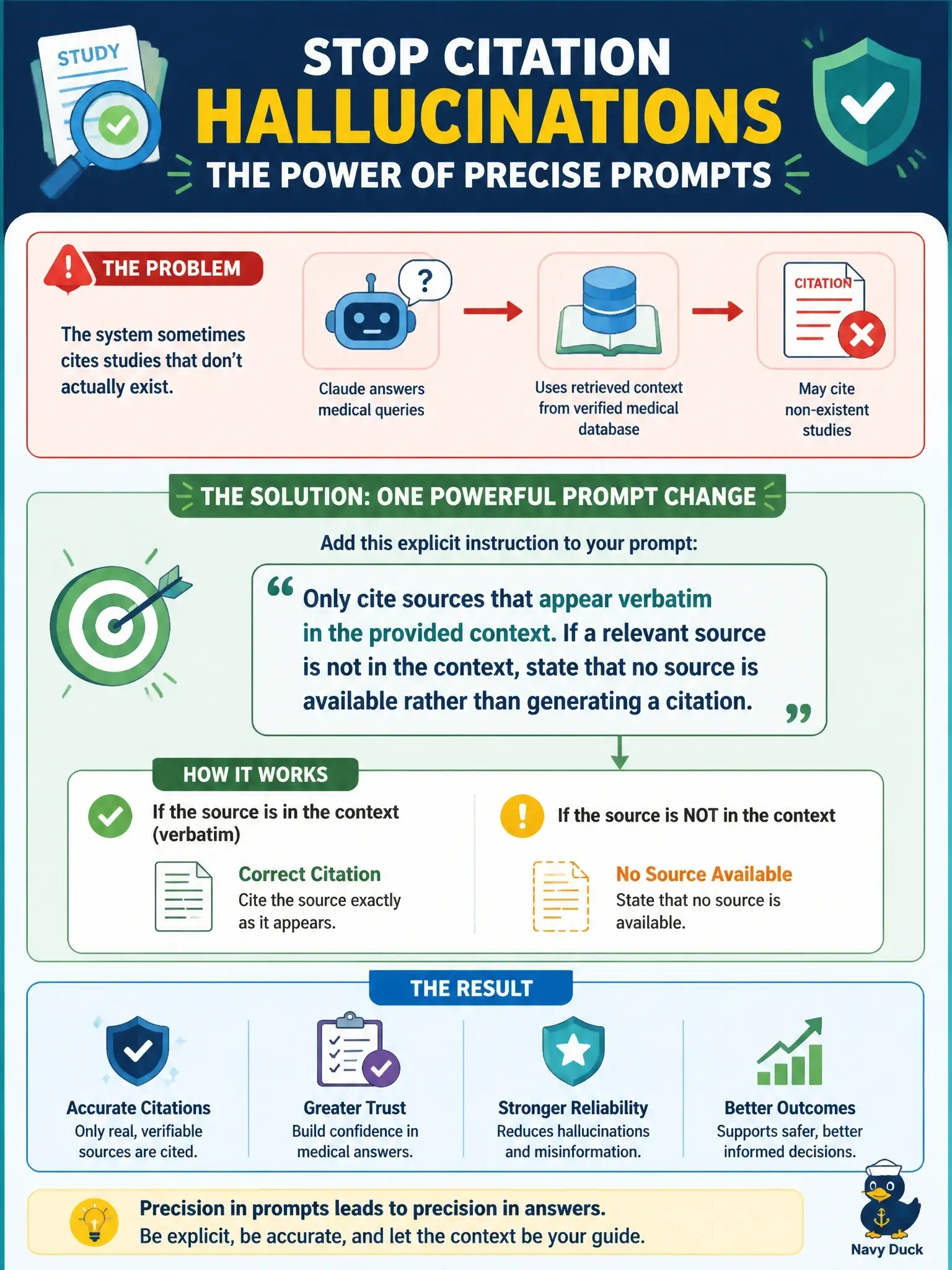
Here's the deal — you need explicit instructions that tell Claude to cite only sources appearing verbatim in the provided context and to say no source is available when one isn't there. That sets the grounding rule and fallback directly, so it cuts fabricated citations at the source.
Full Explanation
Reducing citation hallucination in retrieval-augmented systems requires grounding citations to the retrieved context. The most direct prompt change is explicit instructions: cite only sources that appear verbatim in the provided context, and if a relevant source is absent, state that no source is available rather than generating a citation. This sets the acceptable citation boundary and gives Claude a safe fallback, so it does not invent plausible references. Lowering temperature to 0.1 reduces randomness but does not address the structural grounding problem; fabricated citations are primarily a grounding issue, not a temperature issue. Increasing max_tokens so Claude has room to reproduce the full reference list does not reduce hallucination, because extra output space does not make citations grounded and may allow more unsupported text. Few-shot examples showing correct refusal can demonstrate the desired behavior, but examples alone are incomplete because they lack an explicit rule and fallback; instructions alone can be overridden by helpful tendencies, yet the explicit instruction is the most direct change because it states the rule and fallback at the prompt level.