
An architect is implementing error handling for a Claude API integration. The system receives a 400 Bad Request with error type invalid_request_error. Which action is appropriate?
Select an answer to reveal the explanation.
Short Explanation
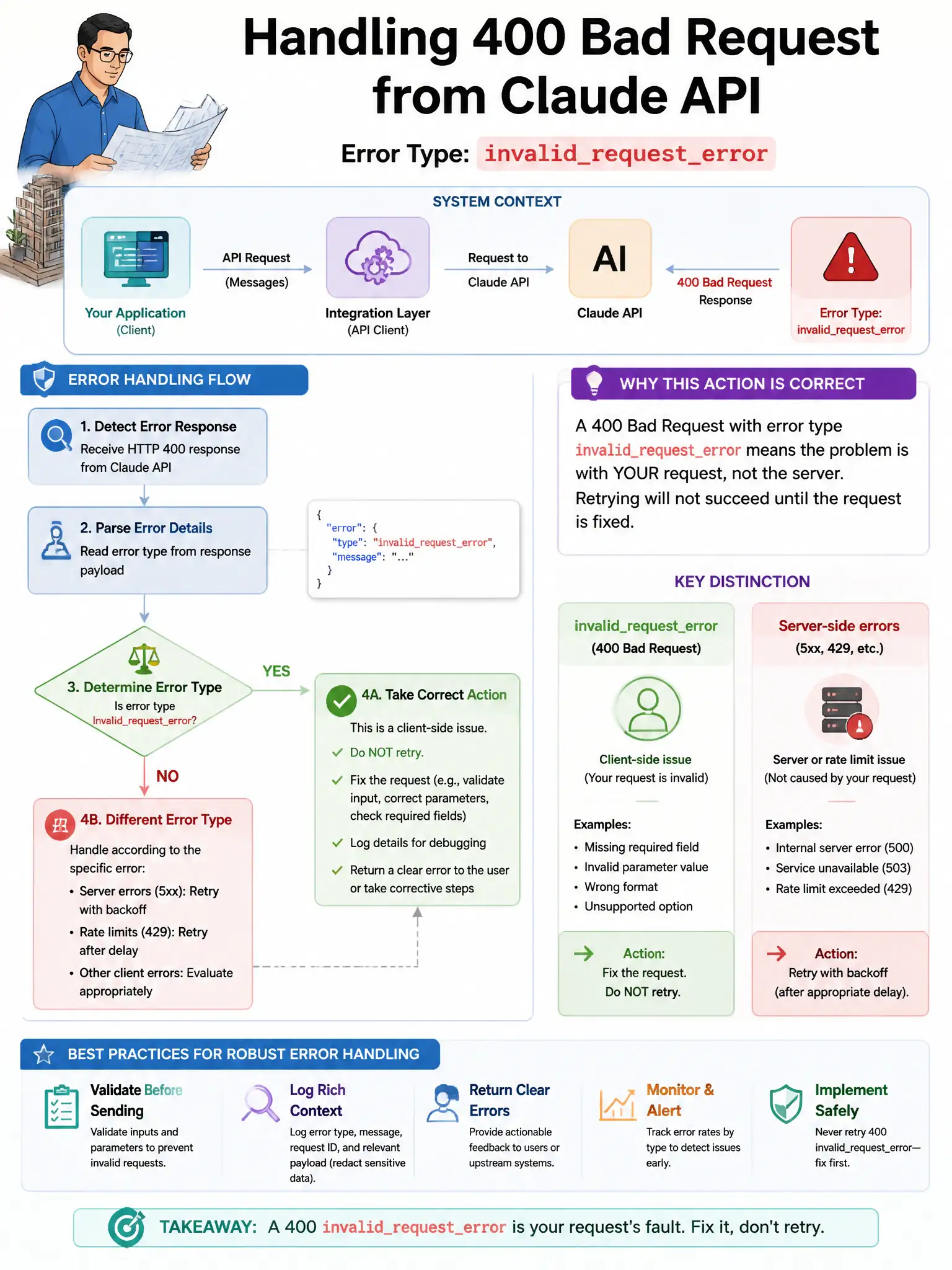
Here's the deal — a 400 invalid_request_error is a client-side problem in the payload, so you inspect the error message, fix the request, and send a corrected version. Retrying the same bad request just fails again.
Full Explanation
A 400 invalid_request_error indicates a client-side error in the request payload — invalid parameters, malformed JSON, missing required fields, or context length exceeded. These errors are deterministic: retrying the same request will always fail. The correct response is to parse the error message, which contains specific details about the failure, identify the validation issue, correct the payload, and submit a fixed request. The retry-with-exponential-backoff approach is correct for 5xx and 529 errors, never for 4xx client errors — retrying an invalid payload wastes tokens and time without any chance of success. The escalate-to-next-model-tier approach is incorrect because 400 errors are payload problems, not model capability limitations. The dead-letter-queue-for-manual-review approach is overly conservative because most 400 errors, such as malformed input, token count too large, or a missing required field, are straightforwardly fixable in code.