
A production API integration is experiencing 529 Overloaded errors during peak traffic periods despite being within published rate limits. An architect is tasked with improving reliability. Which combination of strategies is most appropriate?
Select an answer to reveal the explanation.
Short Explanation
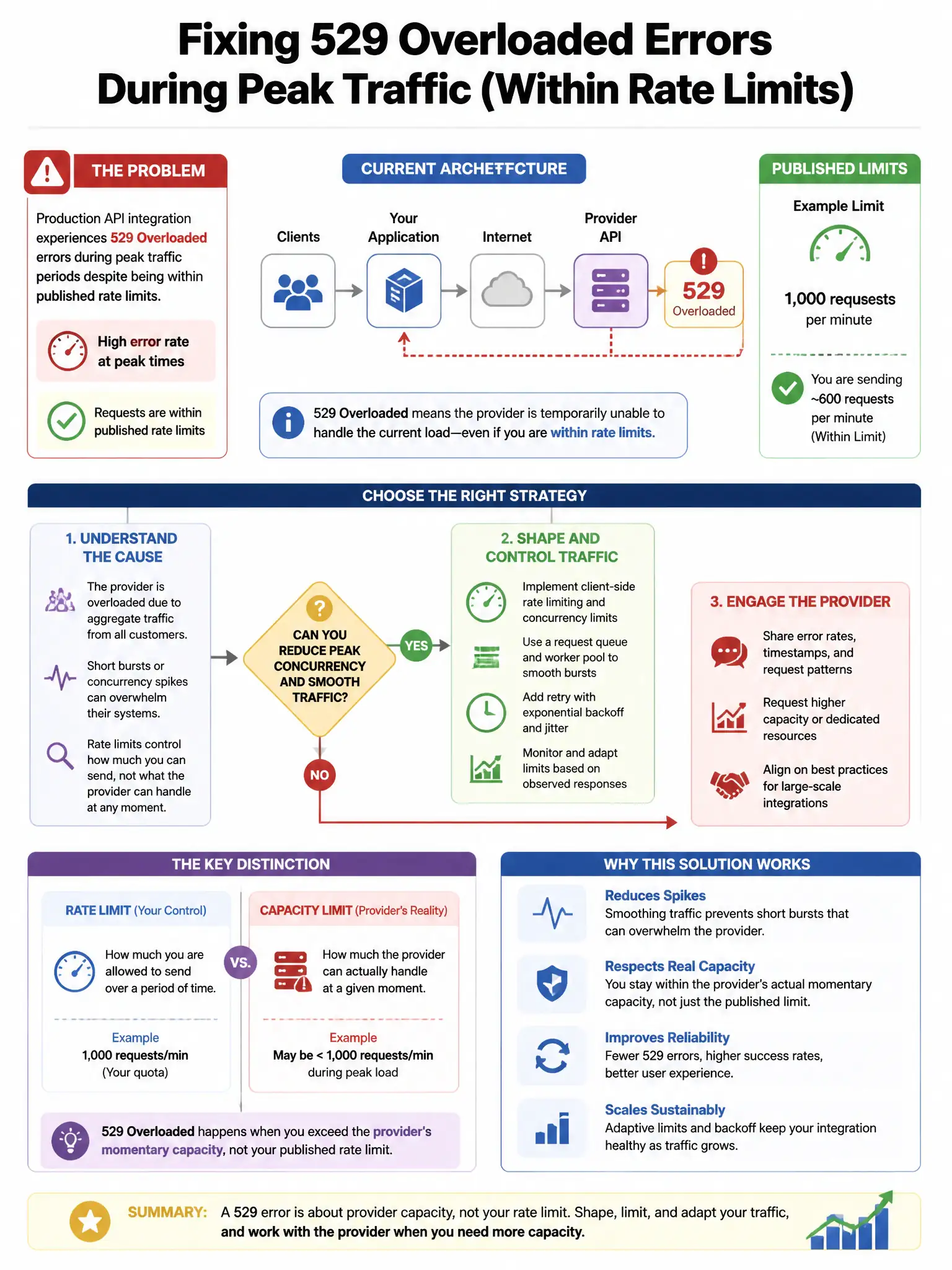
Here's the deal — 529 Overloaded errors mean the service is temporarily overloaded, not that you're violating published rate limits. You should retry with exponential backoff and jitter, queue requests with concurrency limits, and send non-time-sensitive work to the Batches API.
Full Explanation
529 Overloaded errors indicate temporary server-side capacity constraints, not client-side rate limit violations. The most appropriate combination is exponential backoff with jitter on 529 errors, a client-side request queue with configurable concurrency limits, and use of the Batches API for non-time-sensitive workloads: backoff with jitter spreads retry load and avoids thundering herd, concurrency limiting prevents request pile-up during recovery, and the Batches API offers better availability guarantees during peak loads for workloads that don't require real-time responses. The strategy of increasing the API subscription tier to eliminate 529 errors and retrying at fixed 1-second intervals is wrong because a subscription tier change does not eliminate server-side overload, and fixed-interval retries can cause thundering herd behavior and worsen overload conditions. The strategy of caching all API responses in Redis with a 24-hour TTL is wrong because caching is valid for identical requests but doesn't address the underlying overload handling architecture. The strategy of switching to a different Claude model tier is wrong because 529 errors are not model-specific capacity issues; switching models does not resolve server-side overload.