
An architect is evaluating Claude's vision capabilities for a medical imaging triage system that receives JPEG scans and must flag images requiring urgent radiologist review. Which statement most accurately characterizes Claude's vision capabilities and appropriate architectural constraints?
Select an answer to reveal the explanation.
Short Explanation
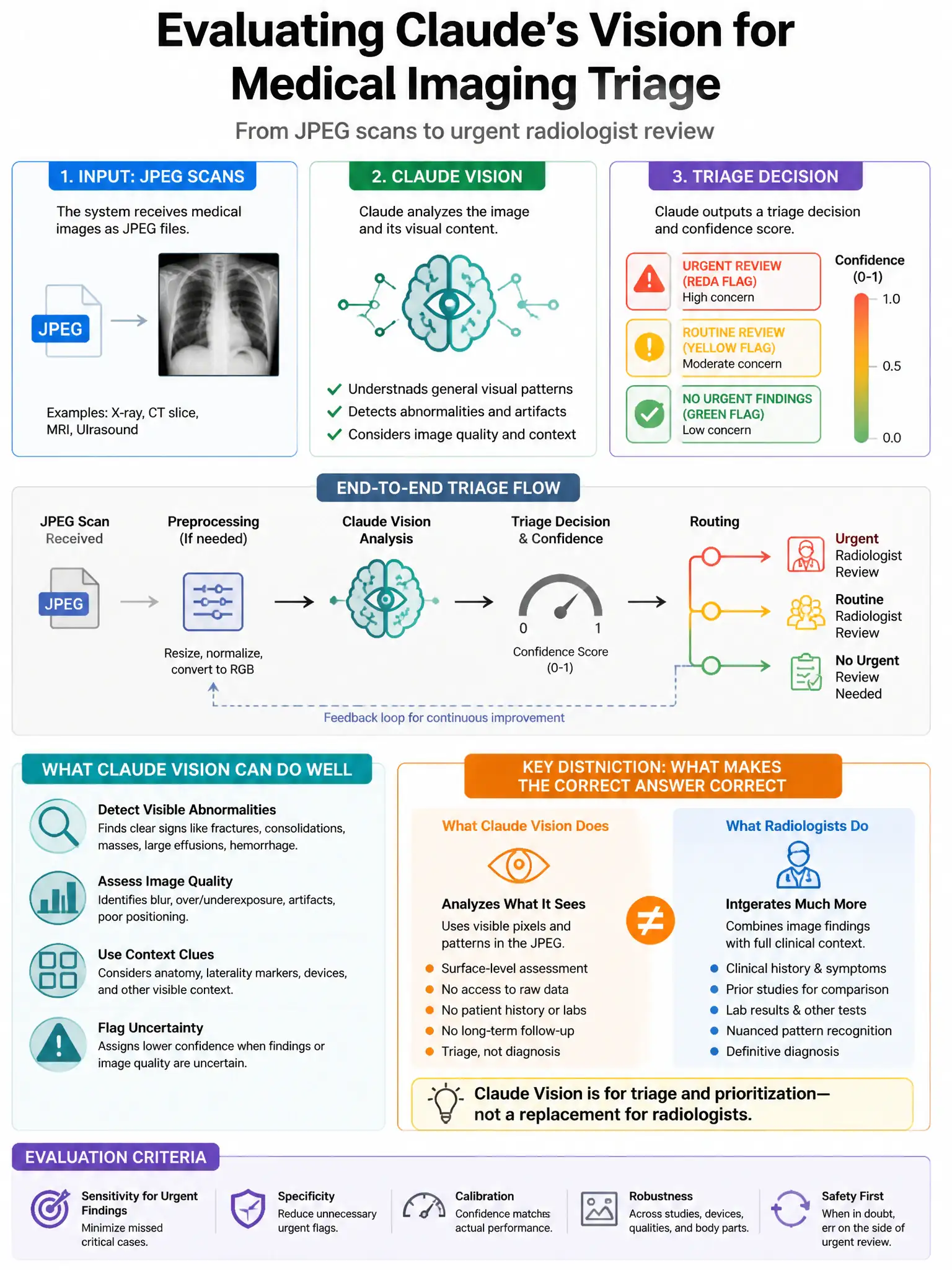
Claude can look at scans and spot general patterns or anomalies, but it isn't a certified diagnostic tool. You must treat its output as a pre-screening signal and require a radiologist to validate it before any clinical decision.
Full Explanation
Claude's vision capabilities enable it to analyze visual content and describe patterns, anomalies, or features in images — including medical scans — but it is not a certified medical diagnostic tool. Architecturally, any system using Claude for medical triage must treat its output as a pre-screening signal, with mandatory human (radiologist) review before any clinical decision. This reflects both Claude's actual capability boundary and responsible AI deployment principles. The claim that Claude's vision is optimized for medical imaging and can provide diagnostic-grade analysis suitable for clinical decision support overstates Claude's fitness for clinical decision support without human oversight. The claim that Claude's vision only supports text extraction from images and cannot perform pattern recognition on medical scans understates Claude's vision — it goes far beyond optical character recognition to genuine image understanding. The claim that Claude's multimodal capabilities require images to be converted to base64 PNG format and that JPEG inputs are not supported by the API is factually incorrect; Claude accepts both JPEG and PNG inputs in base64 or URL form via the API.