
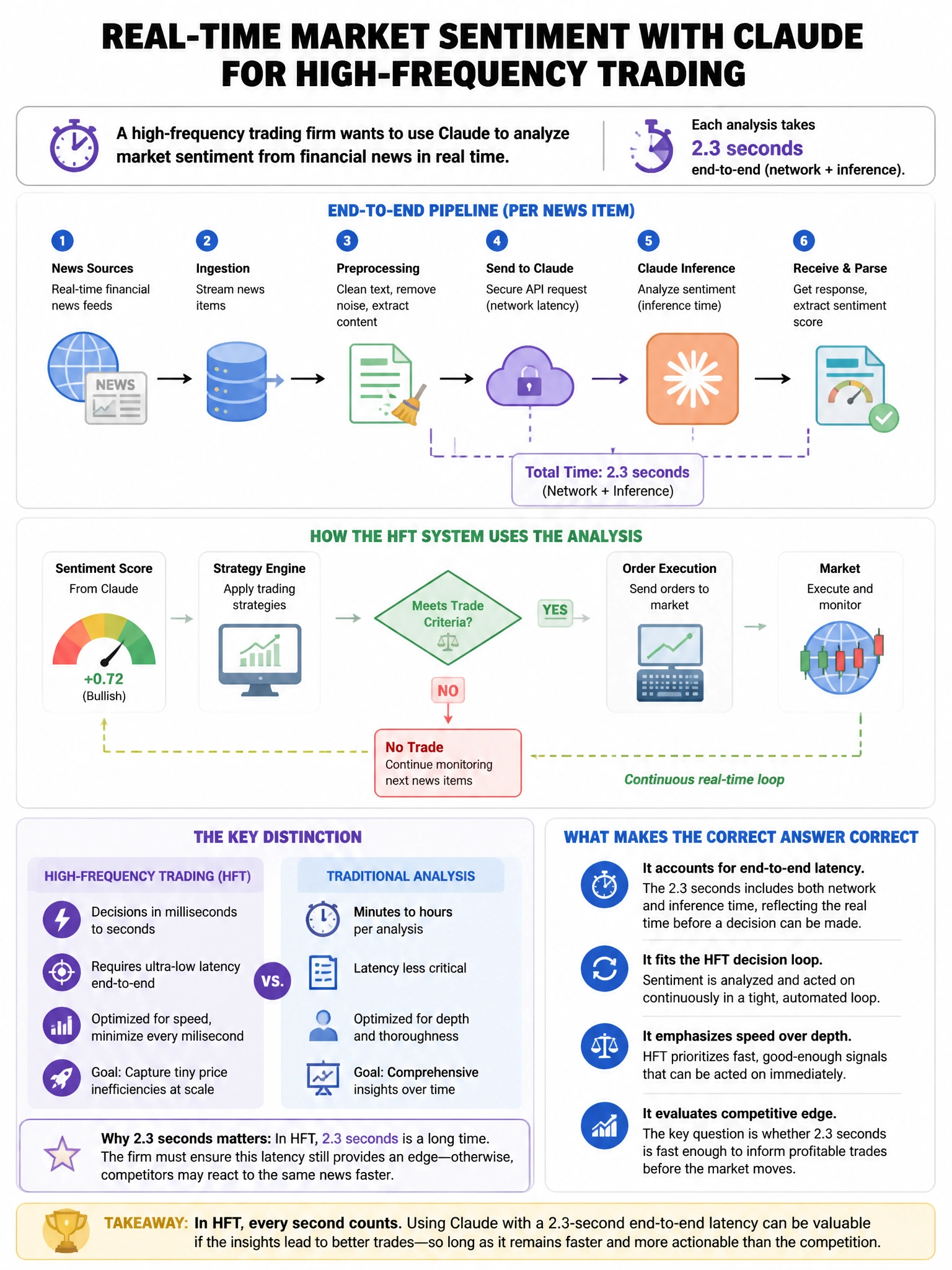
A high-frequency trading firm wants to use Claude to analyze market sentiment from financial news in real time. Each analysis takes 2.3 seconds end-to-end (network + inference). The system needs to analyze 500 news articles per minute. How many concurrent API connections must the architect provision, and what rate limit considerations apply?
Select an answer to reveal the explanation.
Short Explanation and Infographic
Here's the deal — a is correct by Little's Law: throughput (500/min) × latency (2.3s/60s per minute ≈ 0.038 min) = 19.2 concurrent connections. The architect needs approximately 20 concurrent API connections to sustain this throughput.
Full explanation below image
Full Explanation
A is correct by Little's Law: throughput (500/min) × latency (2.3s/60s per minute ≈ 0.038 min) = 19.2 concurrent connections. The architect needs approximately 20 concurrent API connections to sustain this throughput. The critical planning insight is that new API accounts start at conservative rate limits (both requests per minute and tokens per minute), and reaching 500 RPM throughput typically requires requesting a rate limit increase from Anthropic in advance — not just provisioning connections. B is wrong because the Claude API does not manage client concurrency server-side in a way that allows a single connection to submit 500 requests per minute with sub-second scheduling; client-side concurrency management is required. C is wrong because 500 concurrent connections is a severe over-provision — connections do not need to be held open for the duration of a request in the standard HTTP API pattern, and far fewer concurrent connections can sustain 500 RPM. D is wrong because 500 articles per minute with 20 concurrent connections is well within the Claude API's technical capability at appropriate rate limit tiers — on-premises deployment is not required.