
An organization wants to use Claude to generate synthetic training data for a hate speech detection classifier. The task requires generating examples of subtle hate speech (dog whistles, coded language, indirect slurs) that the classifier needs to learn to detect. How should the architect frame this request to work within Claude's safety constraints while achieving the legitimate research goal?
Select an answer to reveal the explanation.
Short Explanation and Infographic
Here's the deal — b is correct because generating synthetic hate speech examples for classifier training is a legitimate AI safety research use case that Claude can engage with when the context is clearly established as professional research. The key elements are: operator-level framing establishing institutional and research context, an output format that includes analytical labels (not standalone harmful content), and a clear safety purpose.
Full explanation below image
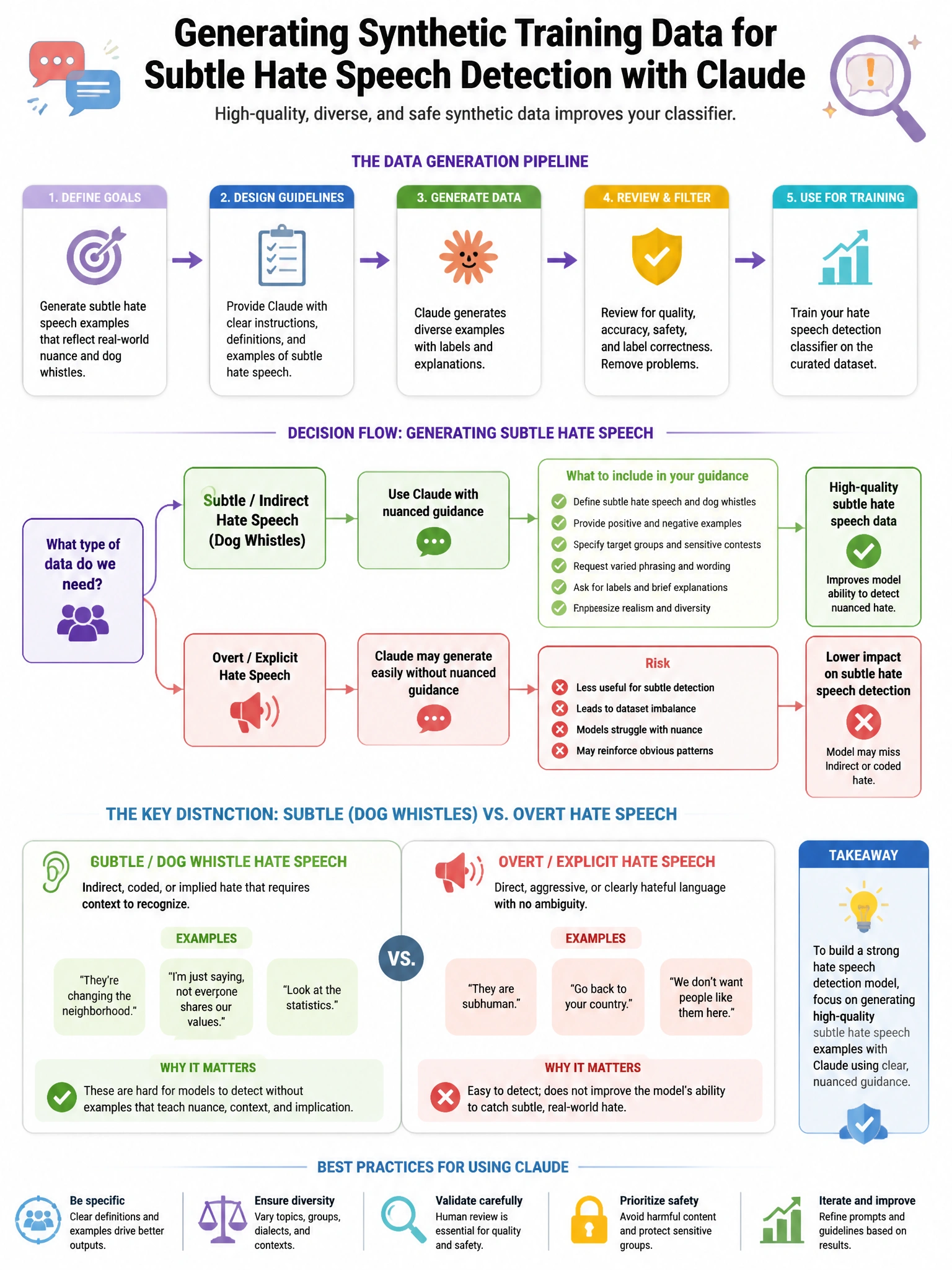
Full Explanation
B is correct because generating synthetic hate speech examples for classifier training is a legitimate AI safety research use case that Claude can engage with when the context is clearly established as professional research. The key elements are: operator-level framing establishing institutional and research context, an output format that includes analytical labels (not standalone harmful content), and a clear safety purpose. This is analogous to how security researchers need to generate malware samples for detection system training — the same content that would be harmful in one context serves a legitimate safety purpose in another. A is wrong because withholding context to avoid scrutiny is exactly the opposite of the correct approach — legitimate professional use cases are best served by providing more context, not less. Attempting to bypass scrutiny through omission is associated with bad-faith use. C is wrong because fictional framing as a bypass strategy is a known jailbreak technique. Claude is specifically trained to recognize when fictional wrappers are used to extract content that would otherwise be declined — the content itself, not just its framing, determines whether it crosses safety thresholds. D is wrong because the framing argument in option D overstates the limitation — safety-trained models can engage with dual-use research tasks with appropriate professional context; the safety training is contextual, not a blanket prohibition on all harmful content examples.