
Your multi-agent research system processes user queries by routing them through a planner agent, a search agent, and a synthesis agent in sequence. Production monitoring reveals that the search agent occasionally takes 45+ seconds and sometimes times out entirely. How should the system implement graceful degradation for this failure mode?
Select an answer to reveal the explanation.
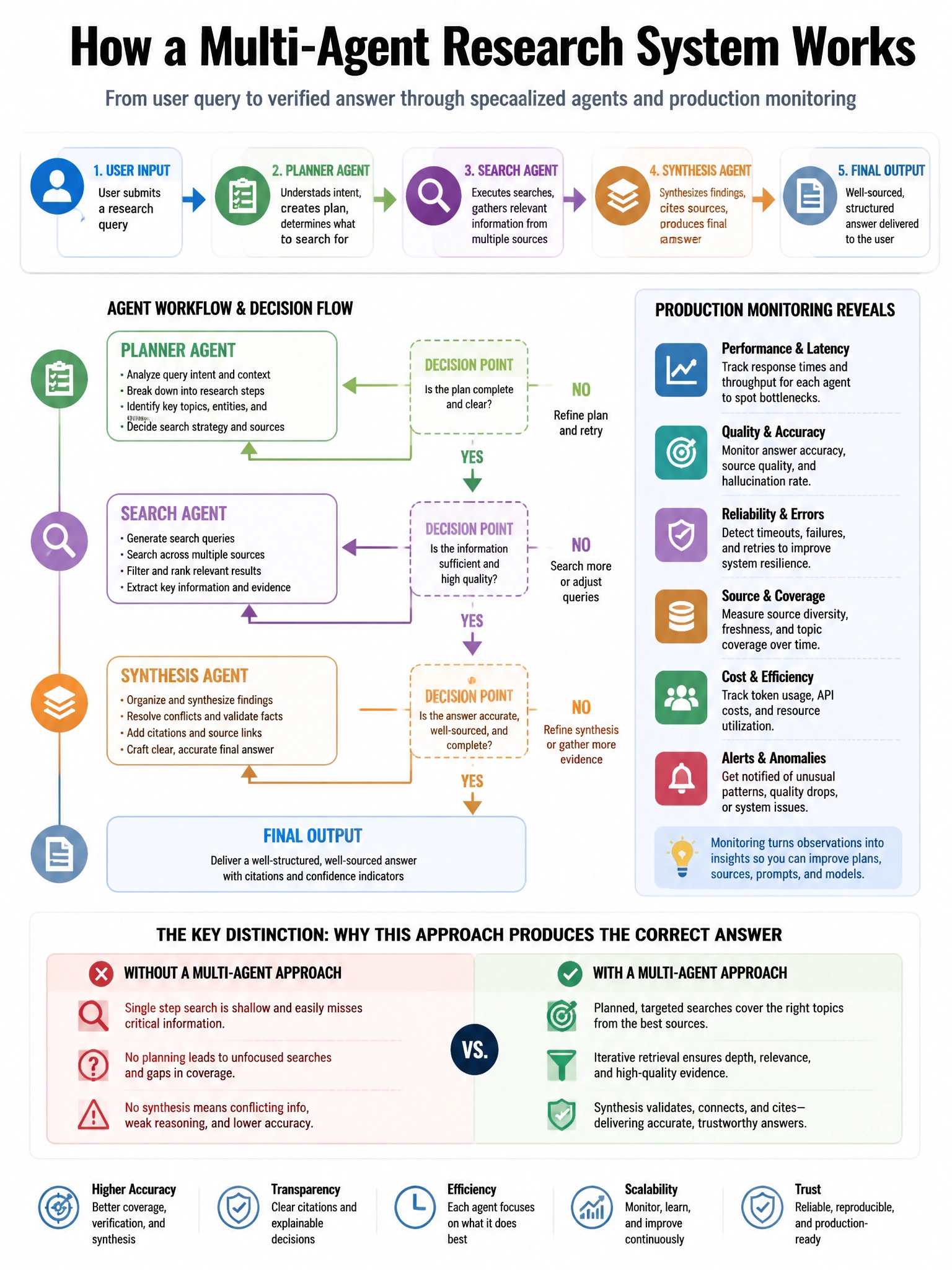
Short Explanation and Infographic
Here's the deal — c is correct because a circuit breaker with a degraded fallback mode is the standard pattern for resilient multi-agent systems. When the search agent fails, rather than collapsing the entire pipeline, the synthesis agent can provide a response using available context — clearly labeled as potentially unverified — which provides value while being transparent about its limitations.
Full explanation below image
Full Explanation
C is correct because a circuit breaker with a degraded fallback mode is the standard pattern for resilient multi-agent systems. When the search agent fails, rather than collapsing the entire pipeline, the synthesis agent can provide a response using available context — clearly labeled as potentially unverified — which provides value while being transparent about its limitations. This maintains system availability at a reduced quality level rather than complete unavailability. A is wrong because waiting up to 360 seconds (120s × 3 retries) on a slow search agent creates unacceptable user-facing latency, and treating persistent timeouts as manual-intervention events is not a scalable operational model. B is wrong because for research queries, a partial response with caveats is generally more valuable than a null response — users can evaluate incomplete information and decide whether to re-query. D is wrong because the latency characteristic of the search agent is an operational problem, not an architectural reason to eliminate AI agents from the pipeline entirely.