
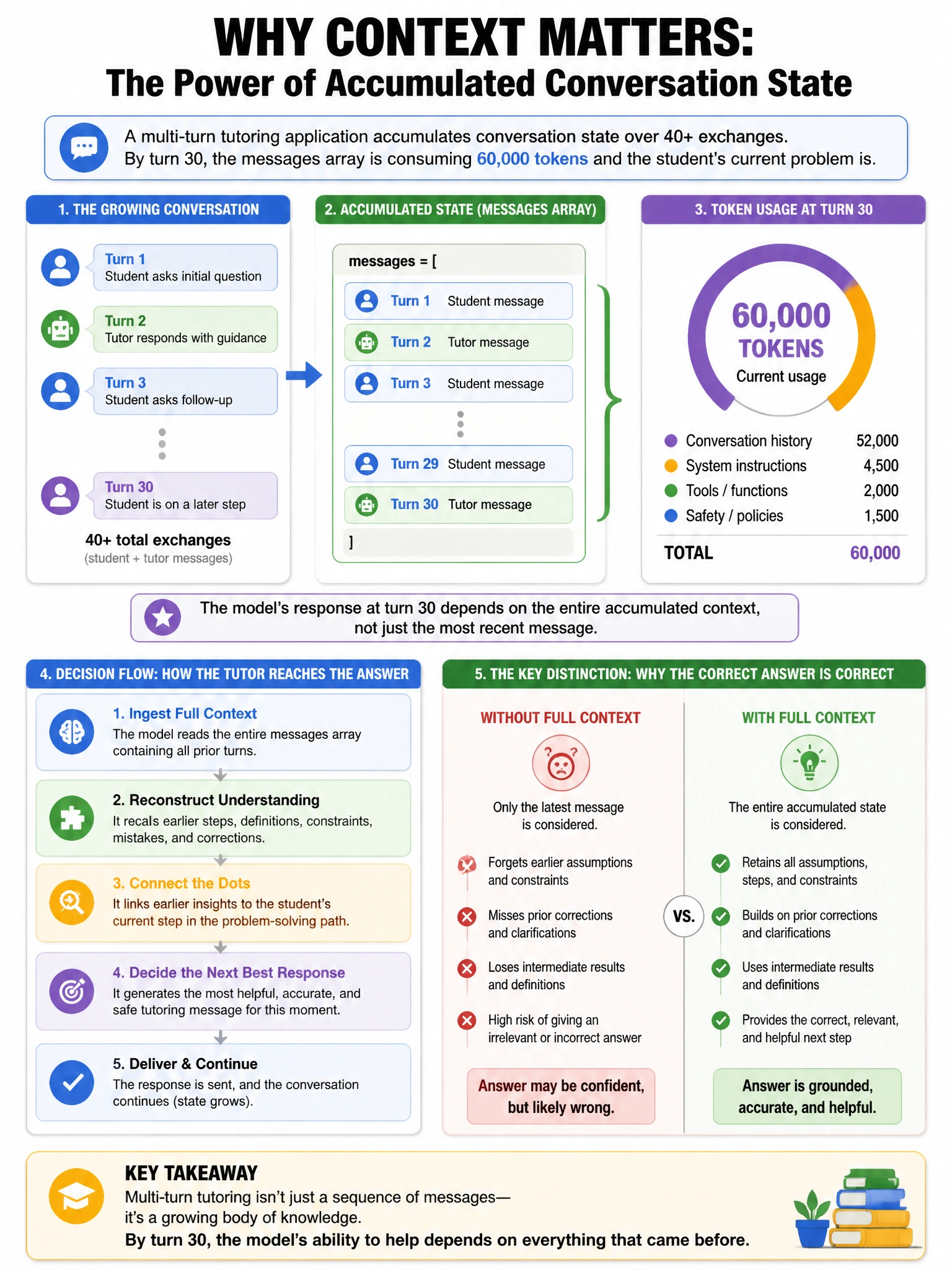
A multi-turn tutoring application accumulates conversation state over 40+ exchanges. By turn 30, the messages array is consuming 60,000 tokens and the student's current problem is only 5 turns old. The architect wants to compress old conversation state without losing pedagogically important context (student mistakes, misconceptions corrected, concepts mastered). What is the optimal compression strategy?
Select an answer to reveal the explanation.
Short Explanation and Infographic
Here's the deal — c is correct because semantic compression via a 'student model' summary preserves the pedagogically critical information — what the student has learned, what errors they persistently make, and where they currently are — in a compact structured format. Replacing raw message history with this structured summary after every 10 turns keeps the messages array bounded while retaining actionable pedagogical context.
Full explanation below image
Full Explanation
C is correct because semantic compression via a 'student model' summary preserves the pedagogically critical information — what the student has learned, what errors they persistently make, and where they currently are — in a compact structured format. Replacing raw message history with this structured summary after every 10 turns keeps the messages array bounded while retaining actionable pedagogical context. A is wrong because removing every other message breaks the logical flow of multi-turn reasoning — questions lose their answers, explanations lose their context — and creates incoherent conversation history. B is wrong because for tutoring, earlier turns often contain the origin of a student's misconception or proof that they mastered a prerequisite concept — discarding this loses valuable diagnostic information. D is wrong because temperature controls output randomness and has no relationship to context dependency or memory compression.