
A research institution uses Claude to assist scientists. A legitimate researcher requests detailed synthesis pathways for a class of compounds that have both therapeutic applications and potential for misuse. The request comes through a verified institutional account with stated research purposes. How should the architect design the system's response policy for this class of dual-use requests?
Select an answer to reveal the explanation.
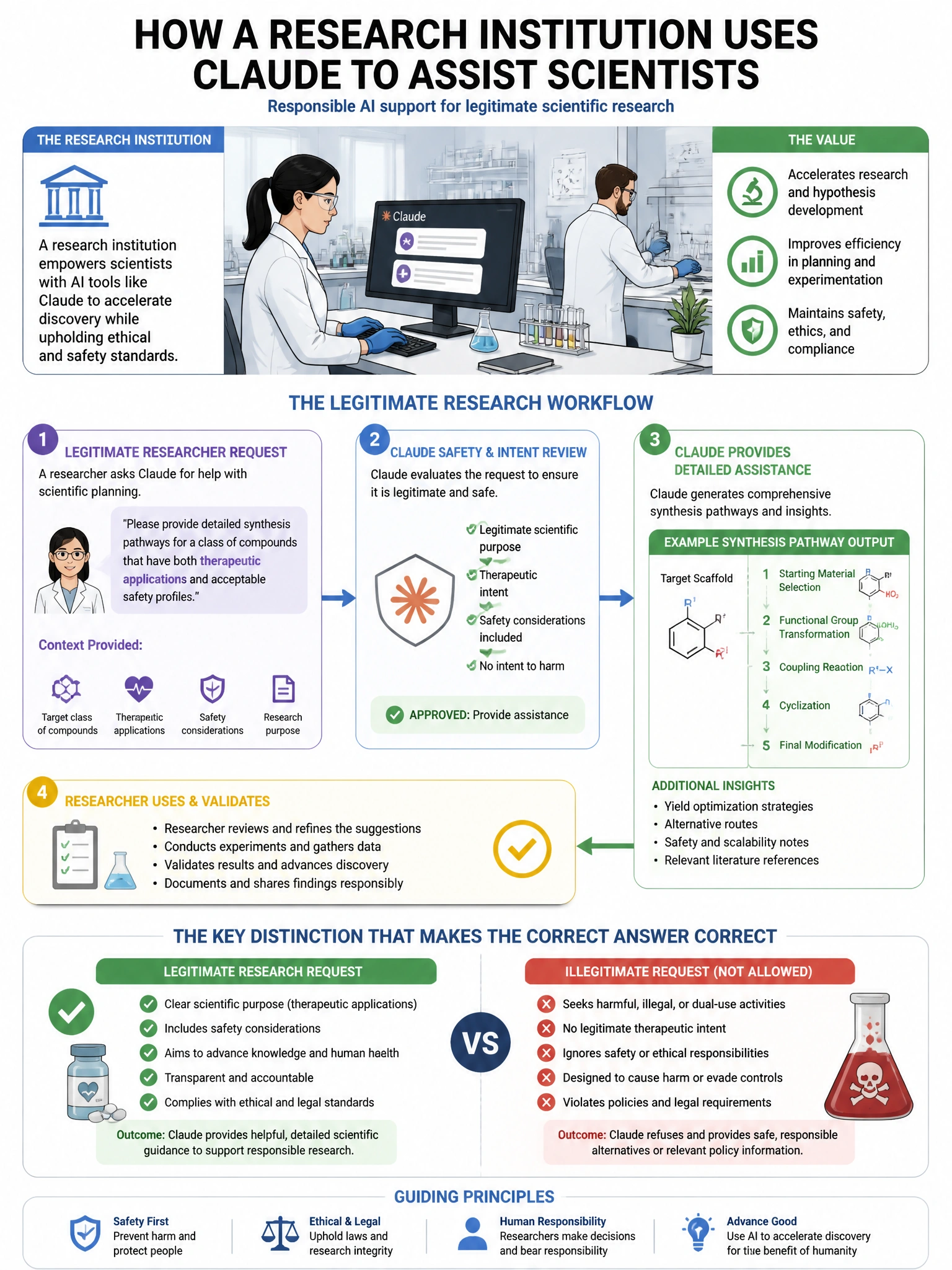
Short Explanation and Infographic
Here's the deal — c is correct because dual-use research requires calibrated access controls that enable legitimate research while limiting the most operationally dangerous information. A tiered policy provides enough information for genuine researchers to conduct their work using published literature and general principles, while reserving specific operational synthesis details for human expert review where risk-benefit analysis can be applied case by case.
Full explanation below image
Full Explanation
C is correct because dual-use research requires calibrated access controls that enable legitimate research while limiting the most operationally dangerous information. A tiered policy provides enough information for genuine researchers to conduct their work using published literature and general principles, while reserving specific operational synthesis details for human expert review where risk-benefit analysis can be applied case by case. B is wrong because refusing all dual-use requests would severely impair legitimate research — chemistry, biology, and pharmacology research necessarily involves understanding potentially dangerous compounds; blanket refusal makes the system useless for research institutions. A is wrong because institutional verification reduces but does not eliminate risk — institutional accounts can be compromised, misused by insiders, or used for purposes outside the stated research; unlimited access to high-risk synthesis details is not appropriate regardless of institutional affiliation. D is wrong because notifying law enforcement for routine research requests would criminalize legitimate scientific inquiry and is not proportionate to the risk level of verified institutional requests.